
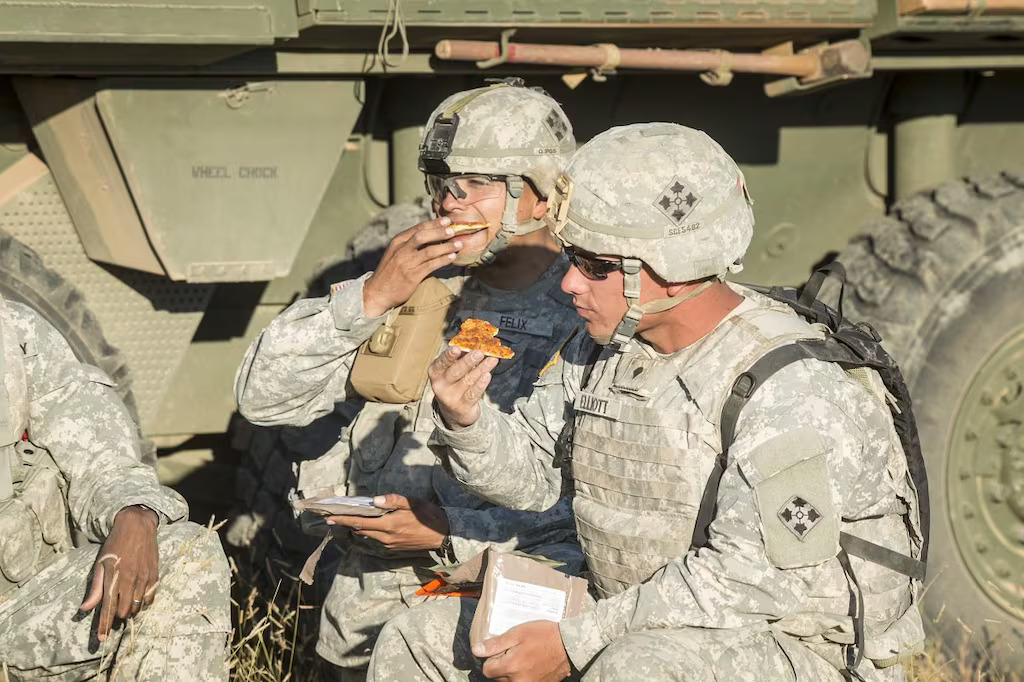
A military-styled pizza that can be stored at room temperature for 3 years and still be edible? This is not a scene from a science fiction movie, but rather the development of the “pocket pizza” by the US military to meet the needs of the battlefield. In order for soldiers to enjoy familiar pizza even in the absence of refrigeration equipment, the US military, along with food scientists, spent over a decade continuously adjusting the recipe and technology to finally uncover the secret to long-term pizza preservation.
This Italian sausage pizza, included in the Meal, Ready-to-Eat (MRE) for individual soldiers, can be preserved for 36 months in a warm environment of 80 degrees Fahrenheit (approximately 27 degrees Celsius), while maintaining the taste and food safety of the dough, sauce, cheese, and sausage.
So, how did the US military achieve this? The key lies in a technology called “hurdle technology.”
This technology combines various food processing methods such as heating, dehydration, pH adjustment, and special packaging to reduce the risk of food spoilage, prolong ambient storage time, and inhibit microbial growth. The research team also precisely controls the pH of the pizza sauce and the moisture and oxygen content within the packaging to prevent the pizza from deteriorating.
Researchers tested the pizza slices in an environment of 100 degrees Fahrenheit (37.8 degrees Celsius) for 6 months, and later tested them at 80 degrees Fahrenheit (approximately 27 degrees Celsius) for a 36-month preservation period. After testing, the team confirmed that this pizza meets the military’s requirements and can be provided to soldiers for consumption.
The biggest challenge the military faced in including pizza in the individual soldier rations was how to keep the different ingredients coexisting without spoiling.
Michelle Richardson, a food scientist at the US Army’s Natick Soldier Systems Center, explained in an interview with NPR that pizza consists of different components like sauce, cheese, sausage, and dough, each with varying moisture levels.
She explained that moisture naturally flows towards drier areas until a balance is reached in each component. Therefore, if the high-moisture sauce contacts the drier crust, moisture will gradually seep into the dough, causing the pizza to become soggy, affecting its taste and increasing the difficulty of preservation.
Even under normal cooking conditions, pizza crust is prone to becoming soggy due to improper moisture control. After numerous trials and adjustments of the moisture content of each ingredient, the US military research team finally managed to ensure that this pizza, after long-term storage, can still maintain a taste and texture close to freshly made pizza.
Richardson mentioned that soldiers can simply open the packaging and enjoy the pizza, and for those who prefer hot pizza, each pizza comes with a Flameless Ration Heater. With the heater, soldiers can enjoy a piping hot pizza in less than 10 minutes.
The US military also conducted field tests with troops to evaluate the appearance, smell, and taste of this pizza. The results showed that this sausage pizza received high praise for its ability to be stored for several years and its convenient lightweight packaging for easy carrying in pockets, making it an excellent supply for soldiers on outdoor missions.
Richardson stated that the taste of this pizza is actually quite similar to the pizzas civilians typically eat. “Of course, even the most advanced military rations cannot replace freshly baked pizza, but for soldiers in the field, being able to enjoy a familiar food in harsh environments can provide a temporary and precious comfort.”
She added, “Military food development has no fixed limits, and the team continues to seek innovative technologies to develop more meals that meet the soldiers’ needs. Due to the high demand for desserts among soldiers, one of the current research directions is using dehydration technology to make cheesecakes, extending their shelf life, reducing weight, while maintaining a taste, color, and texture close to freshly-made desserts.”
She pointed out that in the future, military rations will not only provide basic nutrition but also aim to allow soldiers to enjoy flavors and textures closer to their everyday diet while on missions.
(This article referenced reports from the food website Chowhound and National Public Radio in the US.)