
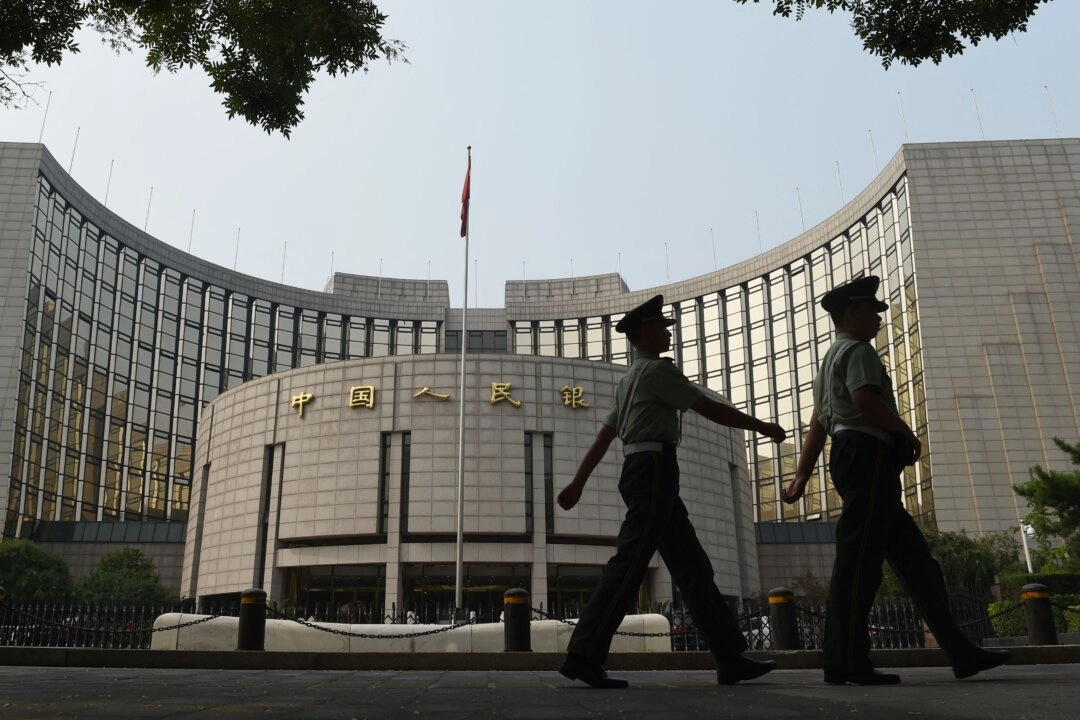
China’s economy continues to decline, with industrial production, consumption, and investment data in August all falling below expectations. The People’s Bank of China monetary policy committee held a quarterly meeting, changing some of its statements regarding the economy and finance. Analysts believe that China’s economy has entered a critical period, and whether further stimulus will be implemented later in the year depends on the data from August and September. However, the key issue lies in the unresolved structural contradictions within the economy.
According to reports from state media on September 25th, the People’s Bank of China’s monetary policy committee recently held its 114th quarterly meeting for the third quarter of 2026. The meeting stated that the moderate loose monetary policy will continue, while recognizing the challenges of strong supply and weak demand, structural differentiation, and external impacts.
Compared to the previous quarter’s meeting, there have been some changes in the official statements. In terms of the macroeconomy, this meeting continued the assessment of the external situation as “uncertain inflation trends and monetary policy adjustments.” Unlike the previous quarter’s emphasis on “increasing countercyclical and cross-cycle adjustments,” this meeting highlighted the need to “increase countercyclical adjustment intensity.”
Financial industry insiders believe that there is a higher likelihood of a reserve requirement ratio cut by the central bank. In order to support the issuance of national bonds by the Ministry of Finance and maintain stable market liquidity at the end of quarters or years, the central bank may use a reserve requirement ratio cut to inject long-term low-cost funds into the market.
A reserve requirement ratio cut refers to a reduction in the reserve ratio that banks are required to hold. It is a monetary policy tool of the central bank that releases long-term liquidity and increases the funds that banks can freely utilize, stimulating economic growth and boosting market credit activity.
Bloomberg’s report suggests that if China’s economy does not show signs of improvement in August and September, the likelihood of the government implementing stimulus measures will increase.
Economists from Citigroup, including Xiangrong Yu, have stated that economic activity in August remained weak. The focus moving forward is on whether there will be a recovery in September after recent policy implementations. “The momentum of domestic economic operations continued to weaken in August, and even the high-performing technology industry failed to provide sufficient cushion. Despite statements at the end of July’s Political Bureau meeting, signs of increased fiscal spending have not yet materialized. September appears to be the key window to decide on additional stimulus measures.”
Reports suggest that the Chinese government seems to view the persisting years-long slump in the real estate market as a new normal, shifting its policy focus towards controlling risks in the industry rather than reviving the real estate market. The government is hopeful that investments in sectors such as software development and research can rapidly increase to offset the economic trauma left by the real estate crisis.
The Wall Street Journal’s report indicates that despite official attempts to downplay the significance of loans as a key financial indicator, the lower-than-expected increase in bank loans in China in August is a noteworthy signal.
Data from the People’s Bank of China shows that new loans in August amounted to 600 billion yuan, while in July, it was -340 billion yuan. This figure falls far below economists’ expectations.
It is believed that part of the weakness in the data is due to seasonal factors, but it also reflects a lackluster domestic lending demand under the prolonged slump in the real estate market.
Chinese economists point out that the key issue lies in the unresolved structural contradictions within the economy. Professor Lu Ming from the Antai School of Economics and Management at Shanghai Jiao Tong University stated to local media on September 21 that the trend of slowing economic growth has not been effectively curbed, indicating that the problem lies not only in quantity but also in structure. The path of achieving growth through expanding capacity and lowering prices has reached its limits. The excessive and inefficient “involutionary” competition leads to constant price pressure, making it difficult to break the cycle of price declines. On the other hand, the supply in the service industry does not match the demand in terms of quantity, quality, diversity, and spatial layout. There are still many problems in areas such as elderly care, education, healthcare, childcare, culture, entertainment, and sports that cannot meet the demands.
Lu Ming believes that the contraction of the real estate industry continues to squeeze related employees, and the current investments concentrated in emerging areas such as artificial intelligence, new energy vehicles, and lithium batteries are capital-intensive. This has resulted in insufficient employment growth and income increases for residents.