
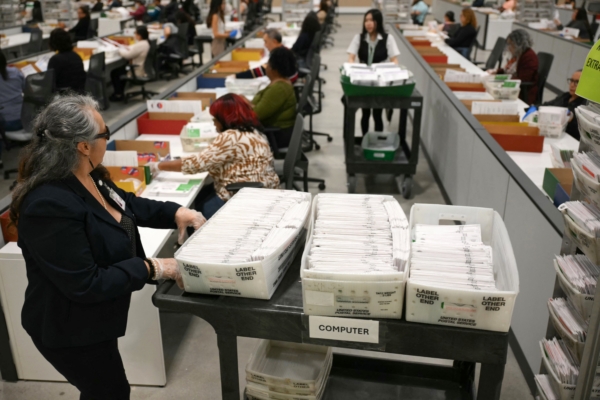
On September 24th, the California Supreme Court unanimously ruled that Riverside County Sheriff Chad Bianco unlawfully seized over 500,000 ballots in a special referendum on redrawing congressional districts in California.
In November 2025, Proposition 50 was easily passed by voters, authorizing the use of congressional district maps drawn up by the state legislature favorable to the Democratic Party for the years 2026-2030.
Bianco, who ran as a Republican candidate in this year’s gubernatorial primary but lost in June, initiated an investigation following a discrepancy of 45,896 votes claimed by a local group called the Riverside Election Integrity Team, comparing handwritten precinct ballot receipts with certified vote counts. This led to the seizure of approximately 650,000 ballots stored in about 1,000 boxes earlier this year.
Art Tinoco, Riverside County Registrar of Voters, clarified that the group misinterpreted the ballot data, with the actual difference being only 103 votes.
The court ordered Bianco to immediately return the ballots to Tinoco.
In a related case, the court ruled that Bianco must comply with a request from California Attorney General Rob Bonta to suspend the criminal investigation into the election.
Chief Justice of the California Supreme Court, Patricia Guerrero, wrote the opinions on both cases. She deemed the ballot seizure as “unlawful” and emphasized that state law mandates that even during a criminal investigation, ballots must be safeguarded by election officials.
Bonta had previously instructed Bianco to halt the investigation, preserve evidence, and hand over relevant documents. Bianco failed to return the ballots. The court has now ruled Bonta’s directive to be binding.
The court ordered the sheriff to “immediately” return the ballots, handle them only as necessary to comply with the court’s orders, refrain from further actions on the November 2025 special election during Bonta’s review, and provide the materials requested in Bonta’s March 6 letter. The court had previously suspended the investigation in April.
Bianco’s lawyer argued to the court that as sheriff, Bianco had a legal obligation to investigate upon receiving a complaint and had followed state criminal law after the first search warrant was issued in February.
The court did not agree with this argument. Guerrero stated that search warrants do not supersede state election law.
She said, “If there are suspicions of election improprieties, the Elections Code provides multiple mechanisms for law enforcement to review and scrutinize ballots without compromising their integrity.”
“But those procedures weren’t followed, and the seizure that occurred in this case directly contravened carefully considered and controlling provisions of the Elections Code,” Guerrero added.
Bonta welcomed the court’s ruling and thanked the court for confirming his authority to supervise county sheriffs.
In a statement, Bonta said, “Election fraud should and must be investigated. However, abusing criminal investigation tools without any evidence of a crime unnecessarily undermines public trust in the electoral system and law enforcement.”
Bianco stated that he will comply with the court’s ruling but not with the “message behind the ruling.” He criticized the rulings for granting the attorney general “unchecked power over any investigation in California.”
He noted that the rulings did not address the issue of the 45,896 ballot discrepancy between certified vote counts and records obtained from the registrar’s office.
Bianco told The Epoch Times, “The registrar says it was a clerical error. Bonta says stop the investigation. I got a search warrant from a judge and I started an investigation. That’s my job.”
On September 19th, prior to the announcement of the rulings, California Democratic Governor Gavin Newsom signed a bill specifying that seizing ballots, election records, or certified voting equipment before the election results are formally certified will constitute a felony.