
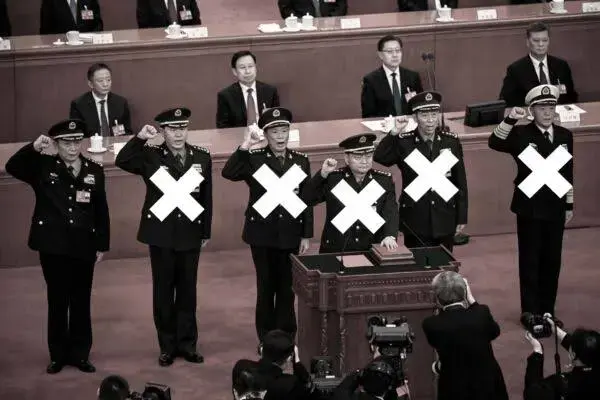
On September 21, the Chinese Communist Party announced the expulsion of Zhang Youxia and Liu Zhenli from the Party, the military, and referral for judicial trial. After an 8-month investigation, the Party’s military discipline commission concluded that Zhang and Liu did not “seriously trample and disrupt the system where the Chairman of the Military Commission is responsible.”
It was on January 25 that the military newspaper applied “five serious charges” to Zhang and Liu, with the most crucial being the accusation of “serious trampling and disruption of the system where the Chairman of the Military Commission is responsible.”
So, what does “serious trampling and disruption of the system where the Chairman of the Military Commission is responsible” mean? In simple terms, it implies rebellion, or what some overseas sources call an attempted coup.
Even after an 8-month internal and external investigation, the military discipline commission did not confirm that Zhang and Liu had “seriously trampled and disrupted the system where the Chairman of the Military Commission is responsible.” What does this indicate? It suggests that Zhang and Liu were not involved in any coup attempt.
Why then were Zhang and Liu accused of plotting a coup on January 25 by the military newspaper, despite the lack of evidence during the lengthy investigation?
This follows the typical tactic of the Chinese Communist Party over the years, where individuals are assigned scandalous accusations to tarnish their reputation and then deprived of the right to defend themselves publicly. Subsequently, the authorities manipulate the narrative by fabricating evidence in secret, controlling the propaganda to nullify any dissenting voices or opposing opinions.
In fact, just one day after Zhang and Liu were publicly targeted, the military newspaper defined their issue with “five serious charges,” a move that blatantly violates the proper inspection procedures for high officials within the Party.
Normally, after a high-ranking official is publicly targeted, the Chinese Party media would not immediately label them; the characterization happens only once the investigation concludes and the decision to expel from the party is made.
The swift characterization of “five serious charges” against Zhang and Liu by the military newspaper the day after their downfall indicates what?
It implies that Zhang and Liu were caught off guard, faced a sudden onslaught, and experienced a quasi-military coup. Zhang and Liu were swiftly apprehended by Xi’s maneuvering and special tactics.
Given that the military discipline commission did not find Zhang and Liu guilty of “seriously trampling and disrupting the system where the Chairman of the Military Commission is responsible” after an 8-month probe, it’s clear that Zhang and Liu were not easy targets. Zhang, with 58 years of military service and rising to the position of the Vice Chairman of the Central Military Commission, is well-acquainted with the system; wouldn’t he consult or report any major issues to Xi?
The reason Xi charged Zhang and Liu with “seriously trampling and disrupting the system where the Chairman of the Military Commission is responsible” was twofold: to create the impression for the outside world that Zhang and Liu intended treason, justifying their arrest; and due to possible actions by Zhang that displeased Xi.
Xi had repeatedly emphasized the need for “deepening the Party’s self-revolution,” yet Zhang presented Xi with evidence of serious violations by Miao Hua, a close associate within the military. Xi was put in a dilemma as to whether or not to investigate Miao Hua, leading to tension. Zhang, supported by Xi’s theory and solid evidence, forced Xi to deal with issues internally, effectively pressuring Xi to make decisions that may have affected his inner circle.
Subsequently, Zhang presented Xi with evidence against He Weidong, another key figure, compelling Xi to take further drastic actions. These strategic moves coerced Xi to weaken his trusted inner circle.
Xi, forced to dismantle parts of his circle by Zhang, likely harbored resentment.
Moreover, with the exposure of strong evidence against seven generals, including He Hongjun, Wang Xiubin, Lin Xiangyang, Qin Shutong, Yuan Huazhi, Wang Houbin, and Wang Chunling, it further illuminated the intricate web in Xi’s inner circle.
The manipulation of promotions and positions within the military by Xi before the downfall of Miao and He points to the broader corruption issue within the military, for which Xi bears primary responsibility as the Chairman of the Military Commission since 2022.
If accountability under the charge of “serious trampling and disruption of the system where the Chairman of the Military Commission is responsible” is to be pursued, it should primarily fall on Xi’s shoulders rather than Zhang and Liu.
Despite this, Xi has not acknowledged any fault or taken responsibility for his serious errors in military appointments and decisions. Given this, without concrete evidence, the military discipline commission could not justify accusing Zhang and Liu of such charges.
Lastly, it is worth noting that if Zhang and Liu had genuinely intended to stage a coup or apprehend Xi, it would have been within their grasp. However, it is plausible that this thought never crossed their minds. Xi may have moved against Zhang and Liu using a “quasi-military coup” to eliminate what he perceived as the most significant obstacle to his continued power at the upcoming 21st Party Congress.