
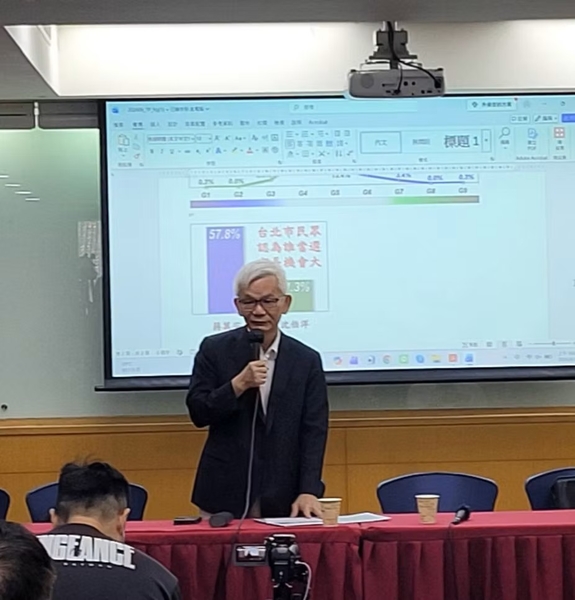
The upcoming 2026 local elections in Taiwan are drawing near, with the focus on the Taipei mayoral race. The Xinyin Cross-Strait Research Association and Taiwan polling experts held their first press conference on a survey regarding the support for the current Taipei Mayor, Jiang Wan-An, and his contender, Shen Bo-Yang. The survey results revealed an extremely close race, with Jiang Wan-An leading at 41.7% and Shen Bo-Yang following closely behind at 40.5%, with a mere 1.2% difference falling within the margin of error.
In regard to the Taipei mayoral election, the Xinyin Cross-Strait Research Association released the results of their first survey and conducted a press conference today. Huang Qing-Long, the founding chairman of the Xinyin Association, stated that the survey was carried out by Dai Li-An for questionnaire design and analysis, with fieldwork execution by Bikin Market Research Company from September 16 to September 18. The survey targeted Taipei residents aged 20 and above, with a total of 1,076 completed interviews (752 via landline and 324 via mobile phone), with a maximum sampling error of ±3.0%. The survey results indicated:
Jiang Wan-An’s job approval rating exceeded 50%, but dissatisfaction reached as high as 41.6%, a significant figure among incumbent mayors. It is noteworthy that a high percentage of Taipei residents, 94.4% to be exact, have already expressed clear opinions, indicating a tendency towards a fixed evaluation of the mayor.
For Jiang Wan-An, 50% found him suitable, while 38.3% did not. Shen Bo-Yang received 46.2% suitability and 32.5% unsuitability. Shen Bo-Yang’s suitability trailed Jiang Wan-An by 3.8%, while Jiang Wan-An’s unsuitability exceeded Shen Bo-Yang’s by 5.8%. “Suitability for mayor” is a measure of public overall assessment of potential candidates. While suitability is related to support, they are not equivalent. If the public perceives a candidate as unsuitable for the position, they are less likely to receive votes.
With support at 41.7% for Jiang Wan-An and 40.5% for Shen Bo-Yang, the gap between them is a mere 1.2%.
Within the margin of error of the survey, the two candidates are currently neck and neck. Cross-analysis reveals that in terms of age, those aged 50 and above tend to support Jiang Wan-An, while those aged 20 to 49 lean towards Shen Bo-Yang. In terms of political party affiliations, 96.1% of Kuomintang supporters expressed support for Jiang Wan-An, 88.5% of People First Party supporters, and 89.4% of Democratic Progressive Party supporters indicated preference for Shen Bo-Yang.
The survey indicated that 38% of respondents favored the Kuomintang remaining in office, while 42% were open to a switch to the Democratic Progressive Party. Contrasting these numbers with Jiang Wan-An’s 41.7% support and Shen Bo-Yang’s 40.5%, it appears that the Kuomintang’s image is struggling to gain an edge over Jiang Wan-An, while Shen Bo-Yang still has room for slight growth.
The survey showed that 57.8% are optimistic about Jiang Wan-An while 21.3% favor Shen Bo-Yang. Through cross-analysis, it was observed that among those who support the Democratic Progressive Party, expressed preference for Shen Bo-Yang, were dissatisfied with Mayor Jiang’s governance, or believe that the mayor should be changed to the Democratic Progressive Party, over 44% see Shen Bo-Yang as having the highest chance of winning (while at least 36% believe it is Jiang Wan-An), while the remaining groups clearly lean towards Jiang Wan-An having the best chance of re-election.
Dai Li-An mentioned the survey question set “try another party,” which is a disadvantageous signal for the blue camp, as it is one of the indicators of a potential change in power. Currently, the blue camp is leading, but the indicator of “trying another party” is slightly higher, signaling a potential shift in power. Just as during the “Han wave” in Kaohsiung back in 2018, this question set in the survey showed a signal of more voters agreeing to giving another party a try. Now, a similar signal has surfaced in the Taipei mayoral election survey, which is “certainly more unfavorable for the Kuomintang and Jiang Wan-An”.
The “Han wave” in Taiwan politics refers to the political storm ignited by Han Kuo-yu during the 2018 local elections, where he ran for mayor of Kaohsiung, breaking the long-standing dominance of the Green camp. In 2019, Han Kuo-yu was nominated by the Kuomintang to run as their presidential candidate in the 2020 Taiwan presidential election, leading to doubts about his commitment.
Han Kuo-yu faced defeat in the 2020 presidential election, and on June 6 of the same year, the third recall motion against him as mayor of Kaohsiung was held, resulting in his removal from office, becoming the first directly elected mayor in Taiwan’s local government history to be removed from office, bringing the “Han wave” to a sad end. On February 1, 2024, Han Kuo-yu returned to politics and was elected and assumed the position of Speaker of the Legislative Yuan.
Today, Taipei Mayor Jiang Wan-An visited the Dong San-Shui Market and Xin Fu Market in Wanhua district. When asked about the narrow 1.2% gap between him and Shen Bo-Yang according to the latest survey released by the Xinyin Association, Jiang Wan-An stated that while numbers are always worth considering, the most crucial aspect is the continuous promotion of various municipal policies in Taipei.