
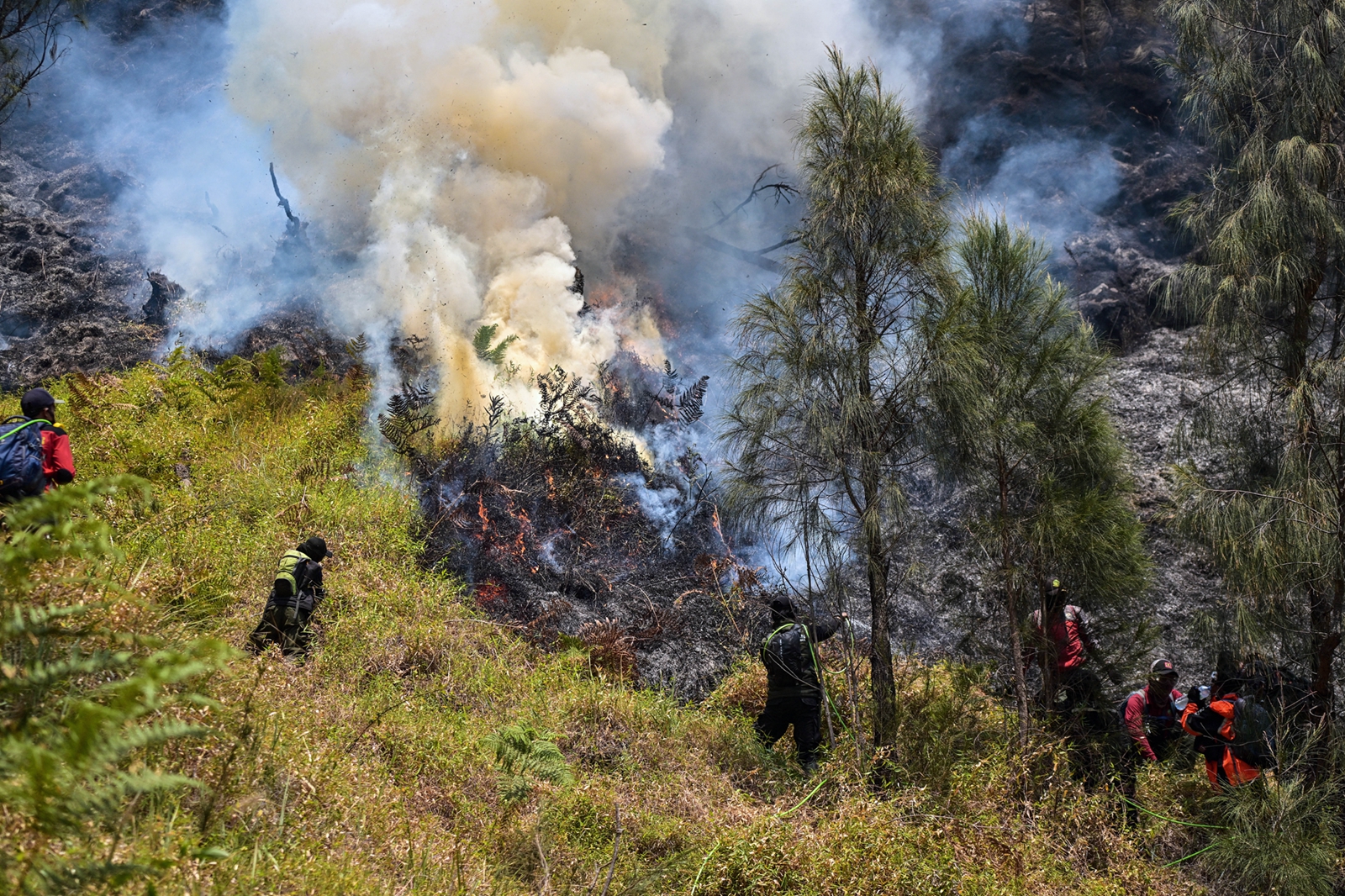
In recent times, several areas in Indonesia have been under severe wildfire attacks, with the famous tourist destination Bromo Tengger Semeru National Park experiencing a continuous blaze for several days, leading to the urgent closure of some scenic areas. Currently, firefighters are still on-site battling the wildfires.
Media reports indicate that the Bromo Tengger Semeru National Park, located in East Java Province, has been ablaze since Monday, August 3, destroying at least 60 hectares of land, equivalent to more than eighty football fields.
The Bromo Tengger Semeru National Park is renowned worldwide for its surreal volcanic landscapes, magnificent sea of sand, and stunning sunrise views of the volcanic range, making it one of Southeast Asia’s most famous active volcano tourist destinations.
The Indonesian National Disaster Management Agency (BNPB) stated in a release on Thursday, August 6, that the steep terrain of the park has made it extremely difficult for ground firefighting teams to approach the ignition points, aided by strong winds fueling the rapid spread of the fires.
The agency has deployed water-spraying helicopters for aerial water bombing and unmanned drones for hotspot monitoring. Additionally, they plan to use aircraft to spread catalysts such as dry ice or salt powder to initiate cloud seeding operations to alleviate the drought conditions.
Currently, local authorities have yet to determine the cause of the fires. For safety reasons, the park management department has urgently closed multiple tourist routes to Mount Bromo until further notice.
Apart from Java Island, wildfires have also erupted in several forest areas in Sumatra Island and Borneo. In the Ketapang Regency of West Kalimantan Province, a resident tragically suffocated to death due to lack of oxygen while attempting to escape through dense wildfire smoke.
This Southeast Asian archipelago nation is currently in the peak of a prolonged dry season, exacerbated by the El Niño phenomenon causing extreme high temperatures and minimal rainfall, making forests and vegetation highly susceptible to ignition and rapid spread of wildfires.