
Taiwan’s President Lai Ching-te pointed out today (23rd) that Taiwan has now completed the construction of 508 offshore wind turbines with a cumulative installed capacity of 4.9GW, ranking fifth globally, thanks to the joint efforts of the government and various sectors. The government will promote three core strategies, balancing stable power supply, environmental sustainability, and local development.
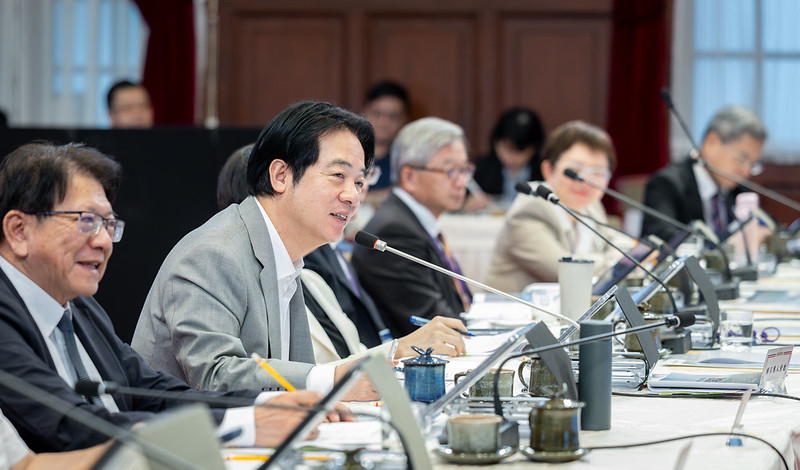
In the afternoon of the 23rd, President Lai Ching-te presided over the 8th meeting of the National Climate Change Response Strategy Committee, stating that today marks the 8th meeting of the committee and the first meeting of the third-term committee.
President Lai expressed gratitude to past vice conveners, advisors, and committee members for their professional advice. Through collective efforts, Taiwan is gradually deepening its carbon reduction strategies and advancing climate adaptation work. By collaborating across committees, climate risks are being integrated into health policies and national security planning to enhance responses to high temperatures, disaster preparedness, and energy resilience.
He looks forward to the third-term committee further implementing climate governance into the land, energy, industry, and daily lives of every individual. Last month, Western Europe experienced its hottest June on record, and the global average temperature for June also hit a historic high. As July begins, the World Meteorological Organization has indicated that the “El Niño phenomenon” has formed, expected to strengthen between July and September, significantly increasing the likelihood of global heatwaves, droughts, and heavy rainfall.
“These developments repeatedly remind us that climate risks are becoming more frequent, complex, and directly impacting our daily lives,” President Lai Ching-te stated. “Taiwan, a densely interconnected island nation of mountains, rivers, and seas with a highly concentrated population and industries, maintaining food self-sufficiency, enhancing energy independence, strengthening disaster prevention and public health are essential national capabilities in response to climate change and international situations.”
President Lai emphasized that in recent years, a heavy rainfall event could simultaneously trigger mountainous landslides in urban areas, increased hot days not only raise water and electricity demands but also lead to agricultural losses and health risks; ocean warming and rising sea levels pose threats to aquaculture and coastal settlements.
Facing these complex challenges affecting national security, food supply, and quality of life, the government must integrate expertise from all sectors to identify risks early, be prepared, and implement policies. Therefore, he presented three core strategies:
First, enhancing social mobilization. Climate governance requires the participation of the entire society. The government should provide clear information, timely warnings, and specific action guidelines to enable the public to understand climate risks, make necessary preparations, and possess the capacity to participate in climate adaptation.
He cited the urban forest planning proposed at the seventh meeting as an example of climate action that everyone can participate in. Currently, the Executive Yuan has established the National Urban Forest Promotion Committee and initiated local forums, planning to hold 50 sessions to gather opinions from county and city governments and organizations, aiming to propose a national urban forest plan by the year end.
He invited the administrative team to ensure that all levels of government, schools, communities, businesses, and citizens have channels to participate in the plan, jointly investing in urban forest planning and maintenance to make urban forests a vital foundation for enhancing urban resilience.
Second, strengthening the stability of energy. Taiwan heavily relies on energy imports, facing fluctuations in international energy prices and extreme climate risks. The government not only needs to continuously expand local low-carbon energy but also enhance grid resilience, energy storage, and dispatch capabilities to ensure stable power supply supporting livelihoods and industrial development.
He mentioned that with comprehensive cooperation from various sectors, Taiwan has installed a total of 508 offshore wind turbines by this month, with a cumulative installed capacity reaching 4.9GW, ranking fifth globally; last year, offshore wind power generation also exceeded 10 billion kilowatt-hours for the first time. Taiwan aims not only for steady offshore wind power development but also to improve industry supply chains and talent cultivation, conduct environmental assessments, ensuring energy transition balances stable power supply, environmental sustainability, and local development.
Third, safeguarding the vitality of the land. Forests, farmland, rivers, wetlands, coasts, and the ocean are precious natural resources of Taiwan, acting as natural barriers for water sources, flood control, and stable food production.
He stated that the government will continue to strengthen scientific monitoring and natural restoration while integrating long-term climate risks into agricultural production and land planning. Taiwan’s actions align with the international community, progressing from the “Kunming-Montreal Global Biodiversity Framework” to global adaptation goals, continuously aligning with international standards to establish more robust climate governance capabilities, utilizing a healthy ecological environment, enhancing land resilience, and safeguarding intergenerational safety.
President Lai Ching-te remarked that these three core strategies, through today’s three reports focusing on public participation, land adaptation, and energy transformation, aim to enhance social mobilization, land vitality, and energy stability.
Firstly, the Ministry of the Environment will present the first report “National Environmental Education for Sustainable Prosperity and Sustainability,” hoping to deepen the public’s risk awareness, making low-carbon sustainability a practical lifestyle action for everyone.
Secondly, the Ministry of Agriculture in collaboration with the Ocean Affairs Council will present the second report “Resilient Agricultural Production and Sustainable Ecological Systems under Climate Change.” Through ecological conservation and scientific governance, food production and land resilience will be enhanced.
Lastly, the Ministry of Economic Affairs will present the third report “Medium to Long-term Development Plan for Offshore Wind Power in Taiwan,” aiming to establish a foreseeable energy development pathway, steadily advancing green energy construction, grid integration, and industry supply chains.
President Lai emphasized that climate governance is a long-term effort that needs continual nurturing. With social mobilization, policies can penetrate local areas and everyday life; energy stability supports livelihoods, industries, and national development; land vitality enables resilience to climate change, ensuring sustainable development for Taiwan.
He expressed that moving forward, he welcomes valuable advice from advisors and committee members focusing on long-term national development and people’s safety, urging collective efforts to continuously enhance Taiwan’s capacity in responding to climate change.
Subsequently, President Lai Ching-te listened to briefings from Minister of the Environment, Peng Ching-ming, Minister of Agriculture, Chen Chun-chi, and Deputy Minister of the Ministry of Economic Affairs, Lai Chien-hsin, followed by exchanging views on the report items with committee members.