
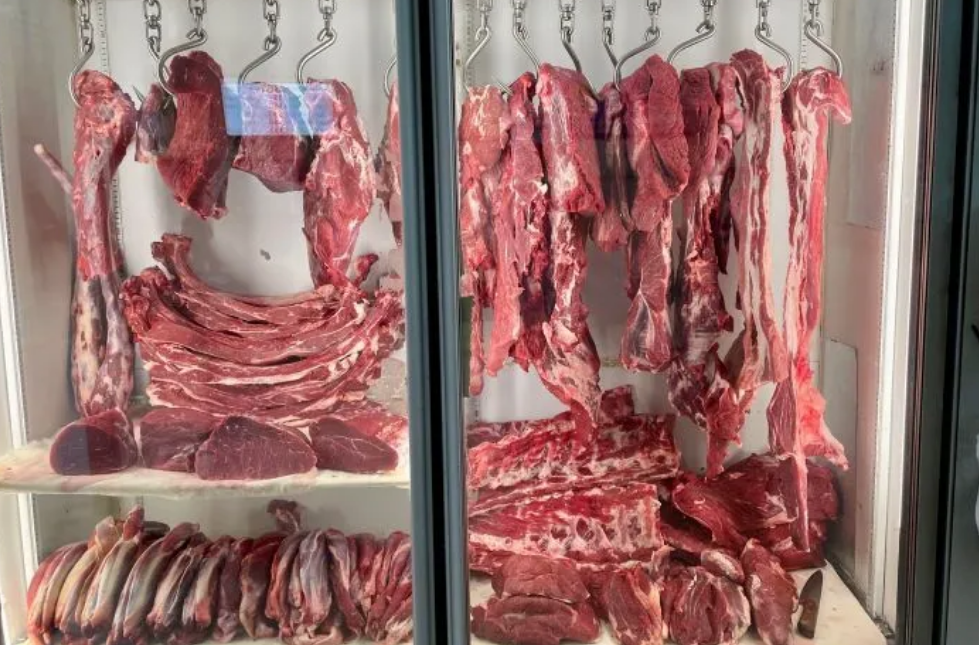
Recently, the price of beef in mainland China has been steadily increasing, with a rise of about 6% since August. Some industry insiders believe that the main reason for this round of price increases is due to a decrease in supply. At the same time, authorities have restricted beef imports, further exacerbating the demand gap. It is possible that the supply gap may continue for more than two years.
According to data from the National Ministry of Agriculture and Rural Affairs of the Communist Party of China, as of September 21st, the average wholesale price of beef in the national agricultural product wholesale market was 71.59 yuan (RMB) per kilogram, a nearly 6% increase since early August, and almost a 9% increase compared to a year ago. Data from the Wind data service provider also shows that the average wholesale price of beef in the national agricultural product wholesale market has reached its highest point in over two years in recent times.
In a report by “First Financial” on September 24th, a Chinese beef wholesaler at the Xijiao International Agricultural Product Trading Center in Shanghai disclosed that the wholesale price of beef has significantly increased recently, rising by about 10 yuan per kilogram over the past month. The wholesaler mentioned, “Beef prices have been continuously increasing, with five to six hikes since August, and it is expected to rise again in the coming days.”
On the morning of September 21st, several beef wholesalers at the Xijiao International Agricultural Product Trading Center in Shanghai indicated that the beef supply from regions like Shanxi and Inner Mongolia has seen overall price increases in recent times, leading to adjustments in wholesale prices. The wholesale price of beef shank, which was close to 80 yuan per kilogram earlier, has now risen to around 90 yuan per kilogram.
At the Xinfadi Agricultural Product Wholesale Market in Beijing, the wholesale price of beef front shank has increased from 71 yuan per kilogram in early August to 80 yuan per kilogram on September 24th, a 9 yuan per kilogram increase.
The increase in wholesale prices has directly resulted in corresponding adjustments in retail prices. Some fresh markets and online retail channels have increased beef prices by around 10 yuan per kilogram on the retail end.
Regarding the reasons for this current price hike, industry insiders attribute it mainly to the decrease in supply. A beef wholesaler at the Xijiao International Agricultural Product Trading Center in Shanghai stated, “The main reason for the price increase is the current shortage of cattle. In the past few years, livestock farming has suffered heavy losses, leading to the slaughter of many cows. Since the growth period of cattle is about two to three years, there is currently a shortage of domestic beef supply in the market.”
Zhao Qiaojiao, an analyst at Zhuochuang Information, also mentioned that from 2023 to 2025, the industry experienced about three years of continuous losses, resulting in the elimination of many small and medium-sized breeding households and the deep reduction of basic breeding capacity. The supply contraction caused by the reduction in production capacity is the main driving factor behind the current price increase.
Data from the National Bureau of Statistics also shows that since 2024, the number of cattle in China has been on a continuous decline, with the national cattle inventory dropping to 96.08 million by the end of 2025. By the end of the second quarter of 2026, the national cattle inventory further decreased to 95.57 million, a 4.3% year-on-year decline.
Furthermore, Zhao Qiaojiao believes that import beef safeguard measures and the upcoming peak consumption season are driving the price increase from both the supply and demand sides.
According to Announcement No. 87 of the Ministry of Commerce in 2025, starting from January 2026, authorities implemented safeguard measures for imported beef in the form of “country quotas and additional tariff surcharges” for a period of three years.
Zhao Qiaojiao believes that the situation of “reduced quantity and increased price” for imported beef has essentially been established.
As for how long this round of beef price increases will last, Zhao Qiaojiao believes that the supply gap in the market may persist for more than two years. It is expected that beef prices will continue to remain high in September, and from the second half of 2026 to the first half of 2027, with both domestic and imported supplies shrinking, prices will further rise.