
In the midst of China’s real estate boom no longer shining and local finances facing a crisis, the Chinese authorities are shifting the national capital and economic lifelines towards artificial intelligence (AI).
This strategic move by the authorities, seen as Xi Jinping’s latest economic gamble, extends beyond virtual grand competition models. It aims to replicate the industry policy model of the previous “New Three” (electric vehicles, solar energy, lithium batteries) by forcefully injecting subsidies into the market on a large scale, pushing the “physicalization” of AI into manufacturing and factories.
However, as policy funds artificially boost the automation boom, the grand plan driven by national capital, can it truly create the next growth engine or is it leading towards another bubble of overcapacity and resource misallocation?
In Changsha, Hunan, there is the so-called “lighthouse factory,” the No.18 of Sany Heavy Industry, covering 100,000 square meters of factory space resembling a science fiction movie. Dozens of Automated Guided Vehicles (AGVs) shuttle silently between robotic welding arms and machine tools, producing a huge concrete pump truck every 45 minutes.
Inside the control center adorned with blue tiled fountains and palm trees, the management team can oversee equipment efficiency and production progress across China in real-time with a few taps on the giant touch screen.
According to the company executives, the introduction of AI vision and intelligent perception has significantly improved sorting efficiency: “Previously, materials varied in length, thickness, some were almost identical, but now the system can accurately distinguish and automatically mix ingredients.”
This wave of AI “physicalization” is also spreading to the fields of logistics and traditional industries. A subsidiary of Alibaba, “Cainiao,” has deployed “ZeeBot” climbing robots in Guangdong warehouses, boasting that they can climb five levels of shelves in 10 seconds, doubling efficiency. Another company engaged in online maps and local life services, Amap, is preparing to release its first quadruped robot (robot dog), directly competing with Boston Dynamics’ Go series products priced at $1,600.
However, behind the dazzling technological lights, the grassroots’ frustrations are reflected. An engineer surnamed Huang from GSK CNC in Guangzhou stood before a giant bronze-colored robotic arm, admitting that while China’s equipment advantage lies in low cost, traditional factory environments are dirty, laborious, and workers’ cultural proficiency is limited. Complex programs are hard to grasp, “workers prefer equipment that is easy to operate, even like cutting-edge AI that can understand them.”
The prosperity scene created by the lighthouse factory, automated arms, and AI logistics stacks is a depiction that the Chinese authorities and tech giants are vigorously showcasing to the outside world the “AI+ physical” high-tech grand vision.
However, whether this picture full of technological confidence is the result of natural market evolution or a policy script by national capital designed to mask the decline of the real economy remains unclear.
Veteran media analyst Li Tingqian analyzed for Dajiyuan that as the era of real estate supported by land, cement, steel, and construction draws to a close, the CCP’s leader Xi Jinping summarizes economic transformation as “new qualitative productivity.” He aims to establish a “technology + manufacturing” combination along the trajectory of “semiconductors->new energy->industrial robots->electric vehicles->AI/big models”.
As the export of the “New Three” (electric vehicles, lithium batteries, solar energy) gradually reaches limitations in the external world, Beijing is forcefully promoting the deep integration of “AI+ physical economy” – including AI+ electric vehicles, AI+ robots, AI+ factories, and AI+ power grid.
To ensure precise allocation of national resources, the Ministry of Industry and Information Technology of the State Council designated “Embodied AI” and “Smart Robots” as the future industry and emerging pillar industries on August 26, 2026, giving them priority allocation rights over national capital such as the National Integrated Circuit Industry Investment Fund (Fund III).
Capital market data highlight traces of state-owned “forced compensation.” A report by the Western institution PitchBook in November 2025 showed that AI investments in China for the first ten months were only about $6 billion, a significant decline year-on-year. However, local database IT Juzi’s data in January 2026 showed 1,579 investment events in 2025 (a 75% increase compared to the previous year), with a total amount of about 150.4 billion RMB (a 24% increase), mainly concentrated in the fourth quarter.
Crunchbase’s venture capital database statistics also indicate a significant contraction in the overall Chinese venture capital market in the first half of 2025 (a 48% decline in the first quarter and a 34% decline in the second quarter), demonstrating that AI is a minority highlight propped up forcefully by policy funds and national capital in an overall shrinking environment.
At the local level, official documents from Beijing E-Town Science and Technology Park show that the area provides companies with sales subsidies, free office space, computing power support, and even special “vouchers” for purchasing training data. In May 2026, component manufacturer Lingyi iTech invested in a “super factory” in E-Town, aiming to produce 10,000 embodied intelligent robots in the first phase, with plans to expand to 500,000 by 2030. The company admitted that the municipal support enabled the factory to go from planning to production in just four months.
Li Tingqian pointed out that the CCP’s system has always relied on “strengthening state-owned enterprises” and “concentrating on major tasks.” This administrative instruction-oriented approach determines that with a large amount of funds pouring in, it will eventually face the fate of blind duplication of construction and overcapacity.
The State Council of the CCP “Opinions on Deepening the Implementation of ‘Artificial Intelligence +'” (Guo Fa [2025] No. 11, issued on August 21, 2025, and released to the public on August 26) set goals for this gamble: the penetration rate of intelligent terminals must exceed 70% by 2027 and over 90% by 2030.
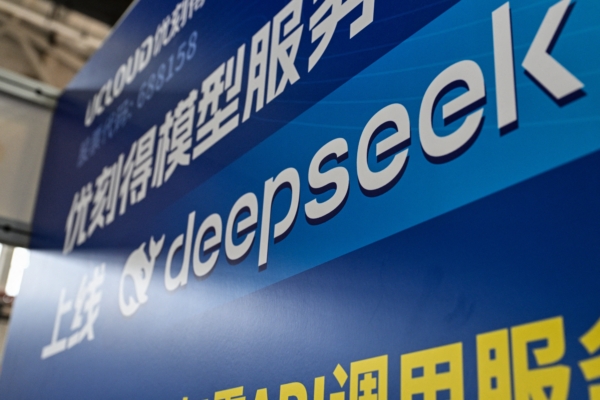
It is noteworthy that these goals were already embedded in the action at the Central Economic Work Conference in December 2024. DeepSeek released DeepSeek-R1 on January 20, 2025, topping the US App Store charts, causing Nvidia’s stock price to plummet by 17% to 18% in a single day.
Research by the Carnegie Foundation found that Beijing’s policy preceded DeepSeek’s release, and DeepSeek strengthens and accelerates the implementation of existing policies.
Facing US chip and capital blockades, Beijing is leaning towards promoting “open-source.” The US-China Economic and Security Review Commission (USCC) released the “Dual Circulation” report in March 2026, indicating that China has built a framework: one part is the “digital circulation” — iteratively collaborative open-source model ecosystem; the other is the “physical circulation” — large-scale industrial deployment, feeding real-world production data back to models for training and improvement.
Hugging Face, the world’s largest open-source AI model hosting and developer community platform, showed on its official blog on August 14 this year that Ali Qwen has derived 151,448 models (4.7 times that of Meta Llama), with a cumulative download count exceeding 3 billion times.
The rampant growth of the open-source ecosystem has even prompted capital moves by global giants. Nvidia announced on September 3 that they would acquire Hugging Face for $12.93 billion, with Nvidia CEO Huang Renxun stating that open models have widened access channels to AI.
However, this expansion of open-source and “distillation” has triggered geopolitical backlash.
On September 8, the US government issued a statement accusing six Chinese companies, including DeepSeek, Moonshot AI, and Alibaba, of engaging in malicious “distillation” activities on an “industrial scale,” using results output by Anthropic, OpenAI, Google, and SpaceX’s models to train defense and commercial AI, and “likely with the knowledge of the Chinese authorities.”
Reuters also reported on July 31 that Chinese military researchers have used American model outputs to train domestic defense systems.
On March 14, 2025, the CCP’s Cyberspace Administration, Ministry of Industry and Information Technology, Ministry of Public Security, and General Administration of Radio and Television jointly released the “Measures for Identifying Synthetic Content Generated by Artificial Intelligence,” which came into effect on September 1. This regulation requires explicit and implicit identification markings on AI-generated content, such as text, images, audio, videos, virtual scenes, with the latter recording the service provider’s name and content identification code and strictly prohibiting deletion or alteration.
In the eyes of industry insiders, this demonstrates that Beijing’s authorities are strengthening administrative control and technological development concurrently, not relaxing ideology and social control despite market demand, when vigorously advancing the “physical circulation.”
While the official push for “physical circulation” intensifies, government propaganda data and independent academic research show a staggering triple gap.
On July 20, the Ministry of Industry and Information Technology’s chief engineer Wang Weiming claimed that the AI penetration rate in the advanced manufacturing sector was “over 30%.” However, researchers Li Xuenan and Wang Xiaolong from the Yangtze Business School discovered during field research in 2026 among 2,016 large-scale enterprises that the actual penetration rate was only about 10.0% (slightly rising to 10.4% in the second quarter), with 79.2% of non-adopting enterprises stating that the “scenario is not applicable,” and most of the funds were only used for hardware procurement.
An August report by Securities Times clearly stated that large models have a “delusion” and are not suitable for direct use in high-risk production, and actual operation discipline is “model suggestion, human confirmation, system execution”; IDC data also shows that about 70% of industrial AI applications are fundamentally small models.
As warned by Li Tingqian, this model forcefully driven by government funds, ignoring market laws, is pushing the combination of AI and manufacturing towards a predicament similar to the “New Three.”