
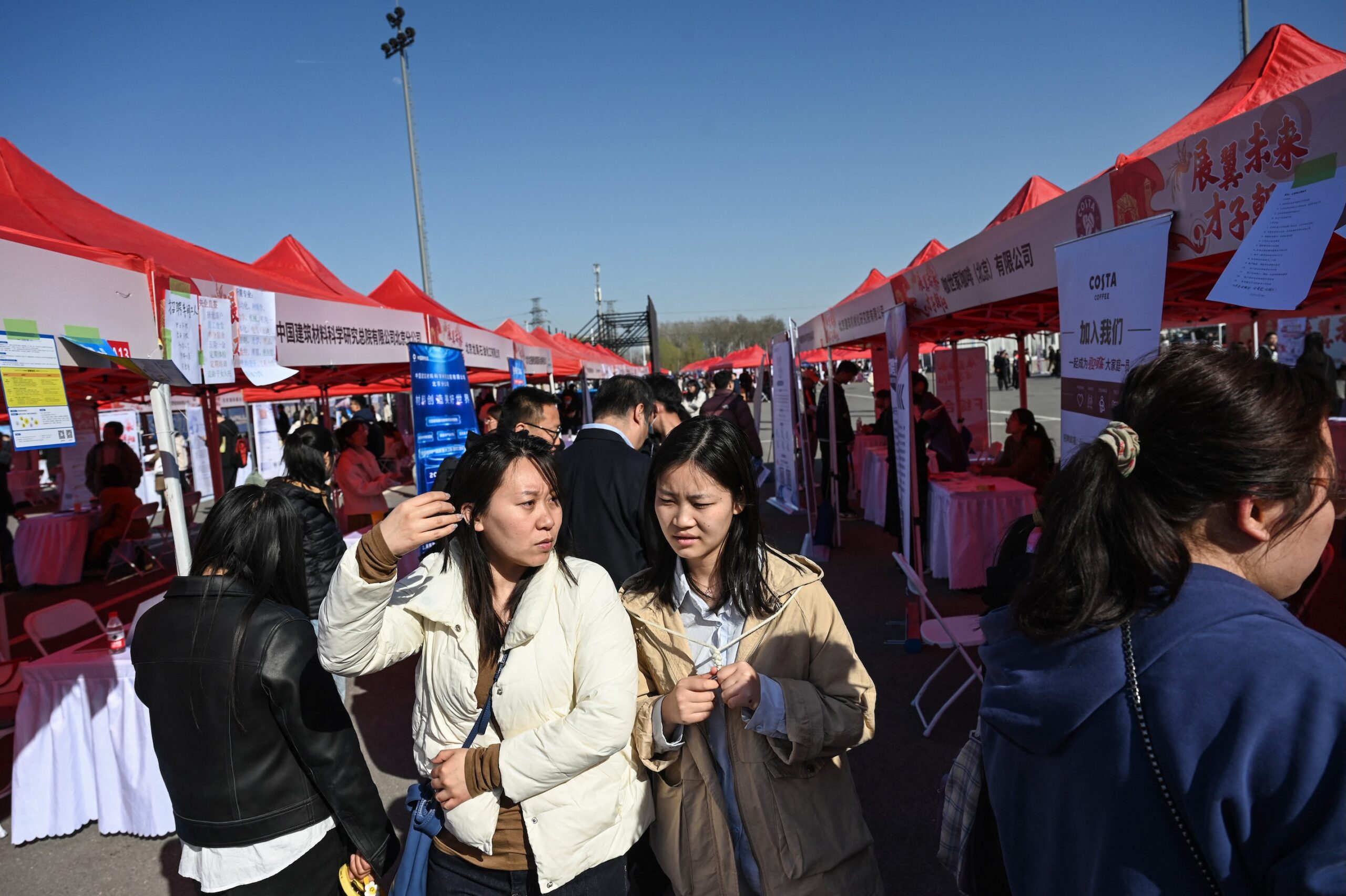
The official figures released by the Chinese Communist Party for July show that the youth unemployment rate has risen to 17.9%, the highest in nearly three years. Experts have questioned the accuracy of the CCP’s unemployment data, with recent Chinese university graduates looking for jobs pointing out that the data does not reflect the actual unemployment situation. Many graduates find themselves jobless immediately after graduating, leading some parents to lament that their children’s education seems to have been in vain.
Experts are skeptical about the CCP’s reported youth unemployment rate of 17.9%, with recent graduates like Dong (pseudonym), who studied computer science, accusing the data of being falsified. Dong expressed his frustration in an interview with the media, stating, “The employment rate is all falsified, especially at major universities where the employment rates are entirely fabricated, with many schools having serious discrepancies in their data.”
Dong shared his struggles in finding a job, expressing reluctance to work for small companies and feeling rejected by larger firms during interviews despite positive feedback online. He emphasized the challenges of lacking experience and the competitive job market, striving to secure a technical position through multiple applications and interviews.
According to Taiwanese financial expert Huang Shicong, the recent months coincide with the period when Chinese university graduates are entering the job market, leading to a higher unemployment rate. He suggested that the actual situation may be worse than official statistics indicate, considering that short-term and temporary jobs are included in the employment figures. Foreign estimates also suggest that China’s youth unemployment rate generally exceeds 20%.
Huang attributed the rise in unemployment to the slowing economic growth in China, including historically low growth rates reported by the government. Additionally, he noted the decline in domestic industries such as real estate and catering, critical pillars of the Chinese economy, which are struggling. With export industries facing increased competition and companies cutting costs, there is a decreased demand for hiring young professionals.
Xu Zhen, a senior figure in mainland China’s capital community, believes that the actual youth unemployment rate could exceed 17.9%. He highlighted that many institutions estimate the true youth unemployment rate to be over 20%, indicating a more severe situation than official figures portray.
Xu criticized the CCP for manipulating the youth unemployment rate by adjusting statistical methodologies to present a more favorable image. He pointed out that certain segments, including underemployed, low-wage, and insecure workers, as well as rural labor force participants, are excluded from the statistics, distorting the true unemployment scenario.
Recent years have seen the collapse of China’s real estate industry, leading to a significant reduction in the number of employees in the sector. Many workers have been forced to shift to alternative occupations like self-employment, food delivery, or ride-hailing to make ends meet, reflecting the challenges posed by rising unemployment and industry contraction.
Videos have emerged showing the impact of the unemployment wave spreading to the streets of Dongguan in Guangdong. On July 29, unemployed individuals occupied the areas near Changping East Station, depicting a chaotic scene as described by witnesses.
This year, an estimated 12.7 million Chinese university graduates are expected to enter the job market, an increase of 480,000 from the previous year. Despite the influx of young talent, the harsh reality exists where job opportunities are becoming scarcer.
A recent graduate from Chongqing named Xiaohua expressed the difficulty in finding suitable job opportunities, particularly mentioning the lack of experience required by many positions. Feeling disillusioned with the job search process, Xiaohua noted the disparity between her expectations based on her education and the actual job market challenges.
She eventually secured a sales position with a basic salary of 2,000 yuan, supplemented by commissions. She acknowledged the importance of having any job in the current market environment, highlighting the prevalent issue of joblessness among many of her peers.
In Shenzhen, a concerned parent of a recent female graduate shared her worries about her daughter’s job search struggles. The young graduate, majoring in environmental design, faced challenges in finding positions without sufficient recommendations from her university. The parent expressed frustration over the bleak job prospects and felt that the hard work put into education had yielded little tangible results.
The sentiments were echoed by a Ph.D. student named Yang Miao (pseudonym) from Tianjin, who had been searching for a job for six months without success. Frustrated by the lack of suitable opportunities, Yang emphasized her desire for a well-paid, stable job close to home, reflecting the high standards set by many young job seekers in the current labor market.
Another male university graduate named Guike (pseudonym) from Yulin, Guangxi, lamented the challenges faced by environmental design graduates due to limited career prospects in the field. With entry-level salaries in urban areas averaging around 2,000-3,000 yuan per month and the preference for experienced candidates, many new graduates like Guike encounter uncertainties and limited job prospects.
He described a scenario where most of his peers remained unemployed, struggling with insufficient income to cover living expenses, ultimately relying on family support for financial stability.
A study by the Chinese New Employment Forms Research Center projected a rise in the number of flexible workers in China, reaching 280 million in 2025 and expected to increase to 320 million by 2026. Representing over 44% of the total employed population in 2025, flexible employment arrangements have become an integral part of the Chinese job market.
Amid discussions on the changing landscape of employment, Professor Zhang Dandan from Peking University’s National Development Research Institute suggested that flexible employment could be viewed as a form of social welfare. While acknowledging the benefits of regular employment with comprehensive social security benefits, Zhang highlighted the appeal of flexible work arrangements that offer individuals autonomy and self-management at the cost of reduced social security coverage.
However, Xu Zhen expressed concerns over such perspectives, particularly noting the vulnerable position of gig workers like food delivery personnel and ride-hailing drivers facing income instability, algorithmic exploitation, lack of workplace injury insurance, and retirement coverage gaps. He criticized the glorification of flexible employment as a form of welfare, highlighting the disparity between expert perspectives and the actual challenges faced by the bottom-tier workforce, suggesting a whitewashing of the CCP’s policy failures and economic struggles.
In an attempt to address the escalating youth unemployment crisis, the Chinese Ministry of Human Resources and Social Security, together with the Ministry of Civil Affairs, issued a joint directive in August 2026 aimed at optimizing community job opportunities to absorb recent graduates and encouraging enterprises to expand recruitment efforts.
Huang Shicong emphasized that the effectiveness of such measures is limited by the current economic downturn affecting tax revenues, making it challenging for local authorities to increase personnel expenditures. He reiterated that the primary driver behind China’s high youth unemployment rate is the economic slowdown leading to business closures and a lack of confidence among private enterprises, trends that show no sign of abating.
Xu Zhen underscored the long-term implications of expanding job opportunities through administrative measures, cautioning against the potential pitfalls of sacrificing efficiency for short-term gains. Analogous to the economic stagnation witnessed in the 1980s, Xu warned that a reliance on government-led employment initiatives could hinder economic progress in the long run.