
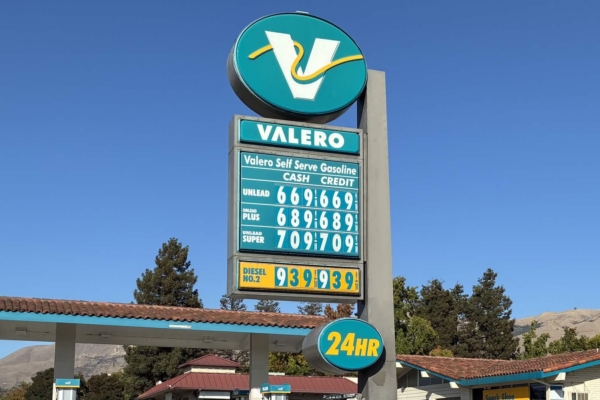
California Bay Area’s diesel prices have soared to over $9 per gallon at several gas stations, reflecting high costs attributed to local environmental regulations, monitoring expenses, as well as the combined impacts of the Iran conflict and Russia-Ukraine tensions, according to an industry analyst.
One Valero gas station in Fremont is selling diesel at $9.39 per gallon. In recent days, many other gas stations in the area have maintained diesel prices at around $9 per gallon or higher.
According to data from the American Automobile Association (AAA) as of Wednesday, September 23, the average diesel price in California was $8.44 per gallon, while the national average remained at a record high of $6.52 per gallon.
GasBuddy’s data for California and the entire United States also show a similar trend in diesel prices, with prices continuously rising since the Labor Day weekend.
On a national scale, according to AAA’s data as of Wednesday, a few states have diesel prices higher than the national average, including Hawaii at $7.15 per gallon, Michigan at $6.89, Pennsylvania at $6.61, Indiana at $6.91, and Illinois at $6.83.
GasBuddy analyst Patrick De Haan stated, “Gas taxes on the West Coast states are generally higher.”
A cost analysis by the California Energy Commission shows that the California gasoline price includes state and local sales taxes, state excise taxes, federal excise taxes, low carbon fuel standard costs, and carbon emissions trading costs, totaling 26% of the gas station selling price.
According to GasBuddy’s fuel price tracking tool, overall, gas prices at gas stations on the West Coast are usually higher than those on the East Coast.
De Haan told The Epoch Times, “This is because the West Coast lacks sufficient refining capacity, and the closures of refineries we’ve seen in California in recent years have exacerbated the issue.”
Since 2024, California has been facing issues related to refinery closures and oil company relocations due to high operating costs and strict regulatory and enforcement environments.
Earlier this year, Valero Energy Corp.’s refinery in Benicia, Northern California, ceased operations.
By the end of 2025, Phillips 66 stopped operating its refinery in Los Angeles. These refineries used to supply fuel to California, Nevada, and Arizona.
De Haan also mentioned that the unique regulations and monitoring requirements of “environmental projects” further increase the prices at gas stations.
Similar to Washington state, California implements a carbon emissions trading program that sets a limit on the total carbon emissions allowed within the state. Companies must then purchase emission allowances (which are often tradable) to emit a certain amount of greenhouse gases.
California and Washington state claim that these programs aim to encourage companies to reduce emissions and promote the adoption of low-carbon or renewable energy alternatives. Businesses failing to meet emission allowances or submit enough allowances may face fines.
The cost of maintaining these environmental programs results in an increase of about 47 cents per gallon for consumers when refueling.
Currently, there are 11 refineries in California with a combined daily crude processing capacity of 1.3 million barrels (equivalent to 56.2 million US gallons). These refineries produce an average of 26.1 million gallons of gasoline and 16.1 million gallons of diesel per day.
This production can meet approximately 72% of California’s daily gasoline demand and over 100% of the diesel demand. Any remaining crude oil is processed into other petroleum products.
De Haan stated, “California and other West Coast states typically need to import fuel.”
According to data from Energy News Beat, a platform focusing on the energy industry, California exported about 9.3 million barrels of diesel in the first quarter of 2025, while importing around 2.3 million barrels during the same period.
Furthermore, the current blockade in the Hormuz Strait and recent attacks by Ukraine on Russian refineries have heightened supply tensions.