
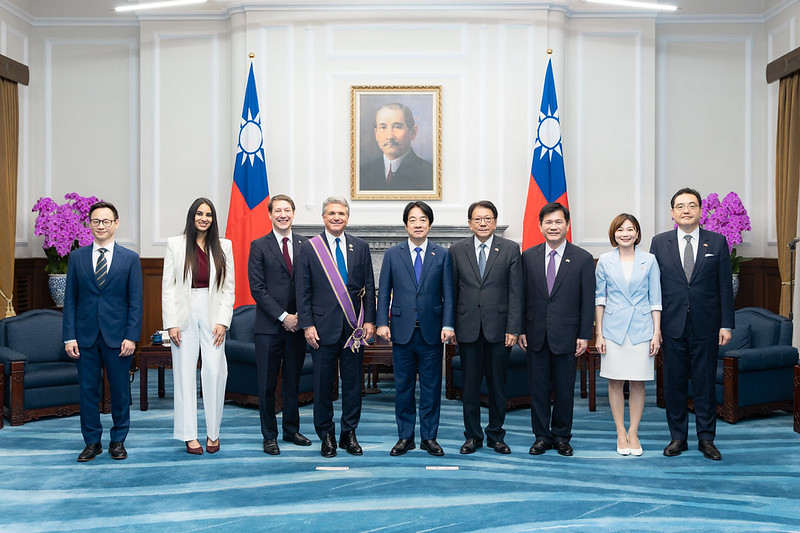
On August 5, 2026, President of the Republic of China (Taiwan), Lai Ching-te, awarded the “Grand Cordon of the Order of Brilliant Star” to Michael McCaul, the Honorary Chairman of the House Foreign Affairs Committee of the United States Congress. President Lai stated that Taiwan will continue to promote defense reform and enhance the overall societal defense resilience, hoping to deepen cooperation with the United States in defense, economy, trade, and technology fields.
President Lai, in his speech, expressed gratitude to Michael McCaul for his longstanding efforts in deepening Taiwan-U.S. relations, supporting democratic Taiwan, and contributing to the maintenance of peace and stability in the Taiwan Strait. The medal carries the most sincere respect of the Taiwanese people and symbolizes the deep friendship between Taiwan and the United States.
President Lai highlighted McCaul as a highly influential political leader in the U.S. Congress who has consistently advocated for peace, supported democratic partners, and courageously stood against authoritarian expansion, earning admiration for his clear stance and determination.
During their last meeting at the Presidential Office in 2024, McCaul led the first delegation of U.S. Congress members to visit Taiwan after President Lai took office. McCaul’s statement of “We love Taiwan” in Chinese, along with emphasizing unwavering U.S. support for Taiwan, deeply touched and inspired everyone present.
President Lai emphasized the shared democratic and free values between Taiwan and the United States in upholding regional peace and stability. Amid the ongoing expansion of authoritarianism from China, Taiwan stands firm in defending democracy, believing that strength is the foundation of peace and must be built upon a firm determination for self-defense.
Lai especially thanked McCaul for his long-standing support in enhancing Taiwan’s defense capabilities, urging expedited delivery of U.S. arms sales to Taiwan and advocating for a special defense budget with bipartisan support from the U.S. Congress this year. These concrete actions demonstrate the firm commitment of the U.S. Congress to Taiwan’s security, greatly inspiring the Taiwanese people.
President Lai stressed Taiwan’s commitment to continuing defense reform, strengthening asymmetric combat capabilities, establishing a drone attack and defense system, and enhancing overall societal defense resilience. He also expressed eagerness to deepen cooperation with the U.S. from military procurement towards joint research and production, working together to safeguard peace and stability in the Indo-Pacific region.
He mentioned that the Taiwan-U.S. partnership is rapidly expanding into economic, trade, and technological fields. Representing Texas, an important hub for energy and technology industries in the U.S., McCaul emphasized the deepening economic and trade exchanges between Taiwan and Texas, highlighting their growing industrial cooperation as a vital force in enhancing Taiwan-U.S. relations.
This year marks the 250th anniversary of the founding of the United States and the 30th anniversary of Taiwan’s direct presidential elections. President Lai noted their joint participation in the Ketagalan Forum, now in its 10th edition, as they stand at a new milestone to once again thank McCaul for his unwavering commitment to safeguarding democratic partners, remaining steadfastly by Taiwan’s side.
In conclusion, President Lai expressed Taiwan’s sincere anticipation of further enhancing relations with the United States with McCaul’s assistance, working together with stronger determination to protect peace and foster closer cooperation.
In his remarks, Honorary Chairman McCaul expressed great honor in receiving the “Grand Cordon of the Order of Brilliant Star,” reflecting on the moniker “Lone Star State” as the representative of Texas. He reiterated his steadfast support for Taiwan and thanked President Lai for his leadership and friendship.
McCaul emphasized that he does not speak as a representative of the Republican or Democratic Party, but as an American who cherishes the friendship between the two nations. Taiwan has proven the viability of democracy; during his last visit to Taiwan, he gifted President Lai a Texas cowboy hat, symbolizing the shared values that tightly bind the two sides together. The cowboy represents freedom and resilience, with time proving that Western cowboys will ultimately triumph over Eastern authoritarian dragons.
He stated that the primary aim of the Chinese Communist Party is to disrupt the Taiwan-U.S. partnership and alter U.S. policies. However, he reiterated that the Taiwan Relations Act, enacted by the U.S. Congress in 1979, remains a solid foundation of bilateral relations.
According to the Taiwan Relations Act, the U.S. is obligated to provide Taiwan with defensive weapons, a commitment that is being honored. In December of last year, the U.S. Congress approved the largest-ever foreign military sale worth $11 billion, with plans for further sales worth an additional $14 billion in crucial military defense equipment. McCaul affirmed that U.S. policy ensures that Taiwan’s arms sales are not impacted by U.S.-China diplomatic relations.
He shared his recent experiences visiting the Ukrainian conflict zone to observe drone technology and production capabilities, stressing their critical importance for Taiwan’s future survival. He encouraged Taiwan to collaborate with other successful democratic nations at the forefront of innovative solutions against modern warfare challenges. Congratulating Taiwan on passing the Special Defense Budget, he emphasized the importance of continuous enhancement in Taiwan’s defense capabilities and resilience, including network security as vital as missiles and drones.
McCaul pointed out that the increasingly aggressive behavior of the Chinese Communist Party poses a direct threat to Taiwan and global power balance. While the U.S. seeks stability in U.S.-China relations, it remains well aware of the threats posed by the CCP and their ultimate goals.
Moreover, he shared his personal encounter with coercive methods from the CCP; during his last visit to Taiwan to congratulate President Lai’s election, China dispatched numerous military aircraft and ships to the vicinity of the Taiwan Strait, leading to sanctions against him by China, a badge of honor in his pursuit of freedom.
McCaul stated that the CCP is continuously testing its own strength and probing Taiwan’s weaknesses in preparation for potential invasion, but such intimidation tactics will not succeed. As President Lai mentioned, the Republic of China does not belong to the People’s Republic of China; the CCP’s attempts to forcefully unify Taiwan will never prevail as they have never in the past and will not in the future.
McCaul described how General MacArthur in 1950 referred to Taiwan as an “unsinkable aircraft carrier,” a description still relevant today. Taiwan remains a crucial pillar of freedom in the Indo-Pacific region, and the U.S. will always be Taiwan’s steadfast partner, working shoulder to shoulder with Taiwan to maintain peace through strength.
Lastly, he once again expressed gratitude to President Lai for bestowing the prestigious Grand Cordon of the Order of Brilliant Star, affirming his support for Taiwan with the declaration, “I love Taiwan.”