
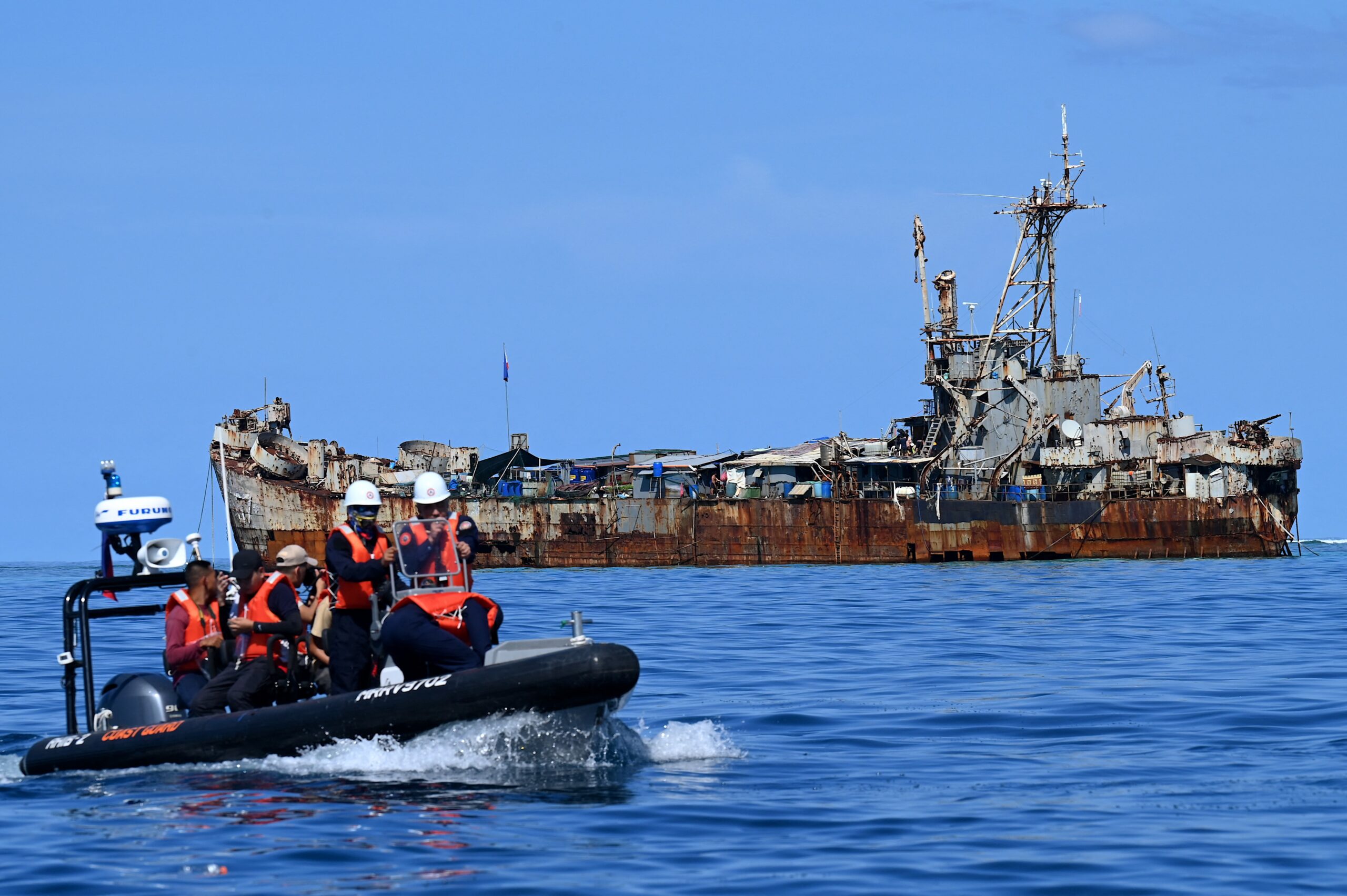
On Monday, July 20, a ship collision erupted between the Chinese Communist Party (CCP) and the Philippines in the disputed waters of the South China Sea, leading to mutual accusations. Philippine authorities accused Chinese coast guard personnel of using sticks to strike the heads of Philippine soldiers, while Beijing countered that it was the Philippine personnel who first launched a malicious attack wielding oars and sticks.
This incident comes as the Association of Southeast Asian Nations (ASEAN) high-level foreign ministers’ meeting is scheduled to take place in Manila this week, with Chinese Foreign Minister Wang Yi planning to attend. The new round of conflicts between China and the Philippines undoubtedly casts a shadow of uncertainty over the upcoming diplomatic meeting.
The Armed Forces of the Philippines (AFP) stated that on Monday, a vessel with 8 personnel from the Chinese coast guard illegally approached the stranded Philippine navy ship BRP Sierra Madre at Second Thomas Shoal (also known as Ayungin Reef or Ren’ai Reef), and started filming. When Philippine forces deployed two navy rubber boats to drive them away, Chinese personnel “made a confrontational violent response, using sticks to strike Philippine navy personnel,” resulting in one sailor sustaining head injuries and another rubber boat being damaged.
The Philippine military subsequently released a 25-second video clip showing coast guard personnel on the rubber boat near the Chinese vessel waving sticks and striking Philippine crew members. The Philippine Department of Foreign Affairs immediately issued a statement condemning such “violent behavior” as completely unacceptable and vowed to take necessary diplomatic actions.
Facing the Philippine accusations, the Chinese Coast Guard quickly issued a rebuttal, accusing Philippine vessels of disregarding repeated warnings from the Chinese side, approaching in a dangerous manner, and deliberately ramming Chinese patrol boats. They squarely pointed the blame at the Filipino side, asserting that the Filipino personnel were the “first” to initiate the attack, using oars, long sticks, and other tools to maliciously assault Chinese law enforcement personnel.
The Second Thomas Shoal is located within the Philippines’ 200-nautical-mile exclusive economic zone but is approximately 1,300 kilometers away from mainland China, which claims sovereignty over the area and much of the South China Sea.
As a strategic waterway, the South China Sea handles almost one-third of global maritime trade and about 40% of global cargo trade. In 2016, an international arbitration court ruled that Beijing’s sovereignty claims in the South China Sea had no legal basis, a decision China has refused to accept. Instead, the CCP has been accused of ongoing illegal expansion in the region.
This is not the first time that China and the Philippines have had a bloody conflict involving cold weapons. In June 2024, serious clashes occurred in the same area resulting in a Philippine sailor losing a thumb. Despite a temporary agreement reached in July 2024 allowing the Philippines to resupply the stranded ship—a fragile peacekeeping agreement—faced a severe test once again following the latest conflict on Monday known as the “clash of sticks.”