
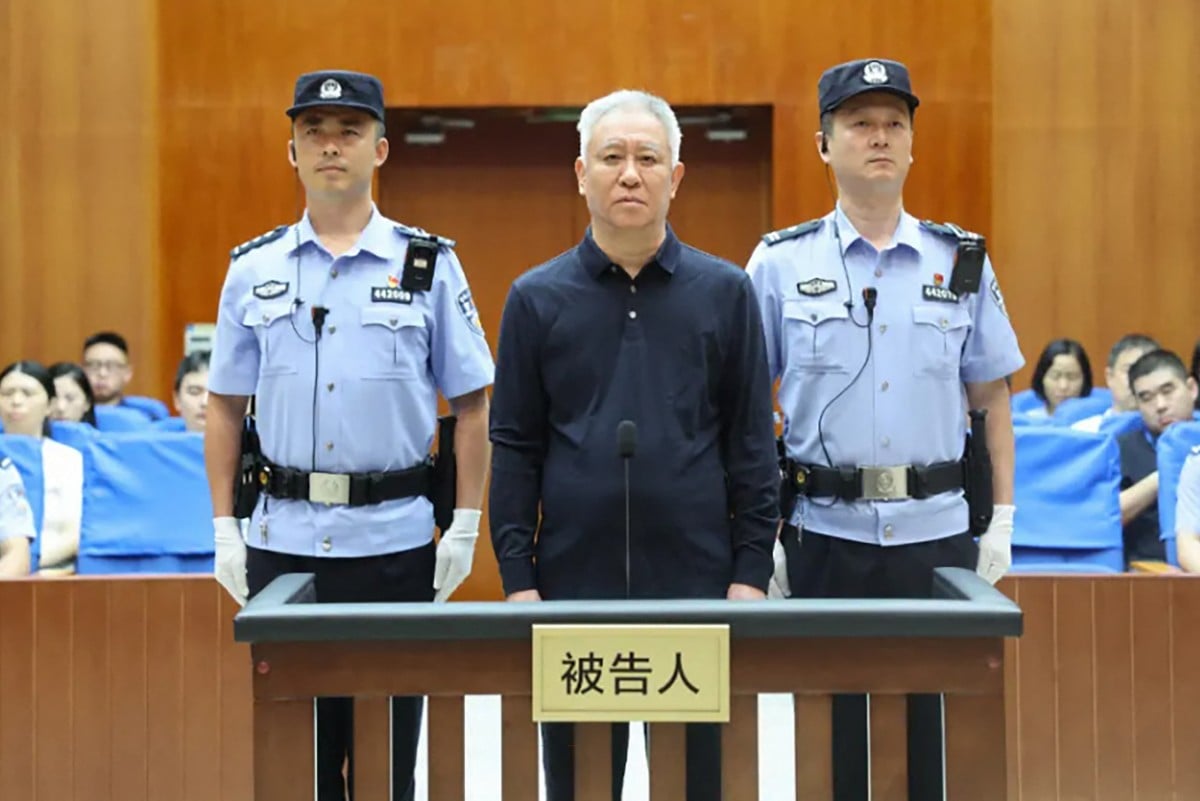
Xu Jiayin has been sentenced to life in prison, which is not only a matter concerning Evergrande Group, but also a symbol of the failure of the Chinese Communist Party’s real estate policies, and even the inevitable failure of the CCP’s reform and opening-up.
The founder of Evergrande Group, Xu Jiayin, was sentenced to life imprisonment by the Shenzhen Intermediate People’s Court on August 20 on charges of fundraising fraud and seven other crimes.
Since March 2022, when it failed to disclose its audited performance and Evergrande Property deposits on time, Evergrande and its subsidiaries have been suspended from trading on the Hong Kong Stock Exchange, marking the end of the Evergrande crisis. However, the lessons of Evergrande have yet to be fully understood.
Evergrande is the largest monster in China’s real estate industry and has been the fastest-growing. Evergrande has long been seen as a benchmark in China’s real estate industry because it has taken the “high leverage, high turnover, and large-scale” development model since the reform of China’s housing system to the extreme.
In other words, Evergrande has never been a rebel against the CCP’s real estate policies but a role model.
Every aspect of China’s real estate policy is under government control.
First, real estate companies have to buy land from local governments, which is the largest part of the cost in housing sales, accounting for 40%-70% of house prices. Moreover, the amount of land acquired by central state-owned enterprises in core first-tier cities accounts for over 60% annually.
The largest part of the local government’s financial resources comes from land sales. This means that local governments have the biggest incentive to promote rising house prices.
The source of funding for real estate developers is mainly bank loans, financing, and presale of properties. While there are private banks in China engaged in mortgage loan business, their total assets and number account for less than 1% of all banks nationwide and have minimal impact. Property presale is regulated by the Law of the People’s Republic of China on Urban Real Estate Administration passed in 1994 and the State Council’s Regulations on Urban Real Estate Development and Management.
Bank loans and presale proceeds are the major sources of financing for real estate developers.
All real estate developers in China are able to operate with high leverage by fully utilizing advance payments from homebuyers and bank loans for rapid development. Evergrande is a shining example of this practice.
Xu Jiayin’s Evergrande Group was able to expand rapidly, with every aspect, from legal to loans, receiving support from various levels of the CCP’s government, and the government, in turn, has received substantial benefits. From this perspective, Xu Jiayin does not belong to any particular faction of power but serves as a white glove for the CCP’s policies.
This is why he received praise from the CCP’s propaganda mouthpieces and even became a member of the National Committee of the Chinese People’s Political Consultative Conference (CPPCC), appearing on the Tiananmen Gate Tower during the events marking the 70th anniversary of the founding of the People’s Republic of China and the 100th anniversary of the founding of the Communist Party of China.
CPPCC members usually come from the party and government system, often holding provincial and ministerial-level positions, belonging to central government officials. Although Xu Jiayin is not a central government official, at least it proves that his Evergrande business model has gained recognition from the highest levels of the CCP.
The eight specific charges against Xu Jiayin were permitted by policies and are common practices in the real estate industry. It’s just that Evergrande went too far and added the adjective “illegal” to them. One of the crimes was bribery to obtain control of financial institutions. During the crisis period, Evergrande’s financial statements showed interest-bearing debts of over 570 billion RMB, of which the balance of bank and other financial institution loans was about 368.4 billion RMB.
Obtaining control of financial institutions is not something that can be achieved solely through bribery; there are policy foundations.
Xu Jiayin did not design a series of real estate policies; he simply maximized the use of these policies.
Taking land finance as an example, in 1988, the National People’s Congress passed a constitutional amendment explicitly stating that “the right to use land can be transferred in accordance with the law,” and the amendment to the Land Administration Law established the country’s implementation of a paid land use system, paving the way for land sales from a legal perspective.
In 1990, the State Council issued the Interim Provisions on the Transfer and Transfer of Urban State-owned Land Use Rights, formally legalizing paid land transfers nationwide with clear regulations.
When Zhu Rongji initiated the tax-sharing reform in 1994, local governments began to heavily rely on land transfer fees returned to the local level because the foundation of land finance was already established.
In 2002, the Ministry of Land and Resources fully implemented land bidding, auctioning, and listing procedures. None of these policies were created by any real estate developer; they could only be utilized. If Zhu Rongji’s tax-sharing system opened up land finances for local governments, Xu Jiayin was the policy’s biggest user and beneficiary.
So, why can local governments transfer land? Public ownership of land serves as the basis for all these processes. There is no private land ownership in China under the CCP’s rule. Public ownership comes in two forms: collective ownership and state ownership.
Initially, rural land in China was privately owned, but during land reforms under the CCP, land was redistributed from landlords to farmers, under the guise of “land to the tiller.” However, this private ownership was short-lived, leading to collective land ownership.
Chinese farmers lost land ownership for the first time in two thousand years. While the land was collectively owned, the “collective” did not have full ownership and use rights over the land. During the Cultural Revolution, even the “collective” had no control over what could be planted on the land. Villagers in Xiaogang Village in Anhui risked their lives just to obtain land contracts.
The change in ownership of urban land is even more absurd. Even after undergoing three major transformations, urban land remained, legally, privately owned. It was not until 1982 when a sentence was added stealthily to the Constitution: “urban land belongs to the state,” that urban land became officially state-owned.
Public land ownership forms the true foundation for the super prosperity and eventual burst of the real estate bubble in China. This kind of frenzied expansion in the real estate sector is unique to China. It would not happen in countries where land is privately owned and constitutionally protected.
Among all commercial activities in China, the real estate industry in private enterprises is the closest to CCP power and has the most intimate connections with the government. To study the collusion between politics and business in China, one cannot overlook the real estate sector, with Xu Jiayin being a prime example.
The unlimited expansion of Evergrande was essentially a giant Ponzi scheme, as expansion based on high leverage is bound to surpass the demand for housing, ultimately leading to a situation where there are no buyers, resulting in the bubble bursting.
Whether it’s the three red lines or any other constraints, they are just ways of purposely bursting the bubble.
Even the notorious Evergrande theatrical troupe was not Xu Jiayin’s creation. During the War of Resistance Against Japan, while Nationalist soldiers fought bravely on the front lines, dances were frequently held in Yan’an. After the founding of the People’s Republic of China, dance parties were regularly organized in Zhongnanhai. Mao Zedong, Liu Shaoqi, Zhou Enlai, Zhu De, and other CCP leaders often attended.
To cater to the needs of central leaders, military art troupes were specifically reassigned, and even a special Zhongnanhai art troupe was established, with young women serving as dancers and musicians. The military art troupes in the CCP’s army largely serve the top leaders.
Xu Jiayin reportedly angered Xi Jinping because of this. The main reason should not be the function of the art troupe but rather the offense against the top leadership, as receiving service from the art troupe is a privilege reserved for CCP dignitaries.
Xi Jinping’s fury likely simply meant, “How dare you share the same surname as the Zhao family.”
Xu Jiayin’s offenses were considered advantages during the rapid development of the real estate sector but became crimes when there was a need to vent public anger, just a matter of semantics. From this perspective, Xu Jiayin can be seen as the scapegoat for the entire CCP real estate policy.
Xu Jiayin certainly deserves his punishment, but let’s not forget that it was the CCP’s policies and system that nurtured him, encouraging his criminal behavior.
If Zhu Rongji’s tax-sharing plan opened up local government land finances, Xu Jiayin was the biggest beneficiary of this policy. The prosperity of the real estate sector represents the pinnacle of the CCP’s imperfect reform and opening-up efforts.
The passing of Zhu Rongji and Xu Jiayin’s sentencing symbolize the end of that grand banquet. The CCP’s reform and opening-up have finally come to a close.