
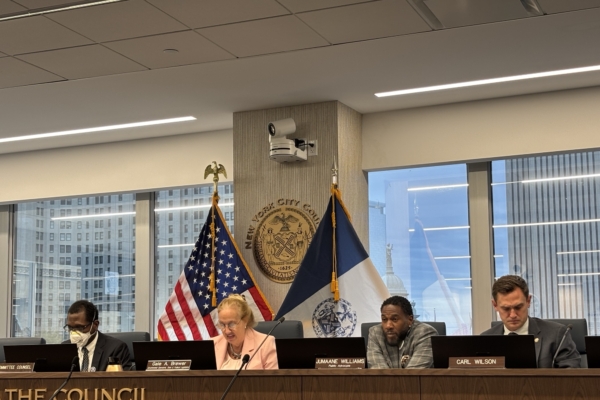
New York City Council held a supervisory hearing on September 22 regarding the cooperation between the Mamdani administration and internet celebrities and content creators. The Mayor’s communications team responsible for the related work was invited but did not attend, and representatives from the city government mainly focused on face-to-face communication with the public. Many core questions regarding the city government’s expenditures on influencer promotions, the selection and disclosure of creators, and whether internet celebrities have the same access to city government information and officials as traditional media, were left unanswered.
During the hearing, Huang Youxing repeatedly inquired about how much the city government spent on influencer promotions this year, how the budget was determined, how influencers were recruited and selected, and how the cooperation and payment relationships were disclosed. Officials present at the hearing repeatedly claimed not to have the relevant information, suggesting he inquire with the Mayor’s communications department.
“So we are holding this hearing on this topic, but the two agency heads sent over don’t have the answers to this issue,” Huang Youxing said.
Chairman of the hearing and chairman of the City Council’s Government Operations Committee, Gale Brewer, immediately added that relevant officials were invited but refused to attend. Huang Youxing responded, “I wonder why they refused.”
Huang Youxing continued to inquire about how the public could find out which influencers were collaborating with the city government, who was being compensated, where the funding came from, and what content they were commissioned to produce, but similarly received no clear answers.
After the hearing, Huang Youxing, in an interview with this newspaper, said, “The people I requested to come to the hearing to answer questions didn’t show up, and those who did come didn’t answer the questions. I am very dissatisfied.” He mentioned considering issuing subpoenas.
Councilman Eric Dinowitz also inquired about the retention of Signal messages. According to the policy of the Department of Records and Information Services (DORIS), content related to city government decisions, actions, or policies is deemed as “substantive messages” that should be preserved. He questioned whether messages sent within Signal groups containing “daily updates, talking points, and video clips for posting purposes” were considered substantive messages.
Officials from the New York City Department of Records and Information Services explained that if the original documents were stored in systems like OneDrive, sending links to the documents via instant messaging could be temporary. Dinowitz, upon hearing this, asked, “Could you explain that again in English? I didn’t quite get it.” The official jokingly replied, “Thank you for your humor.”
Dinowitz then raised the question, following this logic, if one did not want their communication subject to a Freedom of Information Law (FOIL) request, would they only need to retain documents and then send links via instant messaging. The Department of Records and Information Services stated that they would not advise anyone to circumvent FOIL. Finally, Dinowitz commented that based on the testimonies that day, “it appears that the team responsible for these instant messages did not do their job properly.”
New York City Public Advocate Jumaane Williams also questioned who determines whether an instant message needs to be preserved. DORIS stated that instant messages are initially considered temporary; however, if the content is substantive, users are responsible for transferring it to a form that can be preserved.
Williams stated that according to this rule, if former Governor Cuomo wanted to avoid leaving communication records, “he simply wouldn’t need to” switch to BlackBerry, “he could just continue to use Signal or WhatsApp.” He noted that he did not personally determine any improper behavior by the city government, but since questions were raised by the public, answers should be provided, and those who could truly answer the questions were absent.
A study by Columbia University on the New York City government’s use of influencers to disseminate government information served as crucial background for this hearing. The team led by Anya Schiffrin, a lecturer at Columbia University’s School of International and Public Affairs, found that the city government lacked comprehensive public data, making it difficult for outsiders to determine which agencies collaborated with which influencers, how they were selected, and the extent of expenditures involved.
During the study, the team also discovered that the Mayor’s Office had a Signal group of over 200 content creators who received city government messages, talking points, and audiovisual materials. Schiffrin stated that she was told that the group itself was not receiving payment, but existing public data were insufficient to clarify all the collaborations and financial relationships between the city government and content creators.
The question of who can join this group and how the city government treats influencers compared to traditional media outlets was another issue raised during the hearing. Schiffrin pointed out that traditional journalists must go through a specific process to obtain press credentials for City Hall coverage; however, there is a lack of clear public rules regarding how content creators are allowed to join the Signal group, based on what criteria, and whether they receive the same access to city government information, event invitations, and contact with officials as traditional media outlets.
There is a precedent for the city government paying influencers. The New York City Campaign Finance Board (CFB) stated that in 2025, they collaborated with 29 content creators, releasing 73 pieces of content on Instagram and TikTok, with a total cost of $626,365, primarily aimed at promoting voting information to young people and non-English speakers.
Regarding whether the Mayor’s Office Signal group involved payments, witnesses gave conflicting statements. Some witnesses claimed that creators in the group did not receive compensation, while others suggested that some creators may be paid through third-party agencies. The city government did not provide complete cooperation and payment data that day, leaving the situation unclear.
The City Council is currently considering relevant proposals to enhance disclosure of information regarding government collaborations and payments with content creators. Content creator Norberto Briceño stated, “Reporting on the government does not mean endorsing the government. Ultimately, people should have the opportunity to hear what their government is doing and make their own judgments.”