
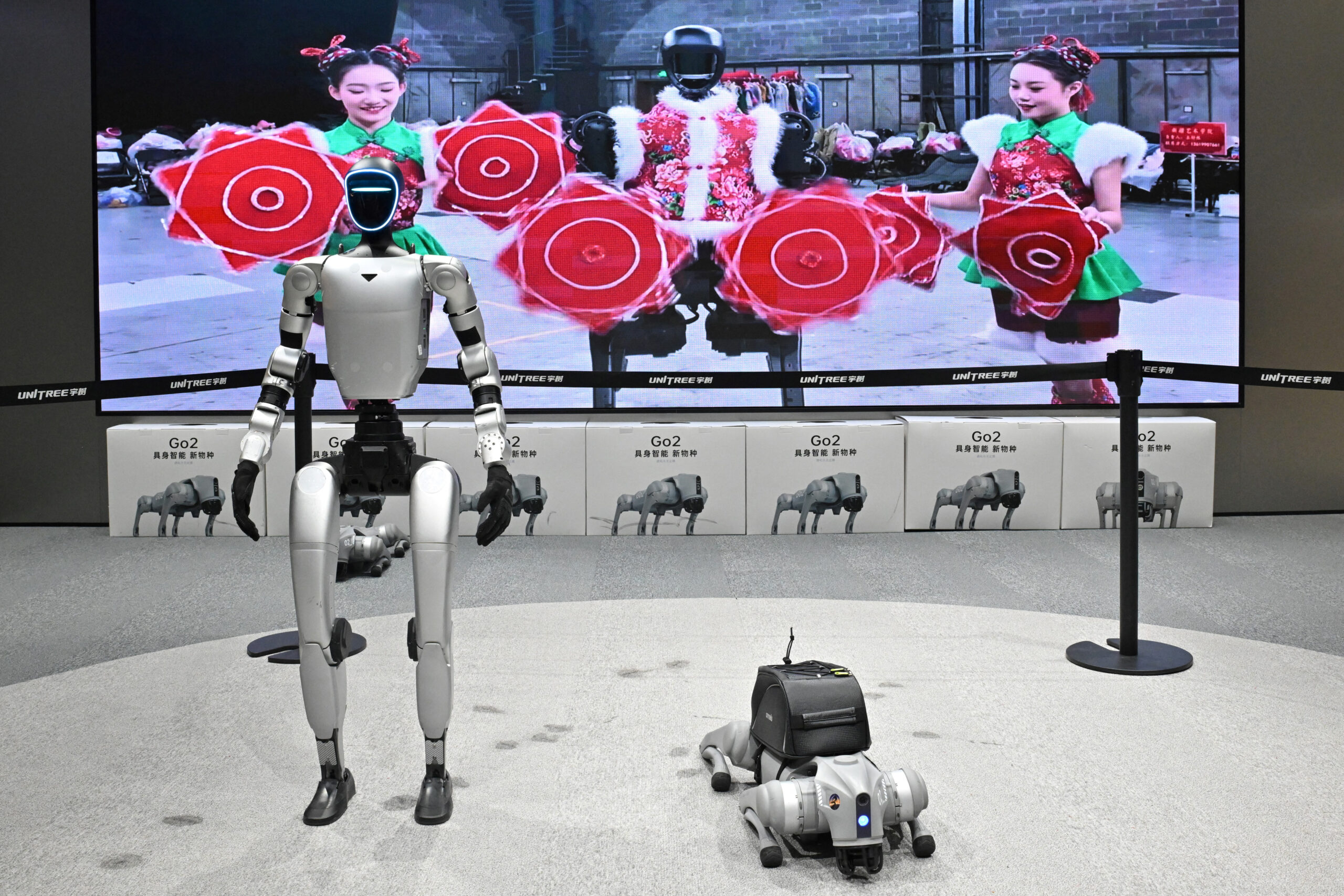
In recent times, the Chinese humanoid robot industry has been drawing significant attention, caught between capital enthusiasm and regulatory shift towards caution. The industry has witnessed an increase in listing requirements for companies and a significant drop in the stock prices of leading companies. Experts suggest that while there is real technological progress in the sector, the expansion of capital and production capacity has clearly outpaced commercial demand. The deep intervention of local governments has raised doubts about the authenticity of some companies’ revenues. The ultimate maturity of the industry will depend on three key indicators: market-driven revenue, repeat purchase rate, and actual operational costs.
Leading Chinese robot company Yushu Technology has been listed for over a month, with its market value reaching approximately 200.1 billion yuan (RMB) as of September 22nd, a reduction of about 244.8 billion yuan from its peak on the first day of trading.
According to the U.S. technology media The Information, the China Securities Regulatory Commission has privately provided “window guidance” to some investment banks and companies to raise the listing threshold for humanoid robot enterprises.
Reuters reported that these changes come at a time when robot companies are experiencing overheated private financing, queuing for listings, and the significant drop in Yushu’s stock price from its peak. The financial regulatory authorities of the Chinese Communist Party did not respond to Reuters’ request for comment.
In an interview with various investment bankers, Caixin learned that some bankers have received reminders from their respective companies, particularly regarding hard technology IPOs including the robotics industry. If a company’s position in the industry is not prominent enough, its listing process may be affected. A top brokerage stated that the bankers did not receive the notifications through window guidance, but the contents were more focused on reinforcing the responsibility of underwriting institutions.
Against the backdrop of tightening regulations, the underlying logic behind the frenzy in the robot industry has garnered attention. In light of this, Epoch Times interviewed American economist Davy J. Wong to interpret the current reality of the Chinese humanoid robot industry.
Wong believes that the Chinese humanoid robot industry currently encompasses both genuine technological advancement and investment expansion driven by policies and capital, rather than simply being labeled as a bubble.
He mentioned that China has made significant progress in electrical motors, gear reducers, batteries, sensors, supply chains, and large-scale manufacturing in the field of humanoid robots, which reflects real industrial capabilities.
However, the biggest contradiction in the industry right now lies in the fact that “the speed of capital investment and capacity construction has clearly outpaced commercial demand.”
Based on his observations, there are over 150 humanoid robot companies in China, yet the global deployment of humanoid robots in industrial and professional services remains limited. He emphasized that evaluating the industry should not solely focus on whether robots can run, dance, or box but rather on their ability to work stably for 8 or even 24 hours a day and at a cost lower than human labor or traditional automation equipment.
Wong also highlighted the realistic issue facing humanoid robots – not all work scenarios necessitate a “humanoid” solution. If dedicated robotic arms can perform the same tasks at a lower cost, higher speed, and greater reliability, “businesses have no reason to purchase humanoid robots just for the sake of being humanoid.”
He pointed out that certain robot data training centers and related projects are heavily financed by local governments initially. “Governments fund the establishment of training centers, the centers purchase robots, generate data and service demand, leading to companies receiving orders and revenue as a result.”
This implies that while company financial statements may indicate sales, revenue, and orders, further delineation is necessary to determine how much of this revenue stems from genuine market demand.
In Wong’s view, genuine commercial demand should originate from economic decisions within enterprises themselves. For example, if an automobile factory, logistics company, hospital, or other users find it more cost-effective to purchase robots after cost accounting, they will use their own funds for procurement and continue purchasing after practical usage.
Therefore, he believes that evaluating a humanoid robot company in the future should not solely focus on revenue scale but should also consider how much sustainable and repeatable market-driven revenue remains after deducting government subsidies, government procurement, and policy-related projects.
“That is the true demand,” he stated.
Wong placed the humanoid robot industry within China’s overall industrial policy framework, noting that a key feature of China is its strong capability for resource mobilization. Once the central government designates a certain technology as a strategic direction, local governments, state-owned enterprises, sovereign funds, banks, and private capital may swiftly converge in the same direction.
This model can create economies of scale in some industries. “If the direction is correct, the speed of progress is astonishing.” Citing examples such as new energy vehicles and photovoltaics, he believes that in these sectors, China has experienced significant repetitive investments and price competition while developing massive supply chains.
However, on the flip side, “mistakes can be amplified rapidly.”
Wong explained that if a venture capital fund makes a misjudgment, the first to bear the losses would be the investors themselves. If after the central government determines the industry direction, local governments, banks, and industrial funds all increase investments, an incorrect technological path or misjudged commercialization timeline could lead to broader misallocation of resources.
“The main ability of companies should ideally lie in producing good products, but when policy resources overflow, companies that are proficient at securing projects, subsidies, and narrating policy stories may also gain substantial resources.”
He further expounded that when the government controls subsidies, land, financing, procurement, and policy qualifications simultaneously, the competitive emphasis among enterprises may shift from consumers towards policy resources. There is a heightened risk of rent-seeking, subsidy fraud, and inferior products driving out quality products. Companies truly proficient in technology and requiring longer product refinement may not necessarily find it easier to secure funding than those adept at accessing policy resources.
Hence, Wong believes that industrial policy needs to address not just “whether the government can choose industries” but also “who determines the direction, who corrects errors, and who bears the costs if mistakes are made.”
Regarding the recent cautious pacing of regulatory oversight over the IPOs of humanoid robot companies, Wong offered his interpretation.
He asserted the need to differentiate between capital market regulation and the policies regarding the robot industry itself. Currently, there isn’t sufficient basis to interpret regulatory changes as a rejection of the robot industry. The more likely scenario reflects a reassessment of the pace of expansion by local governments, enterprises, and capital.
“The actual change lies in the central government possibly realizing that local governments, enterprises, and capital are moving too fast, with valuations, financing, and production capacity expansion running ahead of commercialization.”
In his view, this change aligns with the typical development path of certain strategic industries in China: following the central government’s direction affirmation, local governments compete for projects, capital flows in, companies seek financing and subsidies, valuations rise, redundant investments increase, followed by regulatory intervention to drive industry restructuring.
Therefore, Wong believes that this round of regulatory actions resembles a transition of the industry from the early “land grab” phase to the “elimination and consolidation” stage, rather than a 180-degree change in policy direction.
“The ultimate winners may not necessarily be the current 150-plus companies, but could be the few enterprises that remain after price wars, technological competition, and capital elimination.”
He also emphasized that regulatory caution in the capital market does not indicate a negation of the robot industry itself. “Central support for an industry and the reasonable valuation of each company within that industry are completely different matters.”
In Wong’s perspective, the significant risks worth observing in the humanoid robot industry may not necessarily be plummeting stock prices or business closures but rather the opportunity costs brought about by massive industrial investments.
“Discussing government investing 10 billion yuan in robot development should not only inquire whether robots were ultimately created but should also ask a different question: If this 10 billion yuan had not been invested in robots, where could it have been utilized?”
He believes that theoretically, these resources could have been used for education, healthcare, social security, public welfare, or retained within the resident and private sectors.
Especially against the backdrop of local fiscal pressures, declining real estate and land-related revenues, and insufficient consumer spending, “continuing to concentrate financial, credit, and social resources on government-designated production ends may further reinforce the structural contradiction between supply capacity and inadequate domestic demand.”
Wong summarized this potential cycle as “weak household sector → insufficient domestic demand → government seeking new industry growth points → more resources injected into production ends → further capacity increase → inability of domestic demand to absorb → increasing reliance on exports.”
He pointed out that while policy emphasizes expanding domestic demand on one hand, if resource allocation continues to concentrate on building production capacity, tension could arise between the two. Even if humanoid robots eventually become successful, this success alone cannot prove that resource allocation was optimal.
“Suppose after pouring substantial resources, China indeed establishes a world-leading robot industry. We still need to ask: In the absence of this industry, what would have been the opportunity cost to society?”
Based on the analysis above, Wong provided specific criteria for judging whether this industry can truly mature.
He believes that the key for humanoid robots to break free from policy and capital-driven dynamics lies in returning to genuine commercial value.
He noted that when a country elevates untested technologies to strategic industries, and administrative, financial, credit, and local government investments simultaneously increase, it translates essentially into transforming a single enterprise-level technological investment into a societal level resource allocation choice.
“If they get it right, China may acquire a world-class industrial chain; but if they get it wrong, the costs will be borne not just by investors but possibly by local finances, banks, residents, and other public demands that otherwise could have accessed those resources.”
Thus, he suggests that instead of focusing on the next robot showcase or competition, three indicators are more worthy of observation.
First, market-driven revenue post-exclusion of government factors; Second, the repeat purchase rate of genuine corporate clients; Third, the actual cost of effective hourly work.
Wong pointed out that if these three indicators cannot be validated, then the current hype surrounding Chinese humanoid robots is primarily driven by capital and policy rather than the industry’s true prosperity; only when these three indicators pass scrutiny can humanoid robots transition from being a “national strategy” to a “mature industry.”