
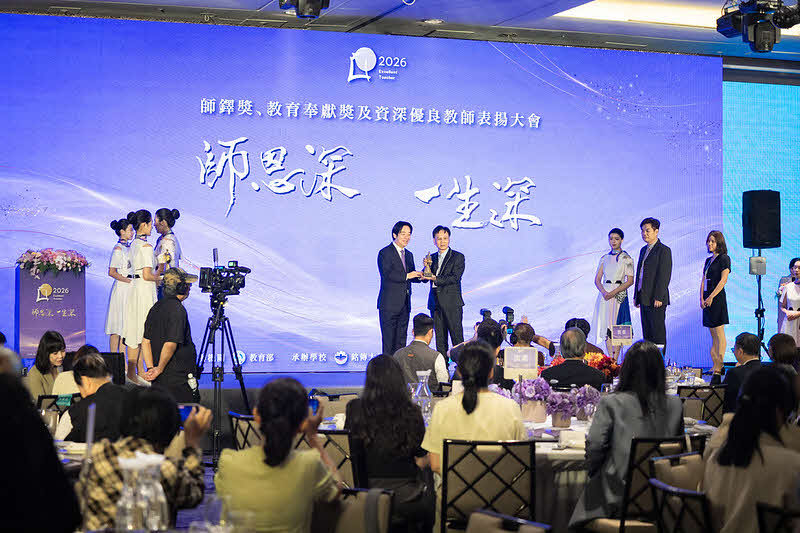
As Teacher’s Day approaches, President of the Republic of China, Lai Ching-te, attended the “115th Teachers’ Day Awards, Education Dedication Awards, and Senior Outstanding Teachers Commendation Ceremony” today to express gratitude to teachers for their long-term contributions to nurturing talents for the country. He stated that the government will continue to improve the teaching environment, implement educational equity, alleviate students’ learning burdens, promote AI education, enhance teachers’ digital teaching professionalism, and assist each child in developing their talents according to their abilities and pursuing their dreams.
In his speech this morning, President Lai Ching-te expressed his honor to attend the ceremony, extending Teacher’s Day greetings to all hardworking teachers nationwide, thanking them for their dedication to nurturing talents for the country. He congratulated the recipients of the Teachers’ Day Awards, Education Dedication Awards, and Senior Outstanding Teachers Commendation, acknowledging their professionalism, compassion, and selfless dedication that have contributed to shaping touching stories in Taiwan’s education.
President Lai Ching-te further remarked that the most commendable aspect is the unwavering commitment and enthusiasm of the award-winning teachers towards the education profession despite changing times and environments. In addition to imparting knowledge, teachers serve as guides in students’ life directions, always illuminating hope in pivotal moments for their students.
He noted that there are still many challenges in the current frontline teaching environment, such as teacher shortages, communication between teachers and parents, student disciplinary methods, and administrative burdens. In response to these challenges, the government will provide teachers with the utmost support, collaborate with teachers and parents, and strive together to create a favorable teaching environment in this era of diverse values. This approach aims to meet parental expectations, enable students to learn according to their aptitudes, and fulfill teachers’ dreams of nurturing talents.
President Lai Ching-te highlighted that during his academic years, he often witnessed classmates discontinuing their studies due to family circumstances and working in factories. Therefore, since taking office as president, he has actively promoted free tuition for all public and private high schools and vocational schools, along with providing an annual subsidy of 35,000 NT dollars for students at private colleges. Additional subsidies of 20,000 NT dollars for low-income households and 15,000 NT dollars for middle to low-income households are also available, narrowing the gap in tuition fees between public and private higher education institutions to ensure equal education opportunities for every student.
Furthermore, President Lai Ching-te emphasized that apart from tuition subsidies, the government encourages student accommodations and offers a subsidy of 5,000 NT dollars per student per semester, with an additional 2,000 NT dollars for low-income households. The Ministry of Education has allocated budgets to assist schools in renovating old buildings, providing a rental subsidy for students living off-campus, and TPASS commuter benefits for students residing with their families. Moreover, the government aids students with educational loans during their higher education studies by waiving interest during the academic period, commencing principal repayment two years after graduation, and further reducing interest rates to alleviate students’ repayment burdens.
He mentioned that starting next year, the government will implement the “Aid for Growth Allowance from 0 to 18 Years Old,” providing a monthly subsidy of 5,000 NT dollars per person. From 0 to 6 years old, families will receive the full subsidy, while from 6 to 18 years old, parents will receive 2,500 NT dollars, and the remaining 2,500 NT dollars will be deposited by the government, accumulating to a total of 360,000 NT dollars over 12 years, ensuring a fixed deposit interest rate for at least two years. President Lai Ching-te expressed his hope that in Taiwan’s progressing economy, regardless of the family background, the government has a duty to ensure that every child with the desire for education has access to it. Through education, individuals gain professional knowledge, and the nation cultivates talents, leading to a prosperous society with abundant and skilled human resources.
President Lai Ching-te stressed his strong commitment to education since taking office, hoping to cooperate with teachers to empower children to chase their dreams through education and assist every child in developing their talents according to their abilities and pursuing their aspirations. The government is determined to implement educational equity by promoting the “Aid for Growth Allowance from 0 to 18 Years Old,” aiming to provide financial support to ensure that children at the age of 18 possess sufficient funds to continue their studies or acquire skills without financial constraints, allowing them to fully unleash their potential.
“In the era of artificial intelligence we are entering,” he pointed out, “teachers will bear more responsibilities and inevitably face more challenges and difficulties.” The Ministry of Education has launched the “AI Talent Ark Plan,” committing 11.755 billion NT dollars from this year to 2029 to establish AI learning environments in primary and secondary schools and support teachers in enhancing digital and AI teaching professionalism, equipping children with the capabilities to confront future challenges.
President Lai Ching-te emphasized that while technology can optimize teaching methods and assist in precise data analysis, the most significant power in education still originates from teachers’ understanding, trust, and companionship towards students. AI can assist teachers, but it can never replace them; technology can provide answers, but only teachers can offer students profound care, evoke critical thinking, and guide them towards the future.
He affirmed that Taiwan is currently at a new era turning point, facing challenges from artificial intelligence, global competition, and rapid societal changes, making education more essential than ever and exceptional teachers more crucial. Each teacher honored today deeply reflects that education is not merely about imparting knowledge but a marvelous process where lives influence lives.
President Lai Ching-te reiterated that the government will continuously support teachers’ professional growth, improve the teaching environment, reduce unnecessary administrative burdens, and establish more friendly and secure campus environments through policy measures. Only when teachers are respected and supported can children receive better education. Subsequently, President Lai Ching-te personally presented the Teachers’ Day Awards to the recipients, with the presence of Prime Minister Cho Rong-tae, Education Minister Cheng Ying-yao, and other attendees at the event.