
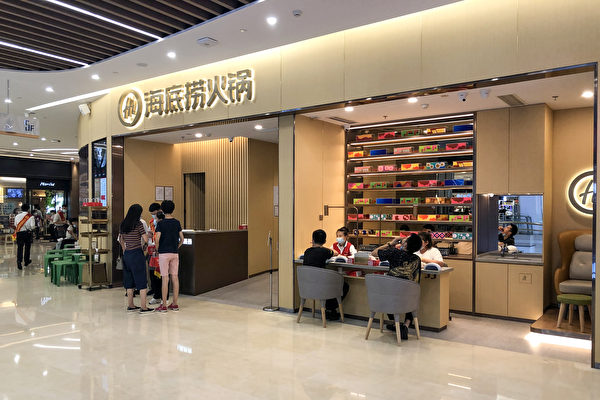
On the morning of September 9th, mainland China’s chain restaurant company HaiDiLao saw its Hong Kong stocks plummet after the opening bell, reaching a low of 10 Hong Kong dollars during the day, a 12.13% drop from the previous day’s closing price of 11.38 Hong Kong dollars, marking a new low since August 2024.
By the midday break, HaiDiLao’s stock price had rebounded to around 10.30 Hong Kong dollars, narrowing the drop to 9.49%, with a trading volume of approximately 3.339 billion Hong Kong dollars.
The direct trigger for this price movement was an unusually large block trade of shares. Data showed that several large transactions occurred before the market opened, involving around 259 million shares at a price of 10.62 Hong Kong dollars per share, totaling approximately 2.75 billion Hong Kong dollars in transactions.
This price represented a discount of about 6.68% from HaiDiLao’s closing price of 11.38 Hong Kong dollars on September 8th. Based on HaiDiLao’s total outstanding shares of about 5.574 billion, these 259 million shares accounted for approximately 4.65% of the company’s total shares.
According to trading documents, HaiDiLao shareholder SP NP raised around 2.75 billion Hong Kong dollars by selling 259 million shares, with UBS acting as the sole bookrunner for the transaction.
Just the day before the block trade, Bloomberg reported that HaiDiLao’s founder, chairman, and CEO Zhang Yong’s wife, Shu Ping, planned to sell 259 million shares of HaiDiLao through UBS at a price range of 10.60 to 10.70 Hong Kong dollars per share.
The actual selling price before the opening on September 9th was 10.62 Hong Kong dollars per share, closely aligning with the previously disclosed pricing range. Consequently, the market broadly associated this block trade with Shu Ping’s share sale.
However, as of now, HaiDiLao has not made a separate confirmation regarding the final seller’s identity for this block trade.
The scale of this share sale is significant. Based on the relevant share quantity, the 259 million shares represent approximately 4.6% of HaiDiLao’s issued shares, accounting for around 12% of the outstanding shares. Prior to this, Zhang Yong and Shu Ping collectively held about 9.3% of HaiDiLao’s shares.
The attention drawn by this share sale also stems from another important factor. In May of this year, Zhang Yong had just purchased around 11.35 million shares of HaiDiLao at a price of 13.39 Hong Kong dollars per share.
Just a few months later, his wife’s substantial share sale came as a surprise to the market.
Morgan Stanley stated in a research report that a major shareholder selling shares could temporarily pressure market sentiment until investors regain confidence in the company’s earnings outlook and confirm that there will be no further asset divestitures.
Currently, Morgan Stanley maintains an “overweight” rating on HaiDiLao with a target price of 16.5 Hong Kong dollars.
It is noteworthy that at a time when the major shareholder is selling a significant number of shares, HaiDiLao’s recently announced 2026 interim performance did not show impressive results.
On August 25th, HaiDiLao disclosed its 2026 interim performance. In the first half of the year, the company achieved operating income of 22.337 billion yuan, a year-on-year increase of 7.9%. The net profit attributable to shareholders was 1.767 billion yuan, a slight increase of only about 0.5%, with core operating profit at 2.513 billion yuan, up by 4.4% year-on-year.
This indicates that while HaiDiLao’s revenue continues to grow, its net profit has seen little to no increase. From a business structure perspective, the company’s growth is increasingly reliant on new businesses outside of its traditional hotpot dining.
In the first half of the year, HaiDiLao’s takeaway business revenue reached 2.051 billion yuan, a growth of 121.2% year-on-year, accounting for 9.2% of the group’s revenue compared to 4.5% in the same period last year, becoming the fastest-growing business segment.
The revenue from other restaurant operations reached 1.271 billion yuan, up by 113.1% year-on-year, accounting for 5.7% of the group’s revenue.
Non-hotpot restaurant operations, including sales of seasonings and ingredients, franchise business, among others, now contribute more than 20% to the group’s revenue.
In comparison, the traditional HaiDiLao restaurant business is facing certain pressures. In the first half of the year, revenue from HaiDiLao restaurants was 17.837 billion yuan, a 4% decrease year-on-year, with the company attributing this mainly to a reduction in the number of self-operated HaiDiLao restaurants.
From an operational efficiency perspective, the average table turnover rate at self-operated HaiDiLao restaurants increased from 3.8 times/day to 3.9 times/day year-on-year; however, the average customer expenditure decreased from 97.9 yuan to 97 yuan.