
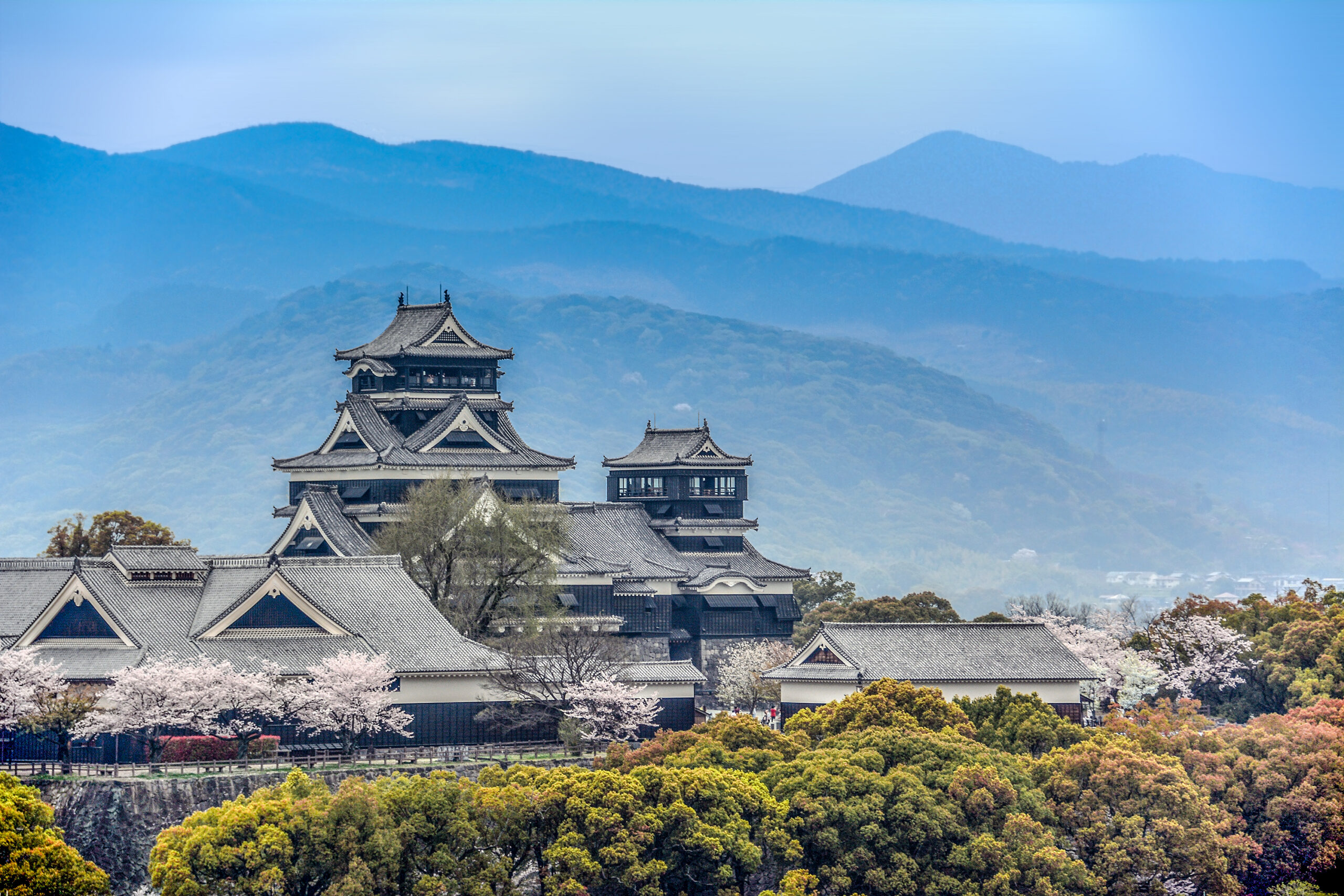
Located on the island of Kyushu in southwestern Japan, Kumamoto Prefecture was struck by a magnitude 7.1 earthquake on July 28, resulting in dozens of deaths. The road to recovery from this powerful earthquake is challenging, with a long and difficult journey ahead. In light of this, the renowned landmark Kumamoto Castle in the area has been illuminated throughout the night, aiming to bring hope to the earthquake victims.
During dark times of major natural disasters, any symbol of hope holds significant importance. The day after the earthquake, Mayor Kazufumi Onishi of Kumamoto City shared a hopeful symbol on social media.
Onishi wrote on Platform X: “Tonight, Kumamoto Castle will be lit up throughout the night. Though we are still facing severe challenges, let us raise our heads to the symbol of Kumamoto, the main tower of the castle, and gather our spirits to continue striving together for a better tomorrow.”
In the photo shared by Onishi, the illuminated main tower of Kumamoto Castle, known as the main keep, is seen. Scaffolding surrounds the castle in the picture, as this historic castle suffered severe damage in a strong earthquake ten years ago.
After five years of restoration work, the main keep was restored and reopened to visitors, while restoration work on other parts of the castle continues to this day.
The official website of Kumamoto Castle describes the main keep with its distinctive curved decorations known as “kara-hafu” on the top layer’s projecting windows and elegant curved “chidori-hafu” decorations on the lower level. It housed weapons during the Edo period and featured traps at strategic locations to prevent enemy invasions.
The official website of the Japan National Tourism Organization points out that Kumamoto Castle was designed to be easily defended and difficult to attack, with its construction specifically focused on repelling enemy assaults. The castle construction began in 1467 by the Ideta family and underwent several changes of ownership until the Hosokawa family took over in 1632, completing the castle within less than 30 years.
The rule of the Hosokawa family spanned over 200 years and 11 generations. With the abolition of the feudal system in Japan in 1871, the management of Kumamoto Castle was transferred to the Japanese government and has remained unchanged since.
Throughout its long history, the castle has undergone multiple renovations and repairs, with each era’s rulers leaving their marks, including figures like Kato Kiyomasa, Hosokawa Tadaoki, Miyamoto Musashi, and Tani Tatewaki.
In 1877, the castle suffered severe damage during the Satsuma Rebellion. Reconstruction efforts began in 1960, and there is currently a massive project underway to repair the destruction caused by the 2016 Kumamoto earthquake.
During the earthquake in 2016, the castle was one of the severely damaged public buildings. Nearly a third of the castle walls sustained damage, with 10% of the walls completely collapsing, and huge stones rolling onto surrounding roads and lush lakeside grass.
The restoration work is expected to take 20 years to complete. Each giant stone of the castle walls needs to be meticulously restored in the correct order to adhere to traditional construction methods for a full restoration to its original state.
Prior to this, only a small area of the castle was open to the public, including the restored main keep. The full reopening of the castle to the public will require several more years. Nonetheless, it continues to attract many visitors eager to explore.
The castle stands as a symbol of Kumamoto City, prompting various fundraising events to support its restoration and return to normal operations. Numerous activities related to the castle are ongoing, such as the Autumn Kumamoto Castle Festival and Spring Festival, along with popular events like taiko drum performances (held in the rear area of the castle).
If you plan to visit Kumamoto Castle, transportation is convenient as the castle is located in the central area of Kumamoto City. Depending on your location, you can choose to walk or take a tram to reach the castle. Walking from Kumamoto Station will take approximately 30 to 45 minutes, allowing you to enjoy the scenic views along the way.