
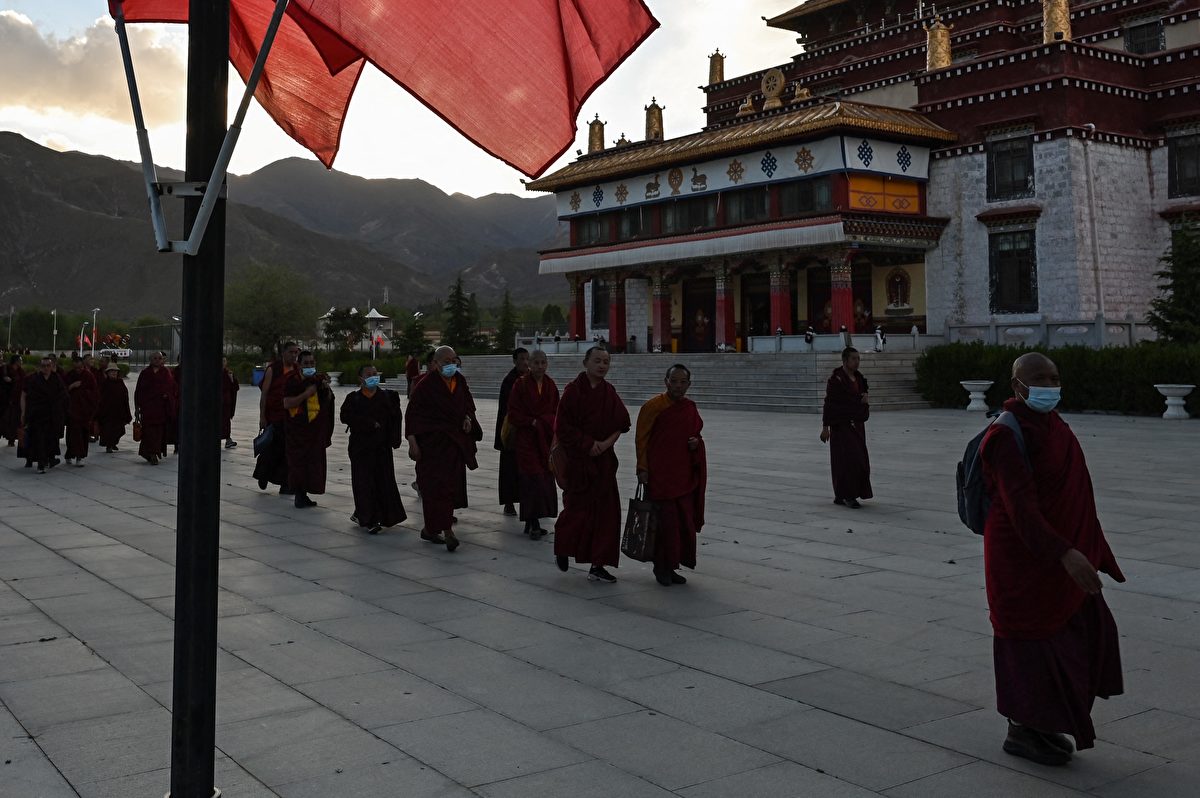
【Epoch Times, July 23, 2026】Chinese Communist Party (CCP) Politburo Standing Committee member and chairman of the National Committee of the Chinese People’s Political Consultative Conference, Wang Huning, conducted a four-day inspection tour in Tibet, emphasizing the need for local stability. He made a rare visit to the disputed border region of Ali between China and India to inspect the area. Analysts believe that Wang’s visit is related to the backlash among Tibetans following the introduction of the new “Law on Ethnic Unity and Progress” (referred to as the “Ethnic Unity Law”), indicating his intent to suppress and strengthen control over Tibetans in border areas.
From July 19 to 22, Wang visited Tibet, where he not only went to Lhasa but also made a rare direct inspection of Ali in the disputed border region between China and India, visiting a village located only 600 meters away from Indian military posts.
Wang Huning urged local authorities to “consolidate the political and social stability” and fully implement the “Ethnic Unity Law” to promote the so-called “sinicization of religions,” claiming to “continuously guide Tibetan Buddhism to adapt to socialist society.”
Wang’s visit to Tibet comes just a few weeks after the implementation of the CCP’s “Ethnic Unity Law” on July 1. This law has been criticized by the United States, the European Union, and several human rights organizations. The provision allowing extraterritorial application of the law grants the CCP the power to hold accountable individuals and organizations overseas who are deemed to “undermine ethnic unity,” leading to international condemnation and outcry.
On the day after the law took effect, a Tibetan man living in the United States self-immolated outside the United Nations headquarters in New York. Activists revealed his identity and stated that his action was a protest against the CCP’s implementation of the “Ethnic Unity Law” and to express the demand for Tibetan independence.
The CCP established the Tibet Autonomous Region in 1965, claiming to grant greater autonomy in policy affairs, including religious freedom, to ethnic minorities such as Tibetans. However, international human rights organizations and exiled Tibetans frequently accuse the CCP of implementing “oppressive” rule in Tibet.
Wang Huning has long served as a key figure in advancing the CCP’s leadership theories, spanning the reigns of three generations of leaders – Jiang, Hu, and Xi, earning him the title of the CCP’s “Three-Session Grand Master.” Currently overseeing the CPPCC system, including ethnic and religious affairs, Wang emphasized social stability and “ethnic unity” during his inspection in Xinjiang in June.
Shen Mingshi, a researcher at the Taiwan Institute of National Defense and Security Studies, told Epoch Times that Wang’s trip to Tibet aims to strengthen united front work. For example, the future recognition of Panchen Lama is a critical issue. Furthermore, in response to Tibetans resorting to self-immolation protests due to the international backlash against the “Ethnic Unity Law,” Wang’s visit also serves to placate and suppress any dissenting actions.
Long-time political commentator Tang Jingyuan based in the United States, shared with Epoch Times that the self-immolation of Tibetans outside the United Nations headquarters triggered significant international repercussions, directly targeting the CCP’s “Ethnic Unity Law.” Wang Huning’s visit to Tibet is intended to maintain stability, suppress dissent, and oversee control.
Tang noted that due to the CCP’s persecutory rule of ethnic minorities, the international community led by the United States has continued to pressure the CCP, such as the widespread coverage of the concentration camps in Xinjiang by international media. Many countries halting economic ties with Xinjiang have indeed played a role in curbing the CCP’s nefarious activities. Democratic nations can also target the CCP’s extraterritorial suppression through targeted legislative measures, responding to the “Ethnic Unity Law.”
Regarding Wang Huning’s visit to the disputed border region of Ali between China and India, Tang believes that it is primarily aimed at advancing the “Ethnic Unity Law.”
He analyzed that in the Sino-Indian border area, Tibetan Buddhism is freely spread on the Indian side, while the CCP promotes the so-called “sinicization of religions” on its side. In the minds of many local believers, Tibetan Buddhism in India is considered authentic, while the religion in China has been distorted by the CCP, and Tibetans do not identify with it. Therefore, Wang Huning’s visit there is more focused on ideological affirmation, demanding local authorities strengthen control over Tibetans in border regions.