
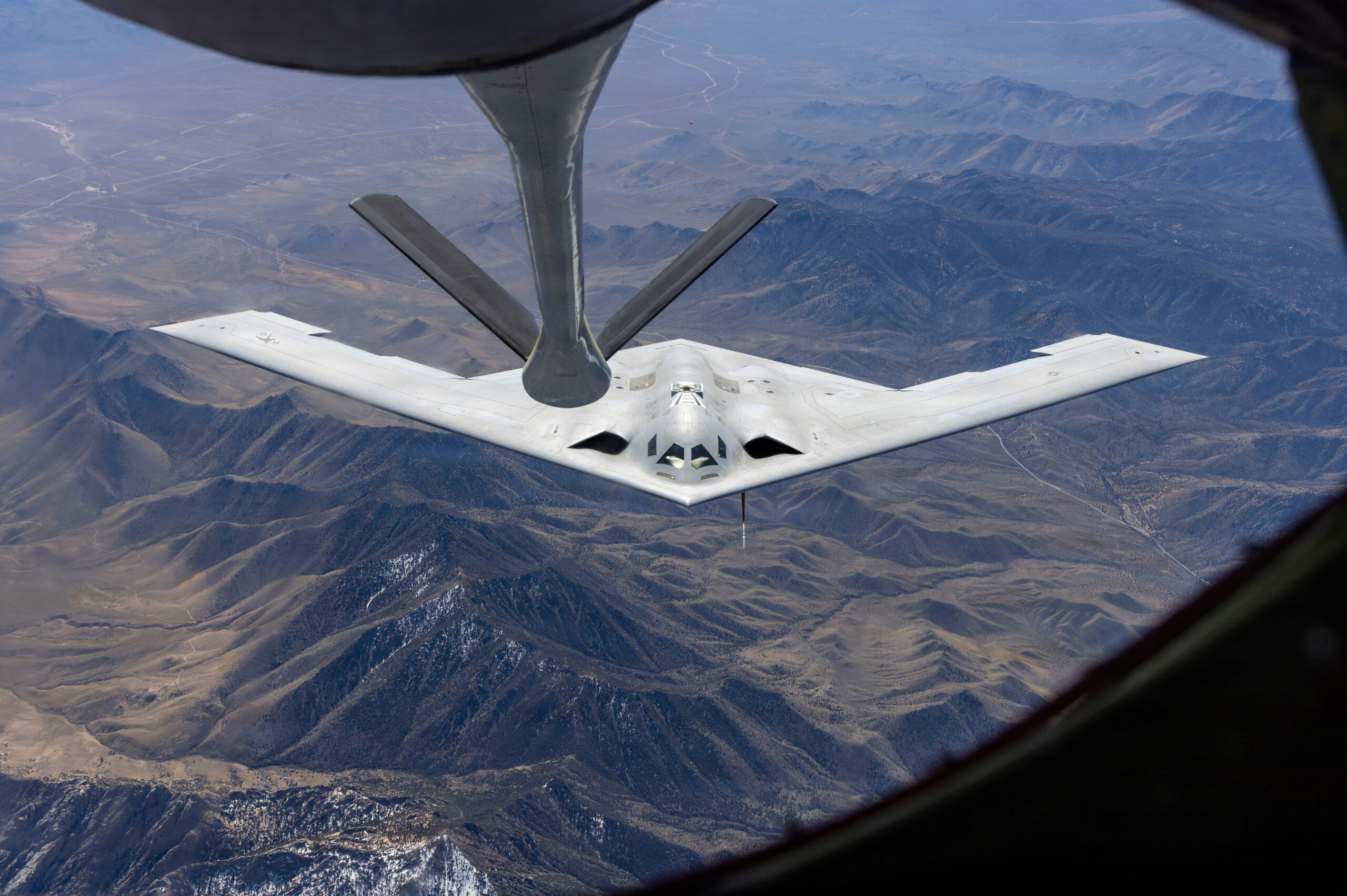
Recently, two of the latest B-21 Raiders, the newest stealth bombers of the US military, were flying over the Mojave Desert, almost completely unnoticed. The B-21 bomber is the most expensive and secretive aerospace project since the B-2 Spirit, and it has quietly entered a stable phase of flight testing, gearing up for action, with two more aircraft planned for delivery this year.
The B-21 first flew in November 2023 and is currently in an intensive phase of flight testing; Ellsworth Air Force Base in South Dakota has been selected as its first operational base. The aircraft aims to replace the B-1 Lancer and the iconic B-2 Spirit bombers; the Air Force plans to acquire at least 100 units, making the B-21 a cornerstone of the bomber fleet for the next half-century.
Northrop Grumman is manufacturing these test aircraft according to the final production standards. This was a carefully considered choice. Unlike most prototype projects, where test aircraft are often one-off handcrafted models that require extensive modifications before approaching the final product, the B-21 test aircraft is essentially identical to the aircraft that will carry nuclear weapons and execute missions in enemy territory. The data and experience gathered during testing can be directly applied to the operational fleet.
The progress of the B-21 project has been smooth and within budget. These two circumstances rarely coincide in the defense procurement field. Against the backdrop of the F-35 project becoming synonymous with cost overruns and the B-2 bomber’s soaring prices leading to a reduction in procurement numbers from 132 to 21, the rigorous control displayed by the B-21 project itself is newsworthy.
The B-21 Raider represents the largest investment by the United States in offensive air power since the Cold War. The orderly progress of the test program indicates that this investment is beginning to pay off. There is no hype, no negative scandals, just a stealth bomber flying over the desert, poised and ready to shift the balance of power.
In contrast, China’s development of the H-20 stealth bomber has yet to unveil a prototype. US Air Force leaders believe that compared to the global strike capability of the US military, the Chinese Air Force only possesses regional strike capabilities.
The Raider has been a black hole of information since its inception. Northrop Grumman and the US Air Force have released very limited information about the bomber’s capabilities. From the images released, the B-21’s flying wing aerodynamic layout is clearly inspired by the iconic shape of the B-2, but with more streamlined and refined contours. The design of the intake and trailing edges of the B-21 is distinctive and unique.
Key parameters that could reveal the exact stealth performance of the aircraft remain highly classified.
The US Air Force has confirmed that the B-21 is designed to penetrate the world’s most advanced integrated air defense systems and will carry both conventional and nuclear weapons.
The B-21 can be piloted or unmanned, a design feature that is unprecedented in the bomber field.
The recent statement from the US Air Force Global Strike Command confirmed that the B-21’s cockpit will be equipped with two pilots. This crew configuration resolves months of debate about whether the bomber would be piloted by a single pilot with a weapon systems officer or include some more autonomy in its operation.
This decision is significant because the B-21 was designed with autonomous flight capabilities in mind, and it is expected to be able to perform unmanned missions in the future. However, with a piloted configuration, the Air Force determined that flying a nuclear-capable bomber deep into enemy-controlled airspace would require a workload shared by two personnel.
Additionally, the B-21 utilizes an open system architecture that supports rapid software and hardware upgrades, avoiding the expensive structural redesign issues that plagued early stealth platforms.
This open architecture may be the most significant feature of the aircraft in the long run, meaning that the B-21 delivered in 2027 could have vastly different operational capabilities from a B-21 flying in 2057, with upgrades in sensors, weapon systems, and electronic warfare suites achievable without the need for a complete airframe redesign.
The US Air Force has faced challenges with the B-2 bomber, where each new capability added resulted in costly modifications.
The birth of the B-21 is a response to China’s actions. Specifically, China has been constructing an integrated air defense network consisting of advanced systems like the HQ-9 missiles, long-range radars, and fighter jets, making the Pacific region increasingly perilous for American bombers.
While the B-1B Lancer carries an impressive payload, surviving in such an environment poses risks; even the groundbreaking B-2 Spirit, which was revolutionary when introduced in 1989, faces growing challenges from modern detection systems.
The Raider is designed to reach areas that other aircraft cannot access. It is capable of penetrating heavily defended areas, carrying precision-guided weapons or nuclear gravity bombs in its bomb bay. Its stealth capabilities go beyond reducing radar cross-section, involving a comprehensive control approach targeting various signals such as radar, infrared, visible light, and electromagnetic spectra. The goal is to create a fighter jet that can achieve operational stealthiness even in front of the most advanced air defense systems by 2040.
Northrop Grumman will produce the B-21 bombers at its Plant 42 facility in Palmdale, California, utilizing digital optimization and supplier partnerships to avoid facility expansion. A $2.5 billion upgrade program scheduled from 2027 to 2029 will enhance production automation levels. The current production target is set at 100 aircraft, but if demand increases, that number could rise to 185 or 200.
The US Air Force is evaluating whether to increase procurement of B-21 bombers, with top military officials and members of Congress pushing for an expanded fleet. Defense Secretary Hegseth and Admiral Correll both support growing the fleet, which may require the establishment of a second production line.
On the other hand, the PLAAF announced the H-20 project in 2016. Since then, the H-20 has been one of the most speculated-about weapons projects, yet it has not been officially unveiled.
Chinese state media hinted in 2018 that the H-20 would be a highlight of the PLAAF’s 70th anniversary parade in 2019, but it failed to materialize.
There were rumors that the aircraft might conduct its maiden flight in 2022, but that also did not happen. As of 2026, an official prototype has not been publicly disclosed.
A US defense official told Breaking Defense that he believes China’s H-20 bomber cannot be compared to American-made bombers. “In terms of the H-20, if you look at its system design, its performance is probably far below that of America’s low observable (LO) platforms, especially those more advanced models we are developing,” the official said.
“They face many challenges in engineering design, especially in achieving a level of capability comparable to the B-2 or B-21 bombers,” he added.
The focus of the H-20’s development is to enhance China’s power projection capabilities and maintain its interests in the Asia-Pacific region.
In comparison, the American B-21 Raider is designed for global power projection, aiming to ensure that the US maintains strategic deterrence and can counter threats from anywhere in the world.
General Davis, commander of the US Air Force Global Strike Command, told The War Zone that China is actively advancing the H-20 bomber project, but it is currently a “regional bomber force.”
Davis said, “I understand their desire to have a long-range strike capability like ours and I know they are working hard on it.”
“But I can tell you they are not there yet,” Davis continued, “I think when our adversaries look at our long-range strike capability… they want to emulate it, but they can’t.”
China has faced difficulties in developing the stealth technology required for a flying wing layout like those in Western designs. Previously, China relied on Russian designs, but those projects did not achieve significant results.
China also has a robust network of cyber espionage, illicitly stealing about $400-600 billion worth of American intellectual property every year.
Analysts point out that engineering hurdles and thermal management issues may be the main sticking points. It has been proven that achieving true low observability (stealth) within intercontinental range is far more challenging than China anticipated.
Compared to Western designs, China’s turbofans operate at higher temperatures and lower efficiency, which could make the aircraft detectable by infrared sensors.