
Despite the continuous development of military technology, beyond visual range missiles and stealth coating technology may make close-range dogfights between fighter jets a thing of the past. However, once combat distances shrink to visual range, weapons with high off-boresight attack capabilities can still determine the outcome.
Currently, six fighter jets in production or active service are designed partially or entirely around winning in close-range dogfights. The key lies in which design philosophy can truly stand the test when combat distances close and battles shift from a contest between “missile launch platforms” to a true fighter showdown.
Listed below are six fighter jets that hold overwhelming advantages in close-range dogfights, as compiled by the website “Simple Flight.”
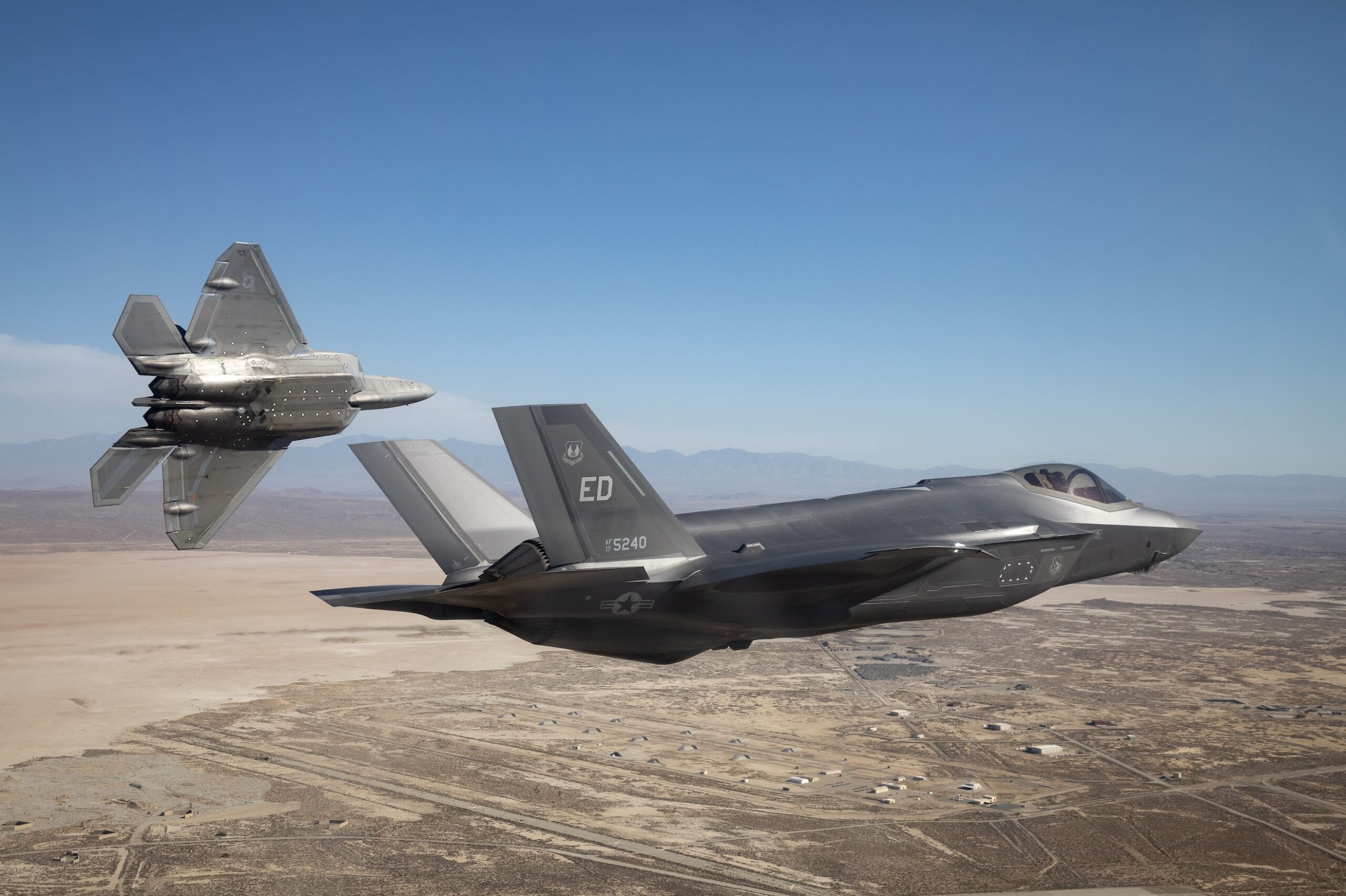
The “Raptor,” developed by Lockheed Martin towards the end of the Cold War, was designed to establish absolute air dominance against Soviet aircraft. This fighter jet’s foundation for achieving superiority within visual range lies in the two Pratt & Whitney F119 engines. These engines not only produce over 70,000 pounds (31,751 kilograms) of tremendous thrust but also come equipped with two-dimensional thrust vectoring nozzles. This combination gives the F-22, created by the Skunk Works, a thrust-to-weight ratio of over 1:1, enabling it to execute post-stall maneuvers based solely on the powerful engine dynamics.
As the world’s first stealth fighter aircraft, the F-22 utilizes radar-absorbing materials and possesses the smallest known radar cross-section of all current fighters. Despite the “Raptor’s” weapon configuration being designed primarily for beyond visual range combat, its super-maneuverability also makes it one of the deadliest dogfighting aircraft globally; thanks to its stealth capabilities, the F-22 often remains undetected by enemies before entering gun range.
Reportedly, F-22 pilots believe the true value of thrust vectoring technology lies in maintaining flight control capability at high angles of attack, serving as more than just a winning strategy in close-range combat. The combination of stealth performance, sustained energy retention capabilities, and high angle of attack control makes the F-22 seemingly invincible in close-range engagements.
The “Typhoon” fighter jet was initially designed as a dedicated energy-maneuverable fighter aircraft. It combines a canard delta-wing layout with twin Eurojet EJ200 engines, resulting in a high thrust-to-weight ratio (TWR) superior to most of its counterparts in climbing rate and acceleration performance. While it is a rapid-climbing interceptor, its design characteristics also exhibit significant advantages in subsonic maneuverability.
In the context of NATO’s “4.5th generation” fighter comparison, the “Typhoon’s” instantaneous turn rate and energy retention during vertical maneuvers stand out, surpassing those of similar F-16 and F/A-18 aircraft. In combat exercises like “Alaska Red Flag,” when forced into close-range dogfights (within visual range air combat), the “Typhoon” has proven fully capable of achieving results comparable to the F-22, essentially realizing a “one for one” scenario where both sides lose one aircraft each in an aerial engagement.
After participating in a dogfight exercise involving the “Typhoon” fighter, an American F-22 pilot praised its maneuverability and control under high G-forces, stating, “The ‘Typhoon’s’ agility and ease of control are truly impressive. The aircraft was designed for agility and ease of control. Especially in the version we test-flew, the avionics system, color dynamic map display, and other configurations are top-notch. Its maneuverability in close-range dogfights also left a deep impression.”
The F-22 excels in “one-circle fights,” where pilots utilize thrust vectoring technology to rapidly rotate the aircraft’s nose for precision shooting at extreme angles. However, if the F-22 misses its initial shooting opportunity, it can quickly lose speed. The “Typhoon” fighter can leverage its excellent energy retention capability to climb out of trouble when speed decreases, and use its agility in spirals to outmaneuver the “Raptor.”
Dassault designed the “Rafale” fighter jet to meet a wide range of mission requirements, encompassing air-to-air combat, nuclear strike, and carrier-based aviation tasks. The resulting canard delta-wing layout has become the backbone of the French Air and Navy forces, with the manufacturer claiming the aircraft maintains excellent agility even in high angle of attack scenarios.
In close-range dogfights, the canard wings of the “Rafale” play a dual role. In high-angle-of-attack conditions, the vortices generated by the canards inject energy into the airflow over the wing surface, enhancing lift at critical moments and boosting nose-pointing capabilities. This performance is particularly notable during the “merge” phase of within-visual-range dogfights, where the “Rafale’s” rapid nose-pointing and high angle of attack control, combined with helmet-mounted cueing systems guiding infrared-guided missiles, allow it to combat almost any adversary during spirals.
The “Rafale” is optimized for multi-role missions in the medium to low-altitude spectrum. With its forward positioned canard wings tightly integrated with the main wings, the fighter gains outstanding lift performance and more compact instantaneous turn rates in low-speed, low-altitude environments.
Boeing’s F-15EX inherits the aerodynamic layout essence of a formidable lineage, with an impressive record of 104 aerial victories and zero losses in combat.
The “Eagle II” was rebuilt on the basis of retaining the original “energy maneuverability” design principles with minimal modifications. It boasts a heavily optimized but still large wing area and twin-engine thrust-to-weight ratio (TWR), which gave the first-generation “Eagle” dominance in air superiority back in the 1970s.
An added highlight is the introduction of the Digital Fly-By-Wire control system (a first for the F-15 series). According to Boeing engineers, this system reduces turn radius, lowers control stick forces, and enables pilots to sustain aggressive high-g maneuvers without fatigue. When paired with the Joint Helmet-Mounted Cueing System (JHMCS) for off-boresight shooting capability, the F-15EX possesses unprecedented close-range aerial combat lethality.
The F-15EX can carry up to 29,500 pounds (13,381 kilograms) of ordnance and features 25 hardpoints, allowing it to carry as many as 12 AMRAAM (Advanced Medium-Range Air-to-Air Missiles) or a total of 22 air-to-air missiles in a “missile truck” configuration, a payload capacity unmatched by any stealth fighter. This remarkable air-to-air weapon-carrying capacity makes it one of the most lethal beyond-visual-range combat aircraft globally.
A leaked January 2015 test report authored by an F-35 pilot, who also has extensive dogfight experience with F-16 and F-15 aircraft, indicated that the F-35’s energy maneuverability performance was “significantly inferior” to traditional platforms.
The Pentagon’s Joint Program Office (JPO) did not directly refute the claim that the F-35’s energy maneuverability was inferior to the F-16 in pure turning performance but emphasized that the F-35’s sensor fusion and stealth were designed to prevent engagements from reaching close-range aerial combat.
Lockheed Martin positions its Distributed Aperture System (DAS) as a crucial advantage of the F-35. This system integrates the imagery from six infrared cameras into a 360-degree panoramic view displayed on the pilot’s helmet, enabling F-35 pilots to “see through” the aircraft and direct weapons towards targets in their line of sight, whether in traditional close-range aerial combat scenarios or not.
This sensor advantage does exist, with the F-35’s effectiveness largely built on leveraging sensor superiority to deny opponents the opportunity for ambushes in close-range aerial combat.
The “Gripen E” from Sweden’s Saab adopts a delta-canard aerodynamic layout, powered by a General Electric F414G engine with approximately 22,000 pounds (9,979 kilograms) of thrust. This provides the lightweight jet with a strong thrust-to-weight ratio, making it highly agile in high-speed engagements. Simultaneously, the fighter’s primary armament for close-range combat comes from the IRIS-T missile. This infrared-guided missile, equipped with thrust vectoring and control surfaces, retains attack capabilities even when the target is out of the pilot’s line of sight.
Henrik Höjer, responsible for Saab’s Gripen project at Saab Aeronautics, commented after the Swedish Air Force’s first flight test in 2020, stating, “The system that enables target indication through the helmet-mounted display gives Gripen pilots true ‘look-and-shoot’ capability, allowing them to launch missiles without first aligning the aircraft’s nose with the target.”
These fighter jets demonstrate the evolution and specialization in close-range aerial combat capabilities, each leveraging unique technology and design philosophies to gain an edge in dogfights.