
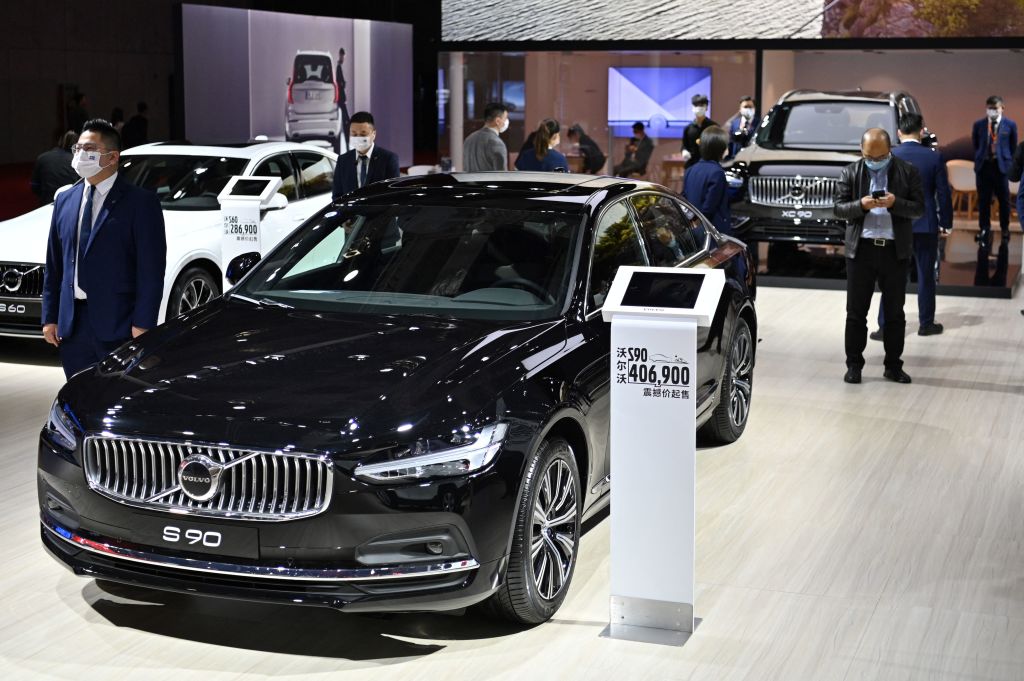
Multiple Volvo dealerships in mainland China have shown on September 19 that the price of the S90 has dropped to around 220,000 yuan after subsidies such as trade-in for old cars, nearly halving from the starting price of 406,900 yuan. Despite the significant price drop initially boosting sales, Volvo’s sales in China continue to decline.
According to a report by “Blue Whale News,” several Volvo dealerships are offering the S90 at a post-subsidy price of around 229,900 yuan. Some sales staff mentioned that after negotiation at the dealership, the actual transaction price could drop to around 220,000 yuan.
Following the substantial price reduction, sales of the S90 briefly increased. The model sold 388 units in July, which rose to 1,554 units in August, approximately four times the sales volume in July.
However, compared to previous years, the sales of the S90 remain low. Public sales data indicates that the average monthly sales of the S90 were around 3,500 units in 2023, decreased to about 2,500 units in 2024, and further dropped to approximately 1,500 units in 2025.
Behind the significant price drop of the S90 lies the sales and revenue pressure Volvo faces in the mainland Chinese market.
In 2025, Volvo’s sales in mainland China were around 149,000 units, a 4% decrease compared to the previous year. The operating income in the Chinese market dropped by 23%, a much larger decline than the sales volume.
During the first half of this year, Volvo’s sales in the Greater China region were approximately 53,200 units, marking a 27% decrease compared to the previous year. In the second quarter, sales were around 24,900 units, indicating a 35% decline, further widening the drop.
Volvo is not the only traditional luxury car brand significantly reducing prices. In the mainland Chinese market, the starting price of the Land Rover Range Rover Evoque L, which was originally 429,800 yuan, has dropped to around 180,000 yuan in some regions. The Jaguar XFL, starting at 439,900 yuan, is being offered at around 220,000 yuan in some stores. Discounts on BMW 5 Series, Audi A6L, and certain Mercedes-Benz models are also expanding.
According to market data released by the China Automobile Dealers Association in August, the retail sales of traditional gasoline-powered cars in mainland China were 540,000 units, a 40% decrease compared to the previous year; luxury brand car retail sales were around 150,000 units, a 26% decline.
In the first half of this year, Porsche’s deliveries in China decreased by nearly 32%, while BMW Group’s deliveries dropped by 20.4%, and the sales of Mercedes-Benz passenger cars and Audi decreased by approximately 28% and 19% respectively.
Claire Yuan, the China Automobile Enterprise Ratings Director at S&P Global Ratings, previously told the Associated Press that the slowdown in the Chinese economy is a significant factor in the weakening demand for high-end automobiles.
Paul Gong, an automotive analyst at UBS, mentioned that the prolonged downturn in the real estate market has diminished consumers’ willingness to purchase big-ticket items like cars. Even wealthier consumers are no longer as willing as before to flaunt their wealth through luxury cars.
Meanwhile, domestic Chinese car manufacturers are seizing the market utilizing electric vehicles, intelligent driving functions, and lower prices, putting further pressure on European and American luxury car brands that primarily produce gasoline-powered vehicles.
The China Automobile Dealers Association’s survey reveals that the comprehensive inventory coefficient for automobile dealers in China was 1.58 in August, a 20.6% increase from the previous year; based on the retail volume for the month, the total inventory at the end of the month was around 2.44 million units.
The inventory levels of thirteen mainstream brands exceeded two months. Volvo topped the list in terms of inventory depth, followed by Roewe, FAW Hongqi, Yueda Kia, and Cadillac, among others.
The survey also noted that price competition continues to intensify, with consumers expecting further price reductions and a prevailing attitude of holding out for better deals. The continuous price drops for new cars also affect the pricing of used cars. An August report on automobile retention rates in China revealed that the average estimated value of Volvo cars after three years is only equivalent to 35.1% of the original purchase price, with the retention rates of all eleven of the luxury brands surveyed showing a decrease.