
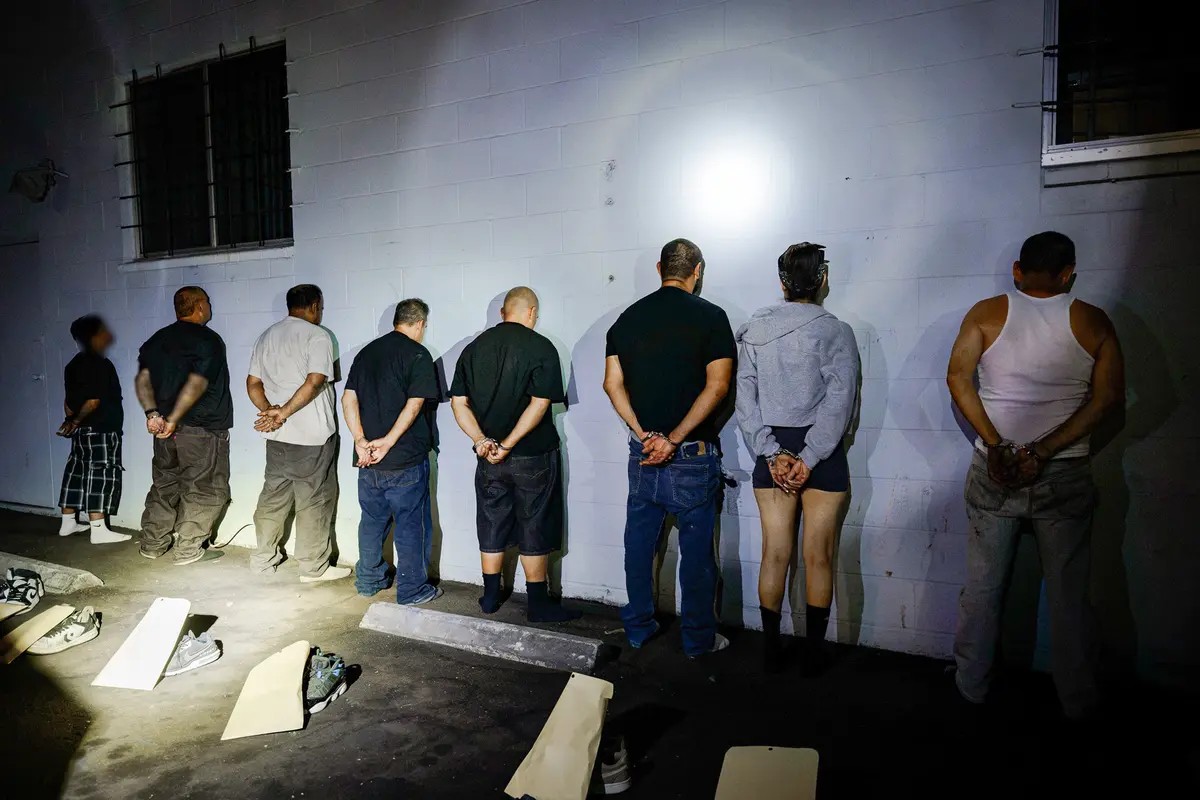
In Southern California, underground gambling dens operated by gangs have been popping up in large numbers within a short period of time, far surpassing the speed at which law enforcement agencies are able to crack down on them.
On a recent summer night in El Monte, California, a convoy of over a dozen patrol cars slowly made its way through residential streets towards a dark industrial area. Deputies suspected that gang members were running a “slap house” there — an underground casino featuring electronic table games imported from China, named after the unique sound made when players frantically press buttons on the tabletop.
A radio alert signaled the presence of “countersurveillance” activities as a motorcycle-riding casino lookout patrolled the streets. The operators of these “slap houses” had even installed surveillance cameras, with the footage transmitted to a large monitor in their dilapidated hideout.
However, when the suspects saw officers from the Los Angeles County Sheriff’s Department suddenly arriving, they had nowhere to escape to. Their hideout was surrounded on three sides by high walls and barbed wire. Upon breaking in, officers found a man calmly standing by the front door.
That night, with the assistance of federal agents, deputies detained seven suspects. While a minor development in the crackdown on underground gambling operations, law enforcement is gradually dismantling these elusive targets.
According to Captain Calvin Mah, head of the Major Crimes Division at the Los Angeles County Sheriff’s Department, almost every city in Los Angeles County is riddled with underground gambling dens, also known as “casitas” in Spanish.
“From the north to the east to the south, this problem exists everywhere,” Mah told The Epoch Times.
These “slap houses” are hidden within storefronts and residential homes, creating a thriving business for organized crime networks operating and profiting from these dens.
Most underground casinos go unnoticed until law enforcement gathers clues from other busts, social media posts, or neighbor complaints.
“It takes time to identify these underground casinos. Once discovered, we systematically work towards demolishing them. However, it takes quite a long time, and their numbers are just too many,” Mah explained.
Mah described “casitas” as safe havens for gangs, where members can engage in various illegal activities such as arms and drug trafficking, extortion, and prostitution in a relatively peaceful setting.
“These dens allow criminals to do drugs in a comfortable setting. They can freely engage in prostitution, sell drugs, and other illegal items such as stolen goods. For them, it’s almost like a convenient place for barter and trade,” he said.
The targeted building in El Monte was a small two-bedroom structure that appeared to have once been a ironworks. Inside, officers searched through all the couch cushions, dismantled walls looking for drugs, firearms, and more.
“Be careful not to touch the meth,” someone warned.
Posters of tattooed pin-up girls, a neon Marilyn Monroe “I Heart California” sign, and a horror movie character sitting in a convertible with a quote from the movie “Mean Girls” adorned the walls, creating an eerie setting inside the room.
Officers soon uncovered some bullets and a few bundles of cash. However, it was still early in the night as their work would continue into the next morning.
On three makeshift gambling tables, revelers left behind a meth straw in the ashtray and a large cup of ice-cold drink.
The DIY (Do It Yourself) versions of these digital tabletop games can cost up to $10,000 or more, featuring vibrant visuals and retro motion effects reminiscent of 1980s arcade games. In these DIY versions, the game console “brains” are connected to a TV display, encased in cheap wooden boards painted black, fitted with buttons and joysticks for multiple players to use.
Players can pay in cash or top up through apps, then compete against each other, shooting monsters that appear on the screen. According to the Sheriff’s Office, the house usually takes a 20% commission.
Investigators explained that these games are mainly imported from China and some are sold to legitimate merchants, but most end up in the black market funneled into gang-operated casinos.
Game distributors would deliver machines to vacant residential or commercial spaces, where casino operators would install video surveillance and soundproofing facilities, then hire cashiers and security staff to manage the gambling venues.
Many detectives and officers noted that these casinos have given rise to an unusual level of cooperation between rival gangs.
“Local gangs run these houses, paying rent in cash. You’ll find that to conduct business, previously rival gangs on the streets come together. They are here to make money,” said a detective involved in the operation. She pointed out that these houses could bring in tens of thousands of dollars in revenue each week.
“Asian gangs have their own cliques, running their own spots—people feel their equipment is superior,” she said. “The location we busted today was controlled by a Hispanic gang.”
San Gabriel Valley in eastern Los Angeles County is known to be a stronghold for Asian and Latinx gangs. According to a local government official who requested anonymity, Lancaster and other northern cities are hubs for underground casinos, often operated by Armenian gang members.
“We have not discovered any Asian gangs here. However, organized crime has its own modus operandi; all groups are using the same criminal tactics,” the official said.
While law enforcement agencies sometimes refrain from explicitly naming specific gangs to avoid exaggerating their street influence, it is well-known that the Mexican Mafia, a prison gang in California, controls and extorts slums in the state and beyond.
“It’s common knowledge that illegal underground casinos are a tool for the Mexican Mafia to raise funds,” said a detective involved in the El Monte raid.
“All illegal activities are controlled by the Mexican Mafia, so if they want to engage in illegal gambling activities, they must first get approval from gang members in the area, and then representatives will be sent over.”
Also known as “La Eme,” the organization uses illegal casinos to launder money, fund international drug trafficking, and enforce and expand control over their territories through acts of violence.
“The specifics always vary based on location and internal struggles within the organization. … It’s not uncommon for gang members to gather at these underground dens to settle gang disputes, and sometimes these incidents lead to attacks, even murder,” law enforcement authorities told The Epoch Times.
Non-gang members can also operate these houses with permission, paying mob protection money to local gangs monthly, which in turn pay tribute to the Mexican Mafia.
Hector Bravo, a retired lieutenant from the California Department of Corrections, recounted his numerous interactions with active members of the Mexican Mafia inside prisons. He said that gang “soldiers” and members on the streets typically receive kickbacks of around 30% of profits from “casitas” and other criminal activities.
“We can imagine them as the Italian Mafia. They’re doing the same things. Mexicans are copying the Italian script,” Bravo said, likening today’s “casitas” to the Al Capone era’s underground bars in Chicago during the Prohibition period of the 1920s and early 1930s.
He added that these high gang protection fees ultimately reach gang members in the form of a Green Dot Visa prepaid card, which prisoners can use within the prison.
“They are essentially laundering money. They clean it up and then use these prepaid cards to send their children to college, buy homes… I wouldn’t say they’re millionaires, but they are definitely making money in prison,” Bravo said, comparing these members to company CEOs, “they are the masterminds behind this organization, sitting at the top of the food chain.”
Founded in the 1950s by young Hispanic inmates within a California correctional facility, the Mexican Mafia, despite having only a few hundred members and being primarily managed by incarcerated individuals, has expanded its operations to at least 13 states.
Bravo explained that the Mexican Mafia’s premise is that there are always willing young people ready to do anything to join the gang, including attacking or killing their enemies and competitors within the gang.
“In reality, most will never truly be accepted into the gang. They are just pawns. Power is concentrated at the top, and they want to keep it that way,” he said.
In recent years, federal and local law enforcement agencies have conducted numerous major crackdown operations, including a raid in Lancaster in 2020 that seized over 200 illegal gambling machines, as well as several cross-county operations targeting underground casinos frequented by Mexican Mafia members and the street gangs funding them.
An operation earlier this year in Orange County called “Gangsta’s Paradise” revealed the key role that “slap houses” play in the vast criminal network of the Mexican Mafia.
In this operation, the Department of Justice made arrests in a major anti-racketeering case after years of investigation, nabbing dozens of members.
The indictment consisting of 66 charges accused over 40 members and associates of various serious crimes, including murder, kidnapping, extortion, fentanyl, and meth trafficking, primarily related to the operation of illegal casinos between 2024 and 2026.
The indictment detailed the Mexican Mafia’s methods: torture, prostitution, international drug trafficking, and assaults — including using hammers to attack those who failed in their tasks as a “warning.”
Such investigations require time, resources, due process, and a systematic approach to connecting each “casitas” with federal conspiracy charges.
Meanwhile, detectives are playing a game of whack-a-mole.
“This situation happens all the time,” said a detective from the Los Angeles County Sheriff’s Department. “We shut down their casinos, and they pop up elsewhere.”
She noted that this pattern has become increasingly popular in recent years because operators realize that criminal charges are often “wobblers” — hovering between misdemeanors and felonies, left to the discretion of prosecutors.
“The reason the Mexican Mafia is getting more involved in this business is that the penalties are not severe. In California, it’s difficult to be charged with a felony,” she said.
She added that even if someone is caught with a gun, charges could be dropped if convicted of a misdemeanor.
Sheriffs insist that this problem is as intertwined and complex as a hydra.
The cheap and easily replicable model of underground gambling dens, “casitas,” is often exploited by various opportunistic criminal activities.
In 2022, in nearby Orange County, a multi-department joint investigation dismantled an illegal gambling network operated by Asian gangs.
“These illicit businesses are breeding grounds for drug trafficking, violence, and even police corruption,” said former U.S. Prosecutor Tracy L. Wilkison at the time, calling these illegal dens a “blight on our community.”
As Inspector Mah surveyed the grimy casino in El Monte, he expressed similar sentiments.
“I feel this issue has a big impact on the community,” he said. “So many criminals gather in one place, gangs are at odds with each other, and there have been shooting incidents. That’s why we are doing everything we can to stop this situation.”
In response to inquiries about the surge of underground casinos in California and other states and the organized crime networks controlling these establishments, the Department of Justice declined to comment.
—
This translation has been provided for informational purposes only.