
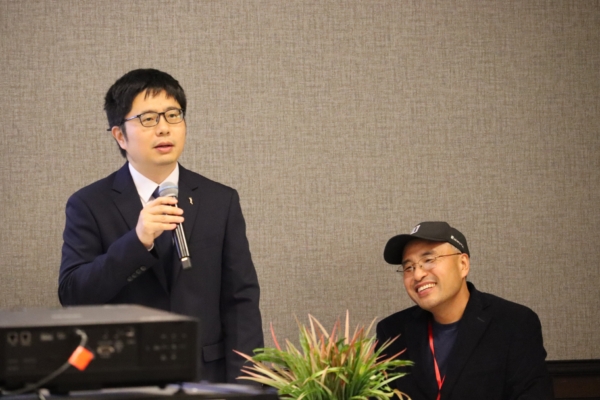
【Epoch Times August 4, 2026】Celebrating the 30th anniversary of Proposition 209, at the 4th annual meeting of the Californians for Equal Rights Foundation (CFER), a parent shared why he sued four prestigious American universities for discrimination in admissions. Despite his child’s SAT score of 1590 out of 1600, he was rejected by 16 universities. After failed communication attempts, the parent utilized artificial intelligence (AI) technology to reduce litigation costs.
Chinese parent Nan Zhong stated, “We have filed lawsuits against four institutions, including the University of California (five campuses), the University of Michigan, the University of Washington in Seattle, and Cornell University, as a last resort after unsuccessful communication with the universities.”
In June 2023, Zhong’s son, Stanley Zhong, graduated from Gunn High School in Santa Clara County, adjacent to Stanford University, with a weighted GPA of 4.42 and an SAT score of 1590. Additionally, he participated in global computer programming competitions, achieved top rankings, and founded a successful startup called RabbitSign.
Stanley applied to multiple universities but was rejected by 16 institutions across nine states. Among them were elite California schools such as UC Berkeley, UC San Diego, UCLA, UC Davis, UC Santa Barbara, and Stanford University. Out-of-state rejections included MIT and Cornell University.
During an interview, Stanley remarked, “Nobody can guarantee admission to Stanford or MIT, but I believed my chances with the University of California campuses were high.” Despite their efforts, both Zhong and his son were left wondering about the selection criteria universities sought in students.
California implemented a “test-optional” policy in its 2023 college admissions, and a court ruling against Harvard University in June highlighted discriminatory practices favoring certain racial groups while rejecting Asian and white applicants.
Apart from university applications, Stanley also submitted job applications, receiving an offer from Google as a software engineer despite being only 18. This opportunity arose after Stanley’s successful interactions with Google showcasing his programming skills.
Zhong mentioned that while the Google interview lasted about 10 hours, the universities likely spent just a few minutes reviewing his son’s application. Efforts to engage in meaningful dialogue with the universities and state officials were met with indifference, leading to the decision to pursue legal action.
Despite the prohibition of discriminations by state law, universities’ actions may not always align. In 2020, over 57% of California voters opposed Proposition 16, reinforcing the 1996 Proposition 209, aimed at preventing discrimination in public education, employment, and contracting.
Zhong’s struggles to find legal representation, coupled with the reluctance of attorneys to take on his cases, demonstrated the challenges faced by individuals challenging university admission policies. The high costs associated with litigation prompted them to utilize AI to draft legal documents efficiently.
In their pursuit for justice, Zhong extensively studied legal literature to navigate the complex legal terrain, with AI serving as a valuable tool in improving the efficiency and effectiveness of their legal arguments.
Their experience highlighted the importance of standing up against injustice and discrimination, providing a platform for others to voice their concerns and advocate for fair treatment in university admissions.
While their journey was peppered with obstacles and setbacks, Zhong remains resolute in his efforts to fight against discrimination and promote transparency in college admissions processes.