
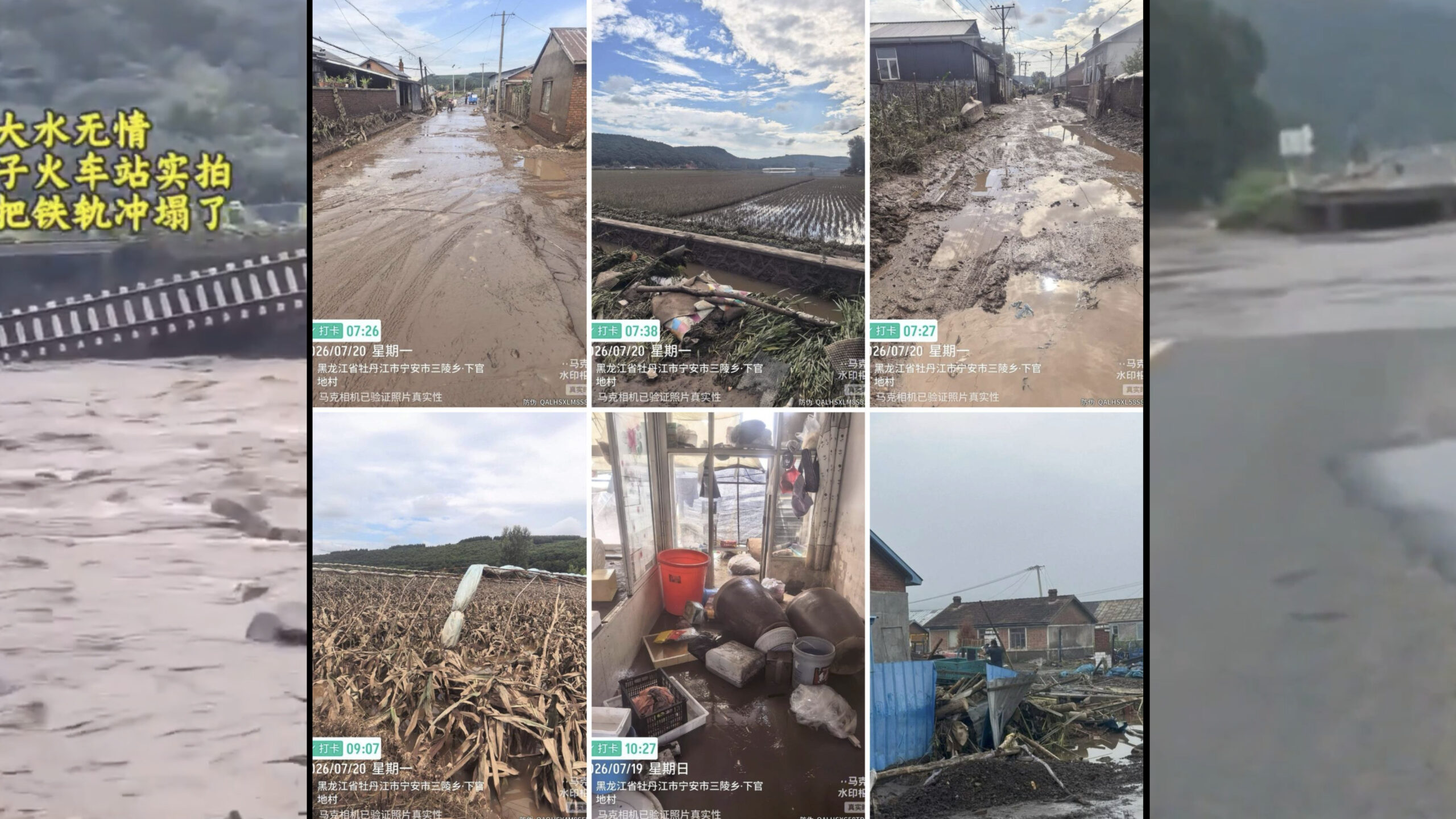
Recently, due to flooding in the Jingpo Lake overflow and heavy rainfall in Ning’an City, Heilongjiang Province, a new wave of floods has occurred. Bridges collapsed, railway tracks were washed away, and several villages were temporarily cut off. Multiple affected residents revealed that two floods within a month resulted in crop failure, damaged houses, or even structurally compromised buildings. Some questioned the authorities for not releasing water in time, leading to a major disaster.
On July 29, due to the overflow of Jingpo Lake, under the jurisdiction of Mudanjiang City in Heilongjiang Province, serious flooding occurred in Ning’an City. The Xiaoma River bridge was washed away, railway tracks were eroded, houses of villagers were destroyed, and some villages lost communication, power, water, and internet access.
According to mainland Chinese media reports, on the afternoon of July 29, the G201 National Highway bridge over the Xiaoma River was destroyed by floodwaters, causing a collapse and interruption of about 50 meters.
Officials attributed part of the bridge collapse to being “built over thirty years ago, making it susceptible to collapse from flood impacts.”
However, locals described that, on the early morning of July 29, Jingpo Lake’s “Yanghu Dam” experienced a second overflow. A video from the scene showed floodwater overflowing the dam, forming a wide turbulent flow on the left side with a significant water volume.
Public data indicates that Jingpo Lake, located in Ning’an City, is a large barrier lake formed by volcanic lava blocking the mainstream of the Mudan River upstream. The Jingpo Town, Bohai Town, Maho Township, and several villages along the river are situated in the lake area or downstream.
Amid the disaster, several affected villagers were contacted by a reporter on July 31 to share how the flood has changed their lives.
One villager, Zhang Hongwei from Shangguandi Village in Dongjing Town, Ning’an City, described the current situation as irreparable losses due to the floodwaters. He mentioned the continuous flooding within a month, resulting in the loss of crops and severe damages to houses.
Zhang stated that crops like corn and rice were all affected, with some areas submerged up to over a meter deep, causing devastating losses.
Dongjing Town, where Shangguandi Village is located, is in the central part of Ning’an City, adjacent to Shiran Town in the east, Maho Township in the south, Bohai Town in the west, and Sanling Township separated by the Mudan River in the north, with a population of over 34,000 residents.
Another villager, Liu Meijuan from Sidao Village in Maho Township, faced similar challenges as her village was cut off and roads were impassable. She mentioned that the farmlands were nearly entirely destroyed, resulting in a complete loss of crops and livestock.
Reflecting on the dangerous situation during the floodwaters in the early morning of July 30, Liu described the village’s vulnerability with nowhere to evacuate.
Maho Township, located in the south of Ning’an City, shares borders with Shiran Town to the east, Chunyang Town in Wangqing County, Jilin Province, Jingpo Town in the west, and Dongjing Town in the north.
After the floodwaters receded, many villagers faced the initial challenge of not being able to return home.
Zhang mentioned that the villagers cannot return to their homes due to extreme dampness, forcing them to seek shelter with relatives and friends. Although a shelter was set up by the government in the area, he chose not to go there.
In a similar situation, Zhao Fugui from Jiangnan Korean and Manchu Township in Ning’an City stated that their land was devastated by the flood. While the first flood destroyed their homes, the second flood made it even more unbearable, leaving their houses uninhabitable due to excessive dampness.
Regarding the recurring floods, the opinions of the interviewed villagers varied on the causes.
Zhang Hongwei believed that the first flood was related to the release of water from Jingpo Lake for tourism purposes without prior proper planning, leading to the destruction of farmlands and houses.
He expressed concerns about the increasing frequency of floods in recent years and the lack of proper measures to prevent such disasters, suggesting that the low-lying villages should be relocated, as they faced flooding seven times in the last ten years.
He also mentioned the authorities’ suppression of disaster information, indicating his failed attempts to share disaster videos online.
Zhao Fugui shared similar views, disputing the official explanation blaming a typhoon for the first flood, and suggesting human factors in the mismanagement of water release from the lake.
Jiangnan Township, located in the northeast of Ning’an City, lies across the Changbai Mountain range from Laoye Ridge in Xi’an District to Wenchun Town, bordered by Wolong Korean Township to the south, Langan Town to the west, and Wenchun Town in Xi’an District to the north.
The impact of the flooding extended beyond the villages as several bridges and roads in various parts of Ning’an City were also severely affected.
A resident, Yang Shuzhen from Shalan Town, Ning’an City, described the fierce rainfall on July 29, causing significant damages. The Dalama River bridge in the area collapsed, causing flooding in the town.
Comparing this year’s disaster to the one in 2024, Shuzhen emphasized that this year’s flooding was more severe due to torrential rainfall combined with the overflow of Jingpo Lake, affecting a larger area.
While Shalan Town faced relatively lighter damages compared to Chunyang Town and other severely affected areas, Shuzhen expressed concern for the farmers whose lands were ruined by the floodwater.
Shalan Town, located in the west of Ning’an City with the Shalan River passing through, had experienced a major mountain flood and debris flow on June 10, 2005, resulting in an official report of 117 deaths. Some believed that the upstream release of water from Shangshui Reservoir caused the catastrophe.
Although the floodwaters have receded, the challenges for the villagers are just beginning.
Zhang Hongwei mentioned that over a hundred households in his village were affected, and he contacted the disaster hotline but felt their responses were inadequate. Zhao Fugui indicated that the government provided temporary shelters for some affected villagers, but as a town resident, he had to find accommodation solutions by himself.
Many affected villagers emphasized that the recent floods not only damaged infrastructure but also caused extensive crop failures and property damages. They hoped the government would implement a long-term management plan for flood prevention rather than focusing solely on post-disaster cleanup and relocation efforts.
It is noteworthy that the neighboring county to the southern part of Maho Township in Ning’an City, Wangqing County in Jilin Province, also faced severe flooding due to extreme heavy rainfall, trapping residents in some townships.
Videos circulating online showed floodwaters rushing into towns like Chunyang, carrying away bundles of wood ear mushrooms and causing chaos. Local media reported that several businesses in Chunyang Town were flooded, prompting merchants to evacuate to higher ground.
Wangqing County, known as the “home of wood ear mushrooms,” heavily relies on mushroom cultivation as a primary source of income for local farmers.
(The pseudonyms Zhang Hongwei, Liu Meijuan, Zhao Fugui, and Yang Shuzhen were used for the interviewed villagers.)