
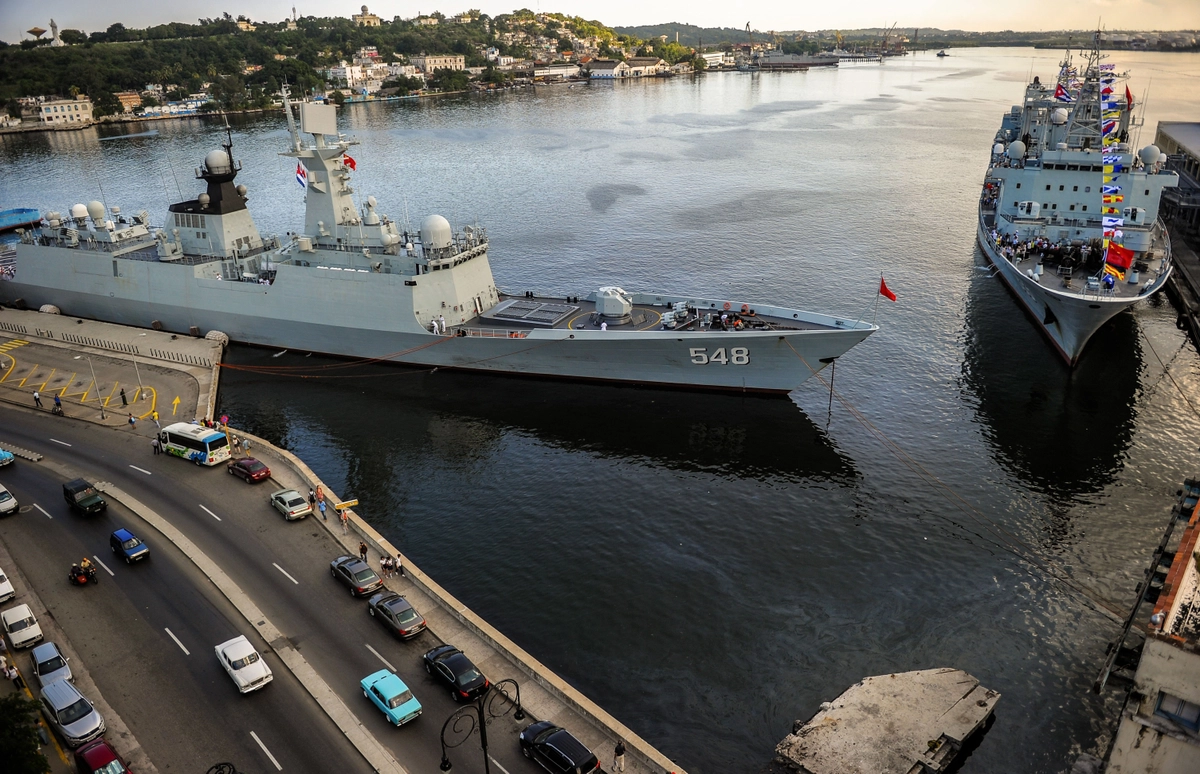
Recently, Cuba has once again become the focus of news headlines, as this failed Caribbean island nation reemerges as a stage for great power competition. For decades, Cuba has played a recurring role as a strategic asset of primary importance for the United States’ main strategic rivals. During the Cold War period, that adversary was the communist Soviet Union; today, it is communist China.
Although the relationship between the CCP and Cuba differs fundamentally from the Soviet military alliance of the 1960s and 70s, the antagonistic nature of this large communist power towards the United States remains unchanged. By leveraging Cuba’s geographic proximity to the U.S., Beijing continues to capitalize on the strategic logic of this advantage.
Cuba is only 90 miles from Florida, occupying one of the most advantageous intelligence positions in the Western Hemisphere. With the CCP’s global ambitions expanding, establishing a long-term strategic relationship with Havana offers Beijing far more opportunities to exert influence than simple trade and diplomatic relations with this small nation can provide.
Few locations are as well-positioned as Cuba for monitoring activities along the southeastern U.S. coastline. Cuba sits at a critical juncture leading to the Gulf of Mexico, adjacent to numerous U.S. military facilities, including those in Florida and the broader southeastern region of the United States.
Of course, this is no state secret.
U.S. officials have expressed concerns that facilities in Cuba associated with the CCP (as well as Russia) could be used for signal intelligence (SIGINT) collection targeting American military communications, satellite activities, and electronic signals.
In 2024, the Center for Strategic and International Studies (CSIS) in Washington, D.C. released satellite images identifying multiple locations within Cuba that researchers assessed as having characteristics consistent with SIGINT facilities. While the report did not reach conclusions on the operations of these facilities, it deemed them worthy of close attention.
This is analogous to the CCP’s preference for a low-key spy strategy.
Unlike the U.S., China typically avoids establishing large overseas military bases. Instead, Beijing increasingly emphasizes dual-use infrastructure, commercial ports, telecommunications, satellite facilities, and intelligence partnerships that can provide strategic advantages without the need for maintaining large-scale overseas troops.
Nevertheless, American intelligence officials have publicly stated that China is expanding its overseas intelligence capabilities, including in Cuba. Chinese and Cuban officials have repeatedly denied accusations of Beijing establishing spy bases in Cuba, attributing such reports to political motives.
However, the operators of specific facilities are not the most critical aspect; their functions are key. U.S. intelligence experts note that modern electronic monitoring often requires relatively small footprints but can yield significant strategic value.
China’s interest in Cuba extends beyond electronic surveillance. Maintaining a close relationship with Cuba holds tangible and symbolic value for Beijing.
Cuba offers China an opportunity to deepen its influence in the Caribbean region and reshape its reputation. Noteworthy is that over the past two decades, Beijing has steadily expanded its economic and diplomatic influence in Latin America through infrastructure investments, trade agreements, development financing, and technology exports.
China has both historically and presently been keen to demonstrate its ability to compete with the U.S. within Washington’s traditional sphere of influence, making Cuba crucial for Beijing. Given the recent U.S. actions to oust Venezuelan dictator Nicolás Maduro and diminish Chinese influence in Panama, this becomes especially significant.
Contain…