
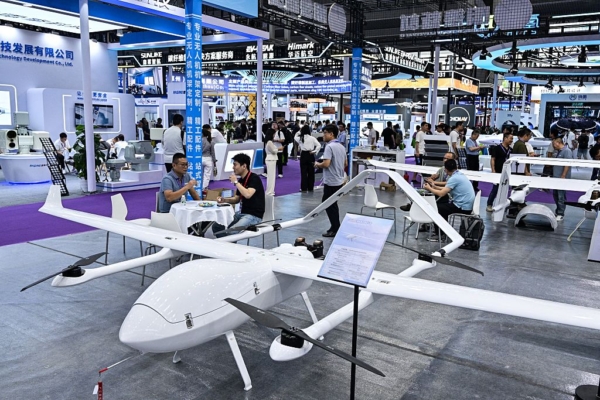
The “2026 International Conference on Aerospace Science and Engineering” (ICASSE 2026) was held in Hong Kong, bringing together top researchers from Germany, China, and Russia. While the organizers claimed that the conference focused on civil projects, several security experts and political figures warned that such high-sensitive exchanges could face risks of military technology and critical knowledge leakage.
During the conference that lasted for several days, experts from various countries discussed cutting-edge topics such as drones, autonomous flight systems, satellite navigation, hypersonic technology, aviation engines, and artificial intelligence. It is worth noting that some reports had explicit “dual-use” potential, such as drone swarm control, airborne target tracking, and drone acoustic detection.
However, the background of this academic event is extremely complex: the Russia-Ukraine conflict has been ongoing for over four years, and Western intelligence agencies closely monitor the strategic cooperation between China and Russia. Against this backdrop, the Technical University of Munich (TU München), which is renowned as one of Europe’s top universities and selected as a “university of excellence” in Germany, still sent multiple drone experts to attend the conference, sparking intense discussions in Germany about the boundaries between academic exchanges and national defense security.
According to the German newspaper “Handelsblatt,” the focus of external questioning lies in the sensitivity of timing and identities. Currently, TU München is actively collaborating with European defense giants like Airbus, Diehl, Hensoldt, as well as emerging defense technology companies such as Quantum Systems and Neuraspace to establish the “Security and Defense Alliance”; however, at the same time, the university continues to maintain close cooperation with research institutions seen as crucial in driving China’s military modernization.
The ICASSE 2026 conference was organized by Shanghai Jiao Tong University (SJTU), co-organized by TU München and the renowned Russian aerospace institution Moscow Aviation Institute (MAI), with the Hong Kong Polytechnic University as the host. Florian Holzapfel, a professor of system dynamics at TU München, served as a committee member of the conference’s International Advisory Committee and delivered the opening speech, with two other professors from the university presenting keynote reports.
Such cooperation recalls the controversy sparked by the CISPA Information Security Center in Germany earlier. Researchers from CISPA faced a special scrutiny by Germany’s Federal Ministry of Education and Research Minister Dorothee Bär for jointly publishing papers with China’s “Guardians of National Defense,” such as Beihang University. Bär emphasized at the time that “academic freedom does not equal spy freedom.”
In response to the scrutiny, a spokesperson for TU München stated, “Such conferences are common in the international academic community. All reports are based on publicly available academic results, and the discussion results will also be open to the public.”
The strategic cooperation between TU München and Chinese universities has been longstanding. The university not only established a “flagship partnership” with Tsinghua University and set up offices but also deepened cooperation in the drone field with Shanghai Jiao Tong University in April this year. Thomas Hofmann, the President of TU München, previously stated, “Global challenges can only be addressed together, and world-class universities must remain open.”
Regarding security reviews, TU München stated that the school has a dedicated export control department and maintains communication with the German Federal Office of Economics and Export Control (BAFA), the Federal Office for the Protection of the Constitution, and the Ministry of Foreign Affairs. However, media pointed out that the university currently only has two export control personnel, while there are as many as eight personnel responsible for sustainability.
Moreover, addressing the contradictions of the Bavarian State Government (led by the Christian Social Union CSU) vigorously supporting TU München’s participation in European defense research while allowing cooperation with China, a university spokesperson explained, “Our planned cooperation with Shanghai Jiao Tong University is limited to ‘urban air transport and logistics,’ such as business models and infrastructure, which are of no value for military applications.”
However, Germany’s professional risk assessment agencies and intelligence sectors hold different views on this. Jennifer Hanley-Giersch, a partner at the commercial risk consultancy firm Berlin Risk, analyzed the risks involved.
The first risk is knowledge overlap: given the highly specialized nature of the aerospace and drone fields, research personnel involved in cooperation with China could potentially participate in European defense projects concurrently or subsequently.
The next risk is third-party infiltration: during the cooperation process, the possibility cannot be ruled out that personnel from Russia could obtain project data through Chinese channels without the knowledge of German counterparts. There are significant doubts about whether the organizational-level ‘firewall’ can operate effectively.
The Federal Office for the Protection of the Constitution (Bavarian branch) also warned that local universities have become a focus of attention for foreign intelligence agencies, with the main aim being to illegally obtain sensitive technology, intellectual property, and core know-how related to security.
At the international level, special committees in the U.S. Congress urged the University of Michigan to terminate its cooperation with Shanghai Jiao Tong University at the end of 2024, citing the latter’s involvement in multiple military modernization projects; meanwhile, co-organizer Moscow Aviation Institute (MAI) has long been on the U.S. government’s sanctions list.
In response to concerns about indirectly assisting the Russian military, TU München emphasized that since the outbreak of the Russia-Ukraine conflict in 2022, the university has completely frozen all official cooperation and exchanges with Russian institutions such as the Moscow Aviation Institute, and some internal teams have been providing direct technical support to Ukraine since the outbreak of hostilities.
Even before the Ukraine war, the Moscow Aviation Institute actively sought international cooperation and maintained contact with Germany, including Dresden University of Technology and universities in cities like Heilbronn and Ingolstadt. The institute previously cooperated with TU München through academic exchange projects. A spokesperson for the institute stated that “since Russia launched its aggressive war against Ukraine, all institutional cooperation with Russian universities has been suspended or frozen.”
International cooperation once seen as a mark of scientific quality and cutting-edge research has now become a political issue. According to Western intelligence agencies, the Chinese Communist Party is training Russian soldiers, adding a new sense of urgency to the current situation. Therefore, the Chinese ambassador to Germany was urgently summoned to the Ministry of Foreign Affairs in Berlin.
At the ICASSE conference in Singapore in 2025, Professor Stephan Myschik, a professor of flight mechanics and flight control at the Federal Armed Forces University, also attended. Myschik stated, “The conference content does not pertain to unmanned aerial vehicles, autonomous systems, or their control, but focuses on the development of battery electric propulsion systems for civil small aircraft to reduce their carbon dioxide emissions. In principle, I am critical of the outflow of German drone technology knowledge to other countries. But our report has nothing to do with this sensitive area.”
The collaboration on drones between TU München and Shanghai Jiao Tong University is also sensitive from an industrial policy perspective. Particularly in Shanghai, it can be observed that the Chinese Communist Party is rapidly building a “low-altitude economy” (including drones, air taxis, low-altitude logistics, etc.).
In December 2024, Shanghai established the city government-led “low-altitude economy” platform company, involving six municipal-level state-owned enterprises, aiming to build a complete value chain from research and development production, infrastructure to operation. The targeted market size exceeds 50 billion RMB (approximately 6.5 billion euros).
From the perspective of TU München, this is not a risk but an opportunity for Germany. A university spokesperson stated that German researchers have the opportunity to “learn from China’s strict application orientation, accumulate technology and system experience in real applications, and contribute their own expertise.” China “is far ahead of European countries in researching flying taxis, drone technology, and many other technological fields.”
However, some analysts believe that in the absence of strict protective mechanisms, the technical accumulation of Western scholars may ultimately accelerate China’s industry and technological monopolies in relevant fields.
Currently, Germany has almost no specific legal regulations for international scientific exchanges, with only relevant constraints under foreign trade economic laws. However, monitoring knowledge outflow is much more difficult than monitoring the export of physical drones.
This implies that as long as there is even a very small possibility of researchers from hostile countries acquiring sensitive knowledge in Germany and using it for military purposes in their own country, German scientists or institutions funded by taxpayers should no longer independently decide whether to cooperate with them.