
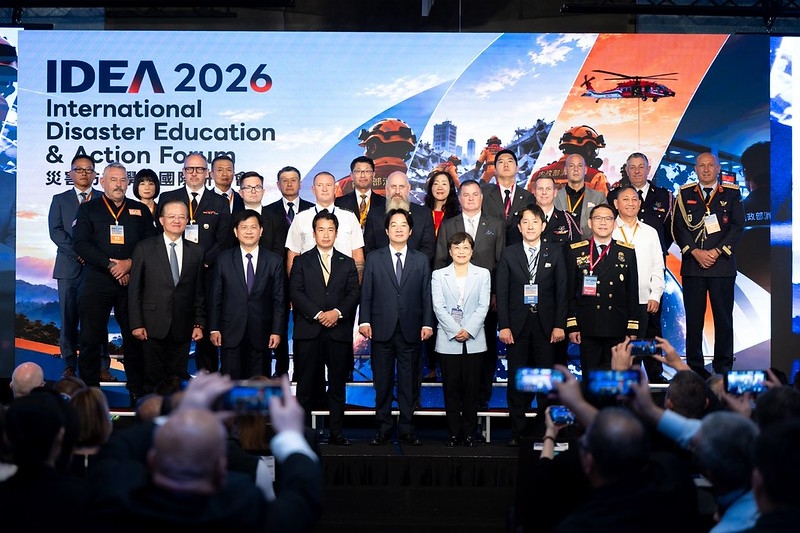
Taiwanese President Lai Ching-te stated today (September 19) that in the face of highly changing international situations and escalating threats from the Chinese Communist Party, his responsibility is to make Taiwan more prepared and stronger to maintain the status quo, refusing to let peace be unilaterally disrupted by provocation. He emphasized that when authoritarianism attempts to export fear, democratic societies should export confidence with resilience. When authoritarian forces try to sow division, democratic partners should collaborate even more.
This morning, President Lai Ching-te attended the opening ceremony of the “2026 Presidential Office National Resilience International Forum – Resilient Taiwan, Sustainable Democracy.” The event was attended by various officials including National Security Council Secretary-General Wellington Wu, Minister of the Interior Shih Chung-liang, Minister of National Defense Chiu Li-hsiung, Minister of Health and Welfare Chong-liang Shih, Minister of Foreign Affairs Joseph Wu, and representatives from multiple countries including Raymond Greene, the Director of the American Institute in Taiwan (AIT).
During his speech, President Lai Ching-te mentioned that this year marks the second anniversary of the establishment of the “Presidential Office National Resilience Committee” and the second time hosting the “National Resilience International Forum.” With over 500 domestic and international experts and VIPs gathering in Taiwan today, they aim to enhance the country’s capability to respond to climate change, grey zone threats, and geopolitical risks through mutual exchange and learning, further advancing Taiwan’s efforts in promoting national resilience and international collaboration.
President Lai Ching-te expressed gratitude towards all international partners who traveled far to attend, thanking them for their support of democratic Taiwan. Two years ago, he established the “National Resilience Committee” in the Presidential Office, with the goal of strengthening the country’s resilience through public-private cooperation, collaboration among industry, government, academia, research, and civil society. The objective is to ensure that when the nation faces any disaster, whether natural or man-made, not only will the government operate effectively but society’s essential functions will also remain intact, capable of supporting military needs if necessary.
He stated, “Two years ago, we sought to learn from the international community, drawing experiences from significant global events and advanced social resilience models from other countries. After two years of preparation, we are confident that Taiwan’s model can now serve as a reference for the international community and provide a basis for other countries to prepare.” Just last month, the government successfully conducted the annual “National Unity Month” – the Han Kuang exercise and urban resilience exercise, drawing global attention with many foreign media outlets visiting Taiwan to report on the exercises.
“We also added new elements to the urban resilience exercise this year, carrying out a simulation of a network slowdown affecting 17 million people, allowing the public to practice backup communication methods when the network is disrupted. Moreover, this year’s urban resilience exercise combined with the Han Kuang exercise, enabling central and local government non-military departments to synchronously train in similar scenarios, enhancing civil-military integration and the response capability of civilian units in extreme circumstances,” President Lai Ching-te explained.
President Lai Ching-te remarked that safeguarding Taiwan has always been more than just the military’s responsibility. Every member of Taiwanese society, regardless of profession, ethnicity, gender, or age, whether civilian or military, can contribute to national defense and enhance Taiwan’s resilience from different positions.
He extended special thanks to the active-duty personnel, the 20,000 reservists, and nearly 10,000 civilian colleagues from central to local government who participated in the exercises. He also expressed gratitude to the entire nation for standing united and successfully completing the largest-ever joint military-civilian exercise in history.
In the face of rapidly changing international situations and escalating threats from the Chinese Communist Party, President Lai Ching-te declared that as the President, his responsibility is clear – to ensure Taiwan is more prepared and stronger to uphold the status quo, preventing peace from being disrupted by unilateral provocations. Over the past decade, Taiwan’s defense budget has doubled. In the upcoming fiscal year, the overall defense budget is set to exceed NT$1 trillion for the first time, reaching NT$1.1225 trillion, consistently surpassing 3% of GDP and projected to reach 5% by 2030. The government is determined to enhance Taiwan’s self-defense capabilities, using strength to defend peace.
President Lai Ching-te stated that today’s international forum focuses on addressing new types of threats. Discussions and exchanges cover various aspects such as global social resilience models, civil-military cooperation, psychological defense, and resilience partnerships from around the world.
He expressed gratitude to the presence of Palmer Luckey, the founder of Anduril, Japanese Senator Hirofumi Takinami, former Philippines National Security Adviser Hermogenes Esperon Jr., former U.S. Deputy National Security Advisors Matthew Pottinger and Anne Neuberger, as well as experts from Ukraine, Finland, the European Union, NATO, and other countries. The government will continue to reference international experiences to strengthen Taiwan’s preparedness in various aspects.
At this gathering, President Lai Ching-te announced the official establishment of the internationally initiated organization by Taiwan – the “World Alliance for Disaster Management (WADM).” He extended special thanks to Vice President Raynold Oilouch of Palau, and Deputy Prime Minister Thulisile Dladla of eSwatini, who attended the event from afar, joining hands with Taiwan in disaster prevention efforts.
President Lai Ching-te emphasized that the establishment of WADM marks a significant breakthrough in Taiwan’s participation in international organizations over the past half-century. Eleven of Taiwan’s diplomatic allies and Somaliland have become founding members, joined by central and local governments, disaster prevention agencies, and groups from 21 different countries including the United States, Japan, the United Kingdom, Germany, the Netherlands, Poland, Turkey, and the Philippines, as observers or partners, establishing a cooperative network spanning regions globally.
“We will promote joint training, exercises, mutual support, and information sharing, linking pre-disaster warnings, in-disaster response, and post-disaster recovery to make Taiwan the hub for cross-border disaster cooperation. We are confident that Taiwan Can Help. The International Disaster and Emergency Assistance Conference IDEA 2026, co-hosted today, is also of great significance. Taiwan aims to connect the firefighting and disaster prevention education and training systems in the Asia-Pacific and Europe-America regions, continually adopting the International Professional Standards of the National Fire Protection Association (NFPA) from the United States and establishing an international cooperation network,” President Lai Ching-te stated.
Currently, the largest in Asia and the third-largest in the world, a firefighting training center is situated at the heart of Taiwan in Zhushan, Nantou. The government looks forward to collaborating with partners worldwide to establish common training standards, a shared professional language, and jointly enhance disaster relief capabilities through mutual training.
President Lai Ching-te emphasized to international partners that Taiwan belongs to the world, and the nation will continue to expand its contributions, build trust through expertise, and connect the world through cooperation. In the face of authoritarian attempts to instill fear, democratic societies should exude confidence with resilience. When authoritarian forces try to divide, democratic partners should further unite.
“Peace relies on strength, strength relies on resilience, and resilience relies on unity,” stated President Lai Ching-te. “All our preparations are for protecting the welfare of our people, safeguarding the way of life of freedom and democracy, defending peace and stability in the Indo-Pacific region and the world.” Simultaneously, in the face of increasingly extreme and uncertain climate environments, societies should boost their ability to withstand impacts, recover quickly, and ultimately achieve sustainability. “Let us work together to make Taiwan more resilient, democratic partners more united, and the world we all live in safer,” he concluded, wishing success for today’s forum and the smooth launch of WADM and IDEA 2026.