
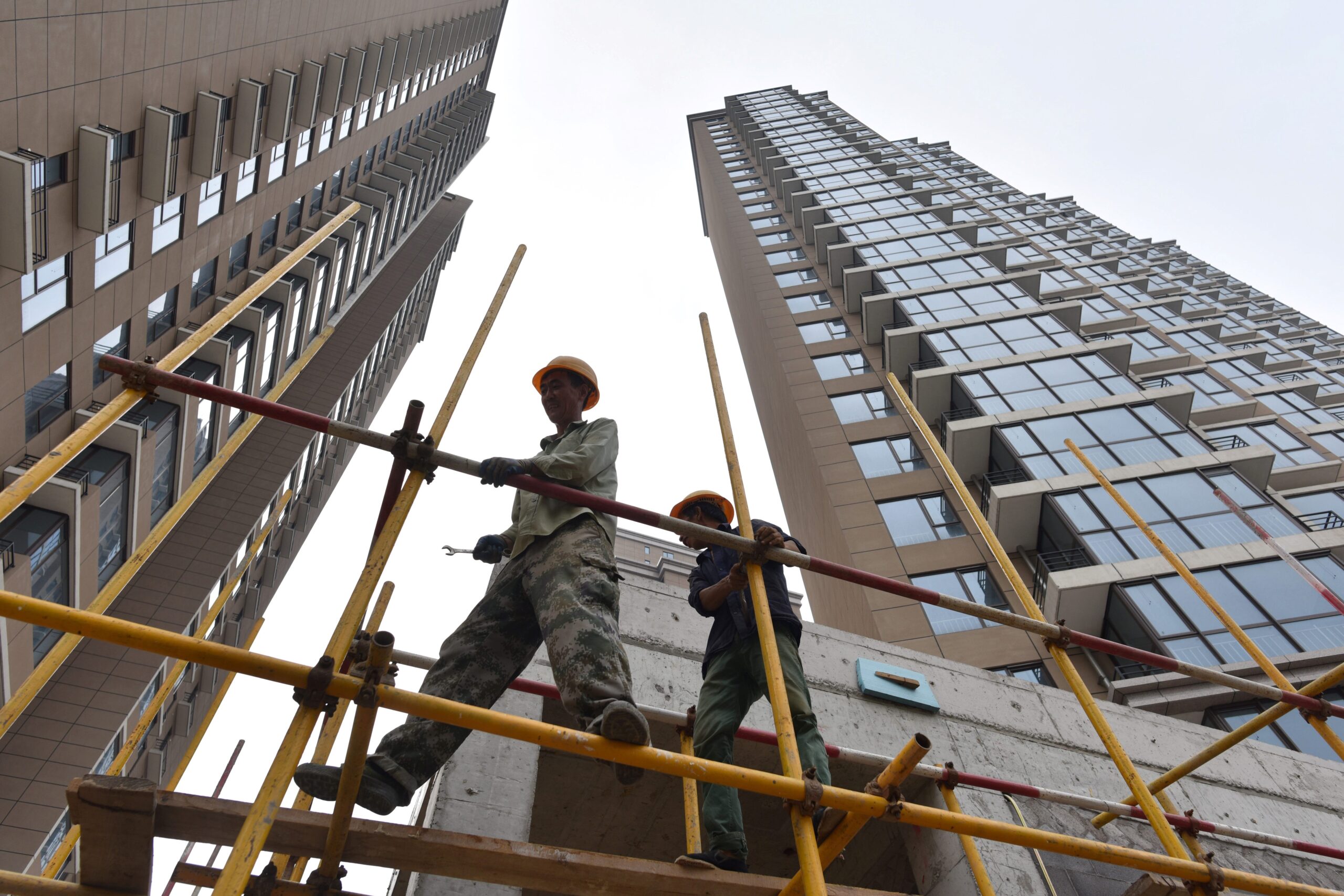
Amid a large number of homebuyers still trapped in the situation of “having a loan but no house,” the Chinese Communist Party rolled out a new round of real estate policies on August 28, promoting existing home sales, extending the mortgage term, and adjusting the financing rules for real estate enterprises. The new policy aims to prevent future unfinished construction risks, but it does not provide a clear answer for the significant amount of existing unfinished buildings and the losses that homebuyers have already suffered.
As existing issues remain unresolved, the new policy faces the challenge of rebuilding market confidence.
China’s real estate regulatory policy has undergone a significant shift. The Ministry of Housing and Urban-Rural Development, the Ministry of Natural Resources, the China Banking and Insurance Regulatory Commission, and the central bank jointly released multiple new policy documents on August 28, promoting reform of the commercial housing sales system and reshaping the credit system, accelerating the construction of a “new model” for real estate development.
The new policy mainly involves two aspects: sales system and financing for real estate enterprises. The priority now shifts to existing home sales in the commercial housing market, raising the pre-sale threshold to the topping-out of the main structure and implementing an “exchange of keys upon delivery” system. Real estate enterprises’ financing will now be under the “lead bank system,” requiring funds to be specifically designated and some development loans to have a maximum term of up to seven years. The maximum term for individual housing loans has been extended from 30 years to 40 years.
The official justification for existing home sales is to provide homebuyers with a “what you see is what you get” model, reducing the risk of construction delays at the source. According to “21st Century Economic Report,” the shift to existing home sales helps to reduce information asymmetry and delivery risks for homebuyers, leaving more of the financial risk with the developers.
However, this system primarily addresses how to reduce the occurrence of future unfinished buildings, rather than resolving the fate of past unfinished projects. Chinese problem expert Mike Li told Dajiyuan, “Introducing new policies at this point is too late, as a large number of unfinished buildings have already appeared.” He believes that the “three red lines” introduced in previous years caused the financial chain of most private real estate enterprises to break, and if this new policy had been implemented earlier, “losses would have been much lower.”
This is also a time lag that the current policy faces: while authorities are redesigning a system to reduce homebuyers’ delivery risks, many families have already paid down payments and begun repaying mortgages without receiving their homes. The reform of the system cannot automatically compensate for the losses that have already occurred.
The official documents use the term “prioritizing existing home sales” rather than making it mandatory across the board. This wording gives leeway to local governments and makes land finance a crucial factor in whether existing home sales can be fully implemented.
Sun Guoxiang, a professor in the Department of International Affairs and Business at Nanhua University in Taiwan, told Dajiyuan that the reason existing home sales were not previously implemented is that the pre-sale system allowed for a “rapid promotion of urbanization with high leverage,” supporting local land and financial operations while long-term delivery risks were overshadowed by rising housing prices. The current shift in policy not only aims to regain housing demand lost due to unfinished projects but also aims to disrupt the old model where developers used prepayments from homebuyers as working capital.
Sun Guoxiang refers to the pre-sale system as a “high leverage amplifier” for local land finance. Therefore, the shift from pre-sale to existing home sales is not just a change in the mode of transaction but also involves the source of income for local governments.
Sun Guoxiang believes that positioning existing home sales as “priority rather than mandatory” in the new policy essentially allows for policy flexibility to address the financial pressures faced by local governments. If all plots switch to existing home sales, developers will need to invest more funds upfront, potentially reducing land acquisition incentives, leading to land auctions being unsuccessful, further impacting local financial revenue and debt repayment capabilities.
Sun Guoxiang believes that reform in existing home sales may lead to differentiation: high-quality plots dominated by central enterprises and with strong demand may adopt existing home sales first, while on a large number of ordinary plots, the transitional arrangement of “topping-out, then pre-sale” may continue.
Sun Guoxiang believes that the reform of the pre-sale system ultimately depends on whether the central government can establish income sources for local governments beyond land finance. If the institutional handling of local fiscal deficits and huge implicit debts is not addressed, local governments still have the incentive to utilize the “priority” instead of “mandatory” aspects of the policy to maintain the pre-sale model.
The official narrative on financing reform is similarly positive. The new policy establishes the “lead bank system” for real estate development loans, emphasizing designated use of funds and extending the term of some project development loans to a maximum of seven years, aimed at improving the reasonable financing needs of real estate enterprises, reducing the risk of broken financial chains and project suspensions.
However, strengthening financial supervision does not mean that all real estate enterprises can improve their survival environment as a result.
Existing home sales require real estate enterprises to bear the longer timeframes for land, construction, and financing costs before major sales revenues are realized. Sun Guoxiang believes this will directly cut off the funding sources of small and medium-sized real estate enterprises that relied on small amounts of capital and high leverage pre-sale funds for high turnover. Compared to central and state-owned enterprises, small and medium-sized real estate enterprises already face disadvantages in financing channels and credit ratings. With the lack of pre-sale fund replenishments, they will find it even more challenging to withstand the cash flow pressure from extended construction periods.
Another impact of existing home sales is the potential for further differentiation in the real estate industry. The previously rapid expansion model reliant on “land acquisition—pre-sale—capital return—new land acquisition” is difficult to sustain. Sun Guoxiang believes that financially robust central enterprises and a few large private enterprises will find it easier to access land, bank loans, and capital market financing, while financially weaker small and medium-sized real estate enterprises may face mergers, transformations, or exits.
Mike Li believes that the “8.28 new policy,” compared to the “no speculation in housing” and “three red lines” policies six years ago, represents a “180-degree turn,” reflecting the ongoing spread of the real estate crisis and an increased risk of economic recession.
Mike Li describes this round of policy shift as “treating a serious problem as if it were trivial.” He believes that this kind of reactionary policy change cannot alter market expectations or recover lost wealth, but its primary function is to assist local governments and financial institutions.
China’s property market is shifting from “collection of money first, then construction” to “construction first, then collection of money.” This means that some of the delivery risks previously borne by homebuyers will now fall more on real estate enterprises and financial institutions. However, the reliance of local governments on land finance, the financing difficulties faced by small and medium-sized real estate enterprises, and the substantial number of unresolved unfinished projects have not disappeared with the change in sales system. For homebuyers already stuck in the situation of “having a loan but no house,” the new policy may reduce the risk of delivery for the next property, but it still cannot answer who will bear the losses from the previous property.