
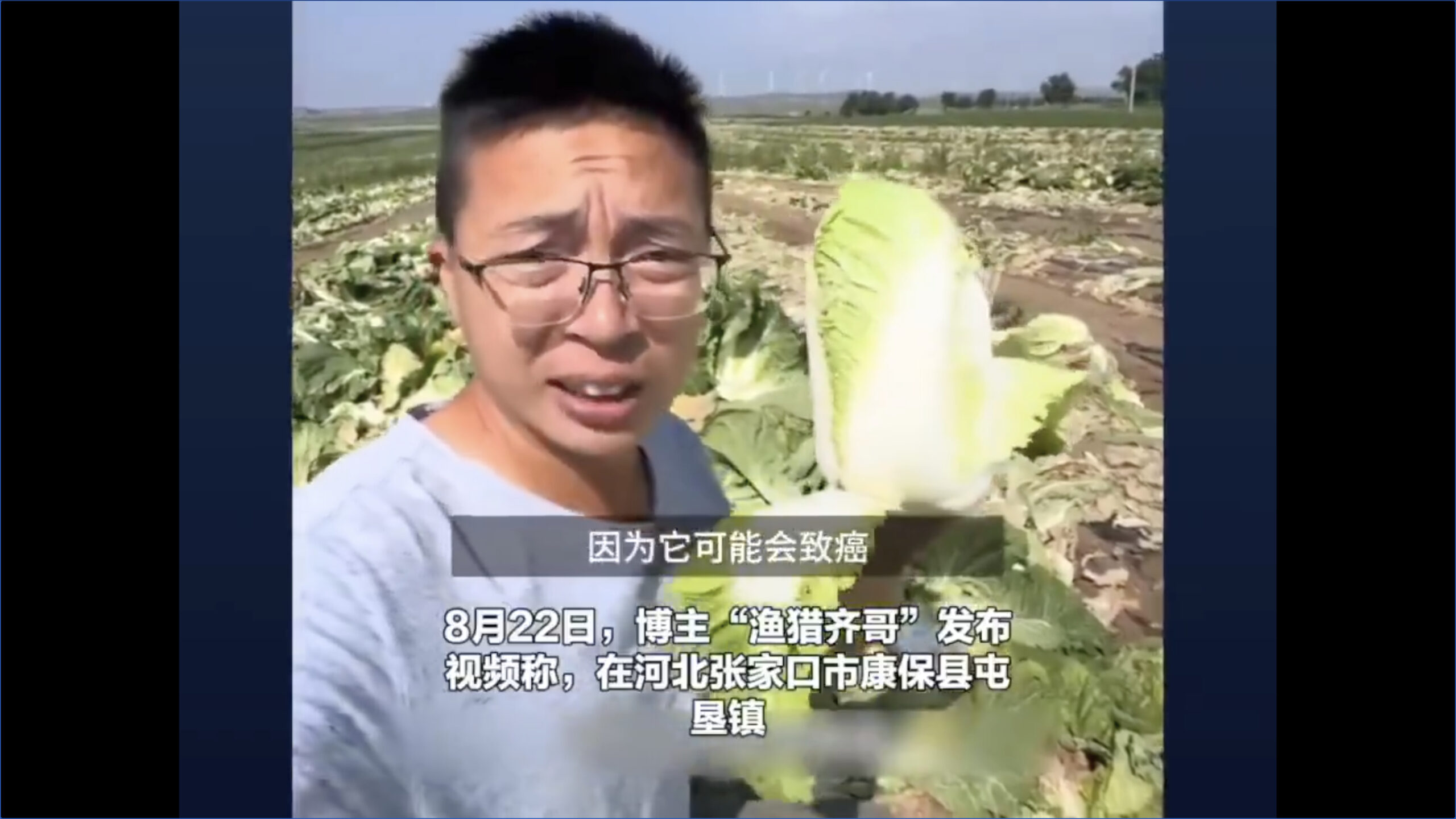
The “Formaldehyde Cabbage” incident in Kangbao County, Zhangjiakou, Hebei Province continues to attract attention. A whistleblower who was interviewed by mainland media stated that it took more than two months of tracking and investigation to finally identify the target. He also admitted to fearing retaliation.
On August 22, mainland blogger “Yulie Qi Ge” released an undercover video exposing the use of formaldehyde solution to preserve some cabbage during the procurement and shipping process. Local authorities confirmed after preliminary investigation that the situation reflected in the video was true, and the related behavior constituted illegal actions by vegetable transporters in the process of shipping.
After the incident was exposed, “Yulie Qi Ge” was regarded by many netizens as a “whistleblower” in the field of food safety. Recently, “Yulie Qi Ge” was interviewed by “Blue Whale News” and provided a more complete account of the investigation.
On June 13, “Yulie Qi Ge” received relevant clues from fans. After initial understanding, he and his companions believed it was necessary to further investigate, but instead of going directly to the production area, they started by sampling and testing the relevant cabbage from the consumer market.
Subsequently, they traced back and gradually uncovered the flow of cabbage from the sourcing, loading, to long-distance transportation based on testing and source clues. After a period of investigation, they eventually pinpointed Kangbao County in Zhangjiakou, Hebei.
Upon arriving in Kangbao, the investigators encountered no obvious obstacles when entering the local cabbage loading point. The on-site workers did not deliberately avoid the camera, and they quickly filmed the process of dipping the cabbage roots in a transparent liquid labeled as “formaldehyde solution” before loading.
Recalling the filming process, “Yulie Qi Ge” mentioned that they were initially cautious but later found that “no matter how they filmed, there were no issues”. In his view, the on-site personnel seemed accustomed to such operations.
He noted that not all transport vehicles undergo this treatment of dipping in formaldehyde solution; it is mainly for long-distance transportation vehicles, while short-distance transport does not require it.
To track where these cabbages ultimately ended up, the investigators divided into two teams. One team followed the vegetable truck towards Jiangsu and Anhui, attempting to trace from the production end to the sales end.
When the truck arrived at the target market, the investigators simultaneously alerted the authorities. Subsequently, the related cabbages were seized, and the incident quickly evolved from a local production area violation to a nationally recognized food safety event.
In “Yulie Qi Ge’s” view, the most shocking aspect of this investigation was not just the use of formaldehyde solution but the fact that the related operations did not seem hidden.
He believed that if some practitioners witness such operations regularly but no one raises objections or reports, then the problem is not just individual behavior. Considering it “normal” should not justify illegal actions.
After the incident was exposed, concerns were raised about possibly impacting local ordinary vegetable farmers who did not use formaldehyde, leading to situations where cabbage might not sell.
In response, “Yulie Qi Ge” acknowledged facing certain pressures.
However, he believed that if a production area has long-term violations that ultimately affect the market, it is challenging to completely avoid these impacts. “If I don’t expose it, and they continue to use formaldehyde and sell, it’s even worse for the general consumers.”
Having previously worked in real estate, “Yulie Qi Ge” gradually shifted towards investigating environmental pollution and food safety due to his love for the natural environment, aversion to pollution, and deception.
Over the years, he has received clues from netizens, conducted on-site investigations and evidence collection in different regions, and produced videos of the investigation results for release. He mentioned that he exposes around 50 issues in a year.
To conduct investigations, he travels extensively throughout the year. In May of this year alone, he visited multiple provinces and cities such as Hunan, Hubei, Jiangxi, Shandong, Henan, Hebei, Sichuan, Chongqing, and Guizhou.
When asked whether he fears retaliation for his long-term investigation into environmental and food safety, “Yulie Qi Ge” admitted to having concerns, but stated, “I may be worried, but this is something that needs to be done. Someone has to step forward.”
Currently, he does not have a strictly defined professional team and mainly relies on some like-minded friends mutually assisting each other.
The investigation from receiving the clues in June to the final exposure spanned over two months, with testing costs alone exceeding 2,000 yuan. Additionally, there were expenses for flights, high-speed trains, rental cars, and other transportation costs.
However, he believed that the most significant cost was time, rather than money. If the investigation can ultimately prevent the illegal use of formaldehyde, he deems all these sacrifices worthwhile.
He thought that the swift nationwide attention to the “Formaldehyde Cabbage” incident was due to the public’s increasing concern for food safety. From sourcing, long-distance transportation, to wholesale markets and retail endpoints, vegetable safety involves the entire distribution chain.
Regarding his future investigative direction, “Yulie Qi Ge” stated that he would continue focusing on environmental pollution primarily while also keeping a close watch on food safety issues.