
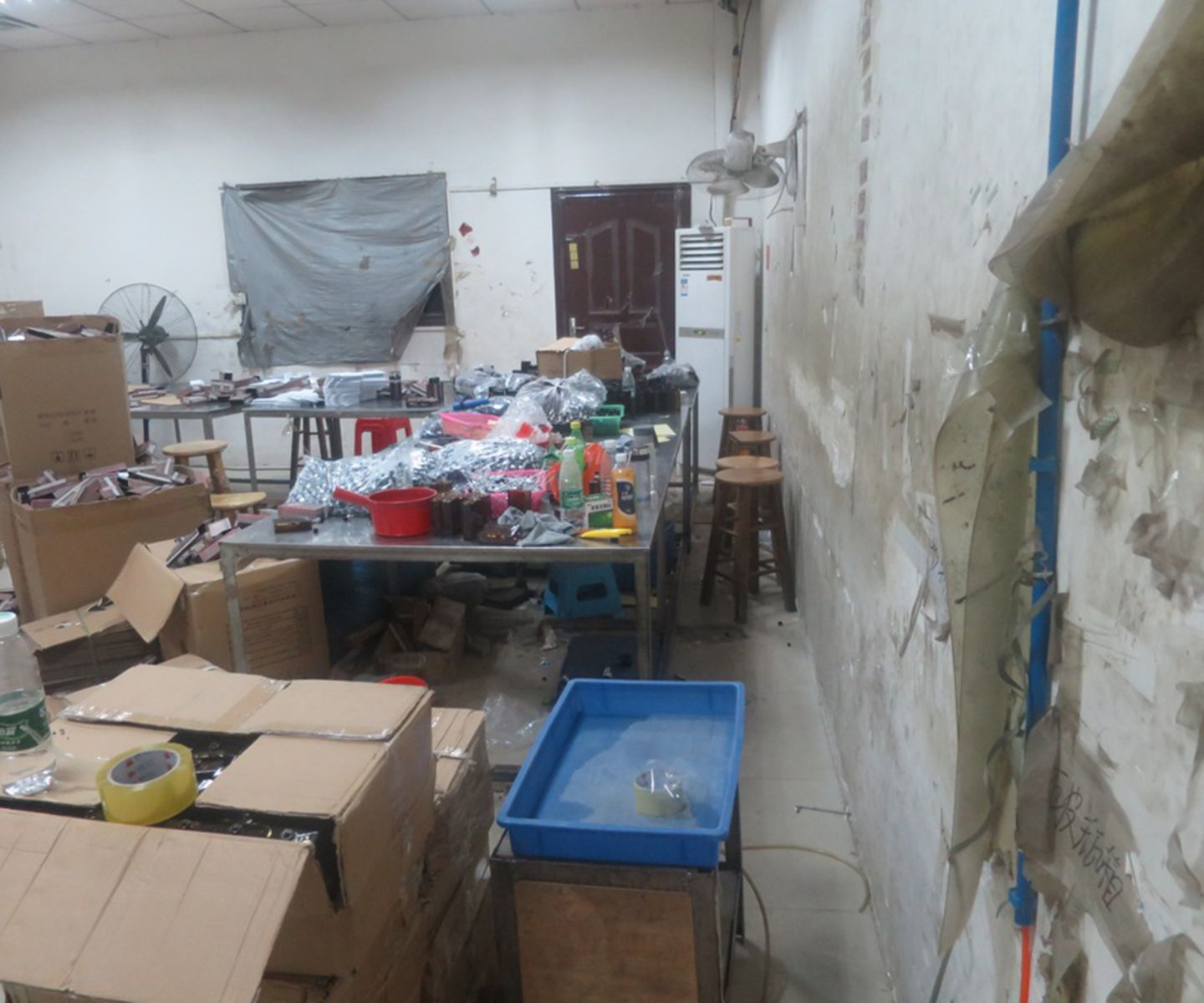
In the town of Heping in Chaoyang District, Shantou City, Guangdong Province, there is a hidden operation producing counterfeit cosmetics inside residential houses. Raw materials are covertly transported into the houses, and finished products are then discreetly put into express delivery vehicles at night before being distributed to consumers through online platforms. During a clandestine investigation by mainland Chinese media reporters, they encountered surveillance, intimidation, and even individuals posing as police officers threatening them with “summonses” late at night.
According to a report by “New Beijing News” on September 21, some consumers complained of skin redness, swelling, and ulcers after using cosmetics purchased online, with some patients diagnosed with contact dermatitis. At the end of May this year, the newspaper’s reporter purchased 6 suspicious high-end cosmetics from various platforms for testing, and compared them with authentic products from counters using infrared spectroscopy. Testing institutions confirmed that all 6 samples were counterfeit goods.
Following this, the reporter contacted counterfeiters under the guise of a “bulk purchaser” to trace the source of the fake products. These counterfeit goods were distributed to various online platforms, with some sellers frequently changing stores; if their store attracted attention, they would close the shop and reopen elsewhere.
The investigation traced the source to the town of Heping in Chaoyang District, Shantou City, where it was discovered that some counterfeit cosmetics were being produced inside residential houses. Raw materials were brought in discreetly, and the finished products were sent out for delivery at night. Some locations had surveillance cameras, and individuals were tasked with surveillance and lookout duties to prevent outsiders from approaching.
Counterfeit products from brands like SK-II and Helena were found in some residential houses, including finished products and packaging.
On September 21, “New Beijing News” released a review article stating that the reporter was followed during the investigation. On one occasion when leaving the village by car, a black sedan was spotted tailing them; and in another instance, an unknown man called late at night claiming to be from a police station, threatening to “summon” the reporter.
After the incident was exposed, a joint enforcement task force was established locally to conduct further investigations.
Official reports indicate that 28,690 counterfeit labels were discovered at the site of exposure, including empty bottles and packaging boxes. Additionally, 4 barrels of fragrance, 18 pieces of production equipment, and 340 barrels of ointment were seized. One of the involved residential house owners named Wu has been arrested, and authorities have initiated a formal investigation.
From production in residential houses to nighttime deliveries, to sales through express delivery and online platforms, this investigation reveals a chain of counterfeit cosmetics involving production, logistics, and online sales. Apart from the exposed locations, the individuals involved, the sources of counterfeit goods, and the sales network still require further investigation.