
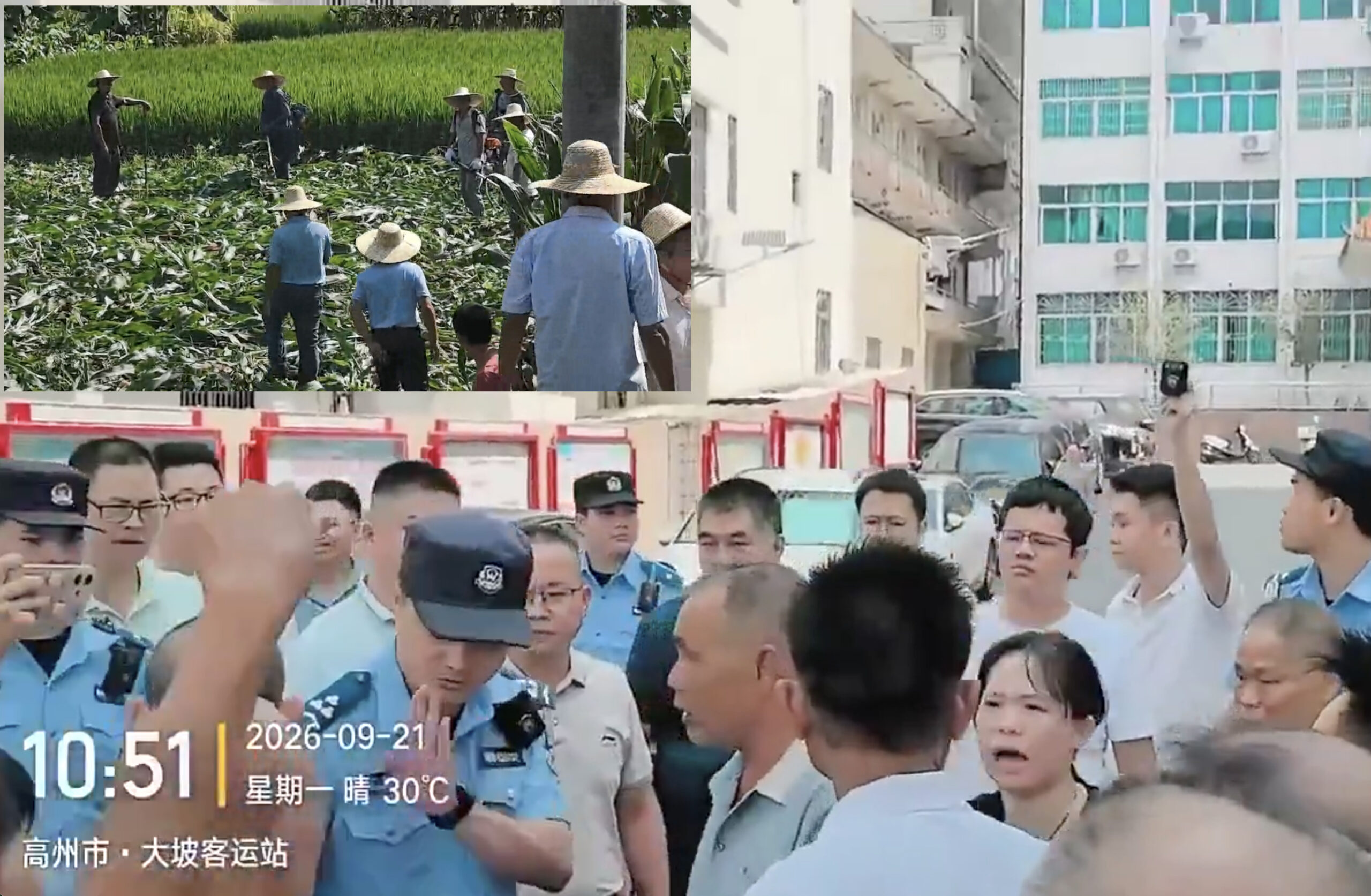
On September 20th, in Maoming Gaozhou, Guangdong, the government of Dapo Town, Gaozhou City, forcibly cleared the crops planted by villagers of Shangliangkeng Village, leading to a conflict and resulting in multiple casualties.
Local villagers revealed that the related land involved mineral resources (gold mines). Prior to the incident, the government did not provide any relevant documents, did not negotiate compensation with the villagers, and raised questions about why doctors were arranged on-site in advance and how the causes of death were determined. The next day, a large number of villagers gathered in front of the town government, holding up banners to demand a public investigation and compensation.
The conflict started with the town government organizing personnel to enter the village to clear crops under the pretext of “soil pollution”.
On September 20th, the government of Dapo Town, Gaozhou City, organized personnel to forcibly harvest the crops of Shangliangkeng Village. A conflict ensued between officials and villagers, resulting in the injury and death of several villagers.
According to Ahui, a villager who was involved in the incident, on September 20th, government personnel from Dapo Town came to the village to clear the crops that the villagers had already planted, leading to a conflict that resulted in one villager’s death and at least one person seriously injured and two others slightly injured.
“They didn’t show any documents and just cut down all those crops,” he said. The reason given by the government was that there were heavy metal pollution issues in the local farmland, so villagers were not allowed to continue farming.
However, Ahui said, “When we planted in June, they didn’t come to deal with it, and by September, the crops were almost ready for harvest, which could have been done by the end of October. And now they come and directly cut down the nearly mature crops.”
He mentioned that the related land was previously involved in mining activities. “Our village used to be a mine with gold mines, some of which have been exhausted, and it should have been mined in the era of Mao Zedong.”
According to public information, Maoming Gaozhou and other cities are located in or on the edge of the Yunkai Dasha Mountain Range, a strategically important comprehensive mineral resources area in southern China, which historically had many small gold veins or associated minerals.
Ahui stated that regarding the issue of heavy metals in the land, the villagers had heard about it before, but in the past, the government still allowed villagers to continue planting. “They suddenly don’t let us plant this year, and I don’t know if it’s related to the local mineral resources.”
“We have been eating local grains since we were young, and those elderly people have been eating them for so many years with no issues. Now the government wants to forcibly stop us from planting on those farmlands.”
Ahui mentioned that after villagers and government personnel clashed, the conflict escalated further. It was the government personnel who initiated the violence. One 64-year-old villager was pushed down during the conflict, hit his head on a stone, and died.
Following the incident, the body of the deceased is still being held in the funeral home, with family members and villagers awaiting further arrangements.
Ahui also mentioned that female villagers were injured in the conflict. “The women, they were grabbed by the government personnel, pressed to the ground, and seriously injured.”
According to the information he provided, both sides had roughly equivalent numbers of people at the scene. “There were about thirty to forty people on the government side, and around thirty villagers, mostly elderly people over fifty, compared to the government personnel who were around thirty years old.”
Regarding the government personnel present at the scene that day, Ahui mentioned a deputy secretary of the town government, but he was not sure if the other party had directed the land acquisition operation.
Local villager Aizhen told Dajiyuan that before the crop clearing operation began, there were already doctors present on-site.
“They must have planned it. Because when government personnel came to harvest our rice, they had already called doctors. Is this normal? If you didn’t plan to forcibly requisition the land, why would you call doctors?” Aizhen believed that if it was just a routine farmland clearing operation, there should be an explanation for why medical personnel were arranged in advance.
She also revealed that after the villagers confronted the personnel who came to clear the crops, the government personnel were briefly stopped by the villagers. Later, more government personnel arrived quickly.
“Later, riot police arrived, forcibly pushed us away, prevented us from stopping them, and then let them go.”
Regarding the handling of the incident, Aizhen raised another question. She believed that since there had been a death, the relevant staff should have been promptly controlled and investigated.
“What I find strange is why, when there was already a homicide, the police didn’t immediately control the perpetrator, instead letting him go?”
Regarding the death of the deceased, Aizhen also mentioned that the family members saw medical records with contents such as “stopped heartbeat.” She said that after being on-site, the deceased was taken to the hospital, but the family had questions about the subsequent handling.
Aizhen said that based on the information the family later learned about the death-related records, there were contents such as “brain infarction,” so they hoped to further understand the exact cause of death.
On September 21st, some villagers went to the government front of Dapo Town to uphold their rights and demanded justice by displaying banners. Ahui said the villagers wanted justice for the deceased. Initially, government personnel blocked villagers from leaving the village, and later riot police arrived for “stabilization.”
Ahui stated that the villagers are most concerned about accountability, casualty handling, and compensation for land and crops. “They just won’t hand over the perpetrator and are hiding.”
Apart from the deceased, Aizhen’s mother-in-law was injured during the conflict. Currently, the related medical expenses, including the treatment costs and the medical expenses incurred during the deceased’s rescue, are still pending.
She explained that the land involved in the village where the incident occurred is collective land, involving villagers from two villages farming on it. Villagers’ families mainly rely on this land for planting rice and other crops.
She said that local villagers have been farming on this land for generations, with many families relying on self-grown crops to meet their annual food needs. “We have been farming these fields for decades. We have always been eating the grains grown on this land. But suddenly, the government says we can’t plant anymore, but they don’t have any documents and haven’t consulted with our villagers.”
Aizhen believes that the villagers lack a voice when dealing with government departments. She said, “The government just bullies us farmers because they think we don’t have any backing.”