
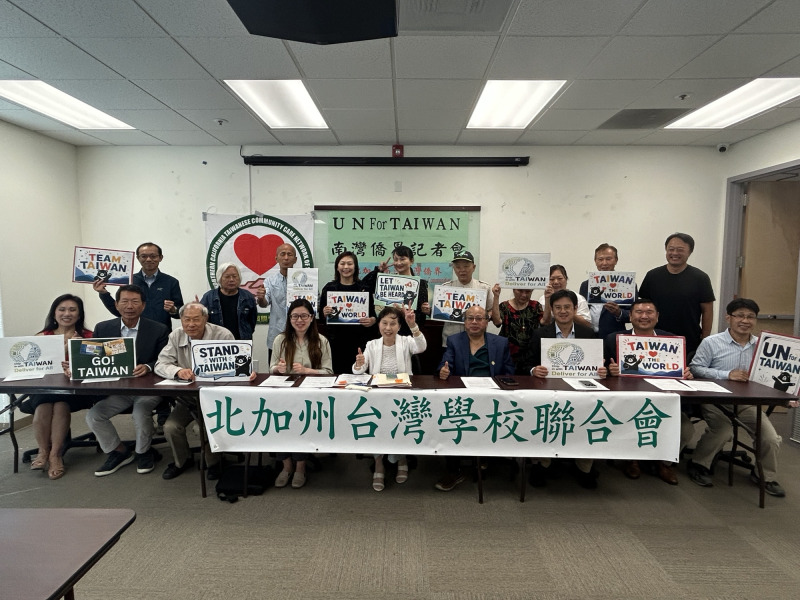
At the opening of the 81st session of the United Nations General Assembly, on September 19th, 12 Taiwanese community groups in Northern California jointly held a press conference advocating for Taiwan’s membership in the United Nations. They urged the UN to recognize the rights of Taiwan’s over 23 million people to participate in international affairs and to accept Taiwan as a member state.
Representatives at the conference condemned the long-standing suppression of Taiwan by the Chinese Communist regime in the international community. They criticized Beijing for distorting the meaning of UN Resolution 2758 to hinder Taiwan’s participation in the UN and other international organizations. They emphasized that Taiwan’s strategic location in the first island chain of the Western Pacific is crucial not only for the safety of its 23 million people but also for the security of the Western Pacific, global high-tech supply chains, and world peace. Allowing Taiwan to participate in the UN system would help the international community collectively maintain regional peace and stability.
The theme of the 81st session of the UN General Assembly, opened on September 8th at the UN headquarters in New York, is “Restoring Trust, Managing Transformation: A United Nations That Delivers for All.”
Yeh Chun-Hsiung, former president of the North America Taiwanese Professors Association Northern California Chapter, read out the joint statement on behalf of the 12 Taiwanese community organizations.
The statement pointed out that Taiwan is still excluded from the UN, with one significant factor being the intentional distortion by the Chinese Communist Party of the 1971 UN General Assembly Resolution 2758.
Yeh emphasized while reading the statement: “This resolution does not mention Taiwan, let alone authorize Beijing to represent Taiwan at the UN.”
The statement criticized the Chinese Communist Party for continuing to compress Taiwan’s international space through its political and diplomatic influence, leading to Taiwan being excluded from many UN mechanisms despite its democracy and effective governance transformation from authoritarianism to democracy. It stated that the exclusion of Taiwan’s 23 million people from many UN mechanisms does not adhere to the principle of universality.
The statement also referenced related documents passed by the European Parliament this year, supporting Taiwan’s meaningful participation in international organizations and opposing unilateral changes to the status quo in the Taiwan Strait by force or coercion.
Yeh Chun-Hsiung said, “The UN must adhere to its charter, treat Taiwan fairly, and allow Taiwan to participate in relevant organizations, which would restore international trust in the UN.”
The joint statement also linked Taiwan’s international participation with peace and security in the Taiwan Strait and the Western Pacific.
Yeh pointed out that in recent years, the world has faced multiple challenges such as wars, public health crises, and geopolitical conflicts, with the Chinese Communist Party continuing to use military and grey-zone tactics in the Indo-Pacific region, especially in the Taiwan Strait and the South China Sea, attempting to unilaterally change the status quo.
The statement criticized the Chinese Communist Party for escalating actions that heighten regional tensions.
Quoting Vice President of the Republic of China, Lai Ching-te, Yeh said, “Though Taiwan is small, it is powerful.”
He stated that Taiwan, at the forefront of the Indo-Pacific’s first island chain, upholds democracy, freedom, and human rights, not only serving as a fortress of freedom and democracy but also as an indispensable part of security and stability in the Indo-Pacific region, as well as an important node for global economic prosperity.
The statement highlighted Taiwan’s essential role in the global advanced semiconductor manufacturing and technology supply chain. Taiwan’s advanced chips provide vital support for global computers, electronic products, and high-tech industries.
Additionally, Taiwan’s accumulated experience in public health, disaster response, technology, and industry can be shared with other countries through international organizations.
Yeh Chun-Hsiung stated, “Taiwan would be an indispensable part of the world’s continued progress.”
He expressed that excluding Taiwan from the UN despite its capability to contribute is a dual moral and substantive loss for the world.
The statement concluded by urging the UN to fulfill its commitment to “leave no one behind” and address the demand of the people of Taiwan to participate in international affairs.
The statement declared, “Taiwan will surely fulfill its responsibilities in the international community and make significant contributions.”
Representatives of the Taipei Economic and Cultural Office in San Francisco, OCA – Asian Pacific American Advocates, and Overseas Community Affairs Council attended the press conference.
She thanked overseas Taiwanese community for continuously speaking up for Taiwan over the years, making the international community aware that “Taiwan is a part of this world, of the international community,” and that Taiwan has the ability to make significant contributions to the international community and global peace.
She stated that the Taiwanese government has three important demands for participating in the UN this year.
Firstly, she stated that UN Resolution 2758 should not be the basis for preventing Taiwan from meaningful participation in the UN system.
Second, Taiwan firmly upholds the peaceful status quo in the Taiwan Strait and is committed to safeguarding it.
“We are not a country that disrupts peace, we are a country that protects peace,” Tsai said.
Thirdly, Taiwan pledges to resolve disputes peacefully with the UN and the international community and to uphold the international legal order.
She stated that any actions attempting to disrupt the current situation in the Taiwan Strait involve the fundamental principles prohibiting the use of force and the requirement to resolve disputes peacefully, as stated in the UN Charter.
Tsai said that the Taiwan government hopes these demands will receive due attention from the international community.
She also specially thanked the overseas Taiwanese community for their long-standing support for Taiwan. “I am really grateful for all the support from the overseas Taiwanese community, advocating for Taiwan and for international peace.”
She expressed hopes that Taiwan’s voice will be heard by more international friends and the international community to allow Taiwan to play a more important role in the international community.
Li Han-wen, an Overseas Community Affairs Council advisory commissioner, contact person and moderator for the press conference, and founder of the Northern California South Bay Taiwanese Overseas Community Alliance, stated that the theme of the 81st UN General Assembly is “Restoring Trust, Managing Transformation” and emphasized establishing a United Nations that is effective for everyone. Therefore, how the UN addresses the demands of Taiwan’s over 23 million people is an important issue for whether it can realize relevant concepts effectively.
“First, let’s see how the UN will handle our demands from Taiwan,” Li said. Taiwan has been consistently knocking on the doors of the UN for many years, but its request to join the UN has been consistently rejected.
She stated that the Taiwan government and overseas Taiwanese communities have been making efforts through various activities to make the voices of the Taiwanese people heard in the international community.
She said, “These activities are to ensure that the voices and demands of our 23.5 million people in Taiwan can be accepted by the UN, and be seen and heard by the mainstream.”
Discussing Resolution 2758, Li emphasized that the resolution only dealt with the issue of the representation of the People’s Republic of China at the UN, but it did not state that Taiwan belongs to the People’s Republic of China.
She criticized the Chinese Communist Party for using its misinterpretation of Resolution 2758 over the years to claim Taiwan as part of the People’s Republic of China in the international community and to compress Taiwan’s international space.
She stated that through international propaganda, Beijing has made the international community accept its position on Taiwan’s status, aiming to further isolate Taiwan and create an international discourse foundation for its annexation of Taiwan.
Therefore, Li called on the people of Taiwan and overseas Taiwanese to unite on the issue of Taiwan’s international participation.
“We all, regardless of our party affiliations, should unite externally,” she said.
She also urged the UN General Assembly and Security Council to return to the UN Charter’s principles of peacekeeping and human rights and address the demands of the Taiwanese people to participate in the UN.
Chou Hsin-Chieh, spokesperson for the Northern California Taiwanese Forum and former president of the North America Taiwanese Professors Association, stated that faced with the Chinese Communist Party’s pressure on Taiwan in diplomatic and military fields in recent years, one important task of overseas Taiwanese is to establish deeper and long-term relationships with the US Congress and mainstream society.
He stated that the Chinese Communist Party, in “diplomatic, military, and all other aspects,” is exerting pressure on Taiwan and attempting to block Taiwan’s channels to participate in international affairs.
Chou believes that Taiwan should further cooperate with the US, Europe, Japan, and other democratic countries.
He stated that Taiwan-US relations should not solely depend on the executive branch but should also deepen cooperation with bipartisan members of the US Congress to institutionalize and perpetuate support for Taiwan.
Chang Chih-Yang, representative of the North American Taiwanese Engineers Association and vice president of the Taiwanese Chamber of Commerce, San Francisco Bay Area, said, “Taiwan should no longer be excluded from the United Nations.”
He stated that Taiwan has over 23 million people, is a crucial pillar in the global technology supply chain, and is a practitioner of democracy, freedom, and the rule of law.
From semiconductors to public health to disaster relief, Taiwan continues to make contributions to the international community, yet it is unable to obtain fair participation opportunities within the UN system. “This is not just Taiwan’s loss, but also that of the world,” he said.
Chang presented three demands: for the UN to stop using Resolution 2758 as a basis for excluding Taiwan from the UN system, to allow Taiwan to participate meaningfully in the UN and specialized agencies and fields such as public health, civil aviation security, climate change, and sustainable development, and to ensure equal participation rights for the people of Taiwan, media, and NGOs in UN-related activities.
“‘Leaving no one behind’ should not just be a slogan,” he said. “Taiwan is willing and able to contribute. Let Taiwan participate in the world to make the world more complete.”
Lin Chin-Tang, former president of the North American Taiwanese Medical Association Northern California Branch, explained the importance of Taiwan’s participation in the UN system from a public health perspective.
He stated that the UN’s vital mission is to maintain world peace, and its system includes the World Health Organization (WHO), which undertakes important global public health work.
Over the years, the North American Taiwanese Medical Association has continuously supported Taiwan’s participation in the World Health Assembly (WHA) by attending meetings in Geneva.
Lin expressed that if Taiwan could further participate in the UN system, it would assist Taiwan in joining WHO and other international organizations and sharing medical, disease prevention, and public health experiences with the world.
Tan Chih-Jen, representative of the San Francisco Bay Area Taiwanese Junior Chamber of Commerce and former president, stated, many young Taiwanese Americans who grew up in the U.S. and recent young immigrants from Taiwan are not fully familiar with Taiwan’s participation in the UN and its international situation.
Therefore, he believes that an essential task for overseas Taiwanese community groups is to help the younger generation understand Taiwan’s relationship with China and how pressures from the Chinese Communist Party affect overseas Taiwanese.
“All our young Taiwanese friends in the chamber are very supportive of the work done by our seniors here (overseas) advocating for Taiwan to join the United Nations,” he said.
Tan stated that they will continue to work with the chamber’s leaders to help more young people understand Taiwan’s situation, encouraging the new generation to participate in pushing for Taiwan to join international organizations.
Hsiang Ching-Yun, representative of the Taiwanese Cultural and Sports Association, said that many people born and raised in Taiwan have no direct connection with China in their life experiences. However, Beijing continuously claims Taiwan belongs to China through its international influence.
He believes that Taiwan plays an important role in the global economy and technology sector but has not obtained corresponding international participation opportunities, which does not align with the UN’s emphasized spirit of equality.
Hsiang expressed that Taiwan has been continually voicing out to the international community in recent years, making more people understand the differences between Taiwan and China.
“If we remain silent and do not speak out, we are essentially admitting to that fact,” he said.
Even though Taiwan is currently unable to join the UN, efforts should not cease. He stated, “As long as we continue to strive, this goal will be achieved.”
Wendy Huang, a Republican candidate for the House of Representatives primary this year, also expressed support for Taiwan’s entry into the UN.
She said that standing together with Taiwanese Americans to support Taiwan’s entry into the UN is because people should be treated equally, and everyone has the right to speak out.
She said, “We don’t need to be afraid,” encouraging Taiwan to continue moving forward, even though the path may not be easy.
Representatives at the conference stated that in recent years, the Chinese Communist Party has been applying pressure on Taiwan through military, diplomatic, and grey-zone tactics, and the issues faced by Taiwan are not just about its own security.
Located at the core of the first island chain with the Taiwan Strait being a vital maritime passage linking Northeast Asia and Southeast Asia, conference participants believed that if peace in the Taiwan Strait is disrupted, the consequences would extend to Japan, the Philippines, and the entire Western Pacific, potentially impacting global shipping, semiconductor, and high-tech supply chains.
Therefore, the conference representatives advocated for Taiwan’s entry into the UN and other international organizations not just as a matter of Taiwan seeking international space but also as a crucial way for Taiwan to collaborate through international multilateral systems with other countries to jointly safeguard peace and prosperity in the Taiwan Strait, Western Pacific, and the world.
The joint statement expressed that Taiwan is willing to contribute its expertise and experience through the UN system and multilateral mechanisms to collectively address global challenges.
“Taiwan firmly upholds the core values of democracy and freedom, safeguards the stability of the Taiwan Strait, and protects world peace,” the statement said.
The twelve organizations participating in the “Advocating for Taiwan to Become a UN Member State” joint statement are:
– Northern California Taiwan Forum
– North America Taiwanese Professors Association, Northern California Chapter
– Northern California South Bay Taiwanese Association
– North America Taiwanese Engineers Association, Headquarters
– Taiwanese Chamber of Commerce San Francisco Bay Area
– San Francisco Bay Area Friends of Taiwan Association
– Taiwanese Junior Chamber of Commerce San Francisco Bay Area
– Northern California Taiwanese Care Association
– San Jose Taiwanese Overseas Community Network
– Northern California Taiwanese Schools Association
– North America Taiwanese Medical Association, Northern California Branch
– Taiwanese Cultural and Sports Association
The twelve organizations urged the UN to uphold the commitment of “leaving no one behind” and address the demands of the people of Taiwan to participate in international affairs.
The conference representatives emphasized that a truly “effective for all” UN should not overlook the voices of Taiwan’s over 23 million people. Allowing Taiwan to participate in the UN system is not only about the international participation of the people of Taiwan but also about enabling Taiwan to share its experiences in public health, technology, disaster response, among other fields with the international community, and jointly maintain peace and prosperity in the Taiwan Strait, Western Pacific, and the world.