
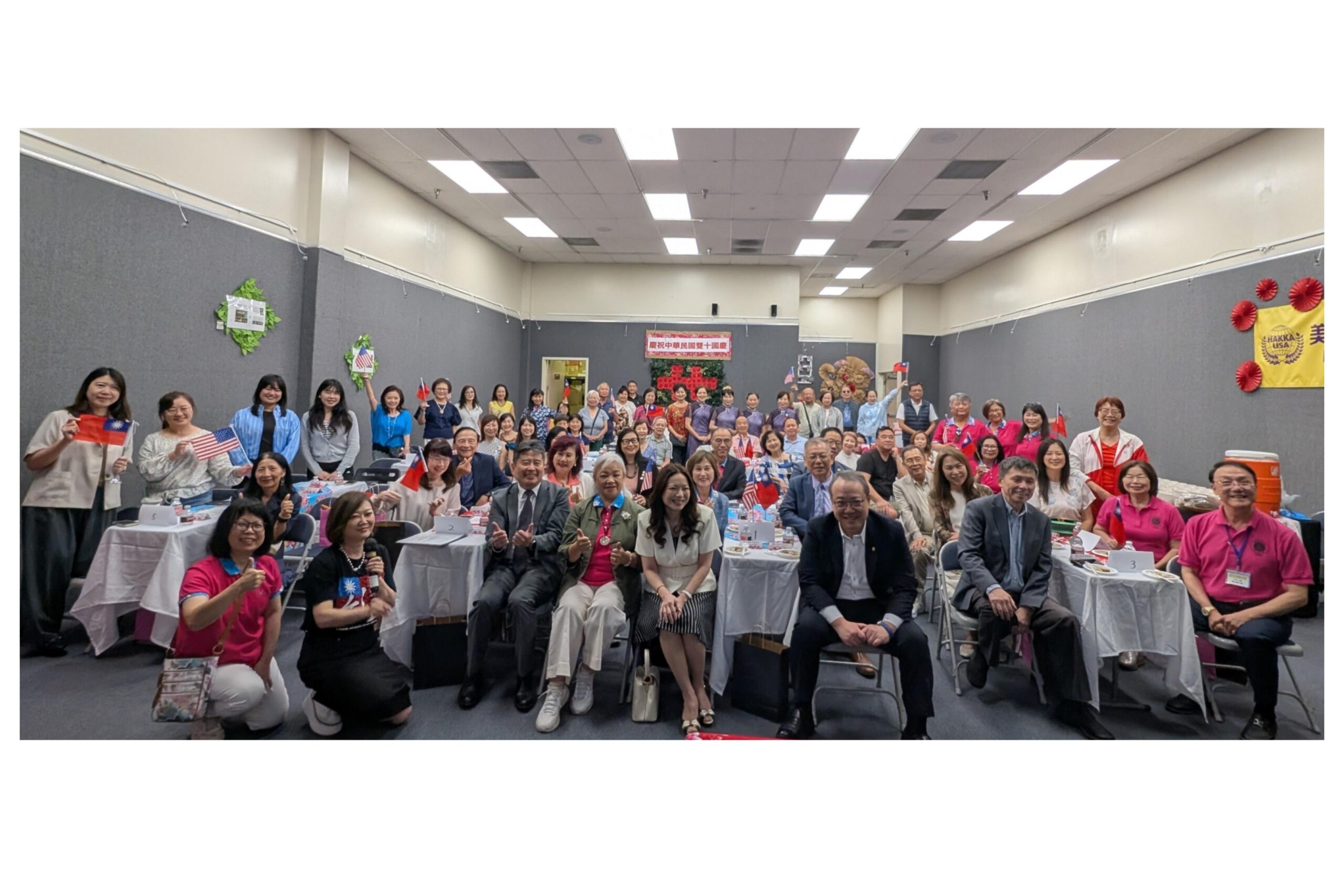
The California Hakka Association hosted the “Celebrating Double Tenth Hakka Charm National Day New Chapter” Hakka Culture Carnival at the Overseas Chinese Cultural and Educational Service Center in Los Angeles on September 19th (Sunday). With the theme of “Hakka Heart, Taiwan Sentiment”, the event aimed to introduce the public to Hakka culture through activities such as Hakka cuisine, Hakka language teaching, tung blossom painting, tea picking dance, and cultural lectures, celebrating the 115th National Day of the Republic of China.
High-level officials including Ma Boyuan, Director-General of the Taipei Economic and Cultural Office in LA, Deputy Director Zhang Haojun, and Director Beida Yu from the Los Angeles Taiwan Trade Center attended the event. Deputy Mayor Tony Ding and Councilor John Wu from the City of San Gabriel also graced the event, presenting certificates of appreciation to recognize the contributions of the organizers in promoting Hakka culture and enriching the diverse culture of Southern California.
The event took place at 1 pm in the exhibition hall of the Overseas Chinese Center, featuring five major cultural experiences including tasting traditional Hakka grass jelly and “niuwen water”, learning 10 practical Hakka phrases, tung blossom painting, Hakka tea picking dance performance, and a cultural lecture on “Understanding Hakka”. Alongside, Hakka rice noodles and souvenirs were prepared for participants to engage in a multi-sensory exploration of Hakka culture.
President Luo Yinye of the California Hakka Association expressed delight in celebrating the National Day of the Republic of China with local residents once again. She explained that in the Hakka dialect, the character “U+2028E” is used as the first-person pronoun “I”, symbolizing the spirit of the Hakka community as hardworking, capable, and proactive dwellers on the cliffs. Embodying the Hakka people’s hospitality, every event organized by the Hakka Association meticulously prepares various experiences catering to guests’ senses, welcoming and treating each visitor with care.
Luo Yinye mentioned that while it may not replicate the vibrant scenes of the Zhudong Central Market in Taiwan, attendees could still experience tung blossom painting, taste traditional grass jelly and niuwen water, and savor authentic Hakka rice noodles during the event. She particularly highlighted the Hakka people’s emphasis on education with the tradition of “cultivating the fields in sunny weather and studying in rainy weather”, and this year introduced “Little Hakka Language Chatter”, aiming to establish the roots of Hakka language and culture in Los Angeles through simple language teaching.
Director Huang Yongju of the Supervisory Board stated that Hakka culture is an integral part of the diverse culture of the Republic of China. The diligence, resilience, and unity of the Hakka people, along with their pride in being associated with the founding father of the nation, Dr. Sun Yat-sen, have enabled them to spread their roots worldwide and contribute to local communities.
Huang Yongju emphasized that this event not only commemorates the birthday of the Republic of China but also seeks to pass on Hakka culture and promote Hakka spirit, allowing more people to understand the profound heritage and contemporary aspects of Hakka culture.
Ma Boyuan, also known as a “Hakka son-in-law,” participated in the event with his wife, sharing anecdotes about accompanying his wife back to the Hakka village during the Lunar New Year period. He mentioned the diverse range of Hakka cuisine and how the Hakka language, somewhat akin to the Russian language for him, might be challenging to understand, but the interactions convey the warmth, hospitality, and unity of the Hakka people.
During the event, Vice President Ke Xinyu and Advisor Jiang Ruiying led participants in learning Hakka language, with lively and engaging teaching moments eliciting laughter. Hakka delicacies such as grass jelly and rice noodles were quickly devoured by attendees, creating a vibrant atmosphere at the venue.
Jiang Ruiying hoped that through the National Day cultural activities, overseas communities could not only celebrate the Double Tenth Festival but also deepen their understanding of Hakka language, cuisine, art, and traditions, continuing the legacy of Hakka culture overseas.