
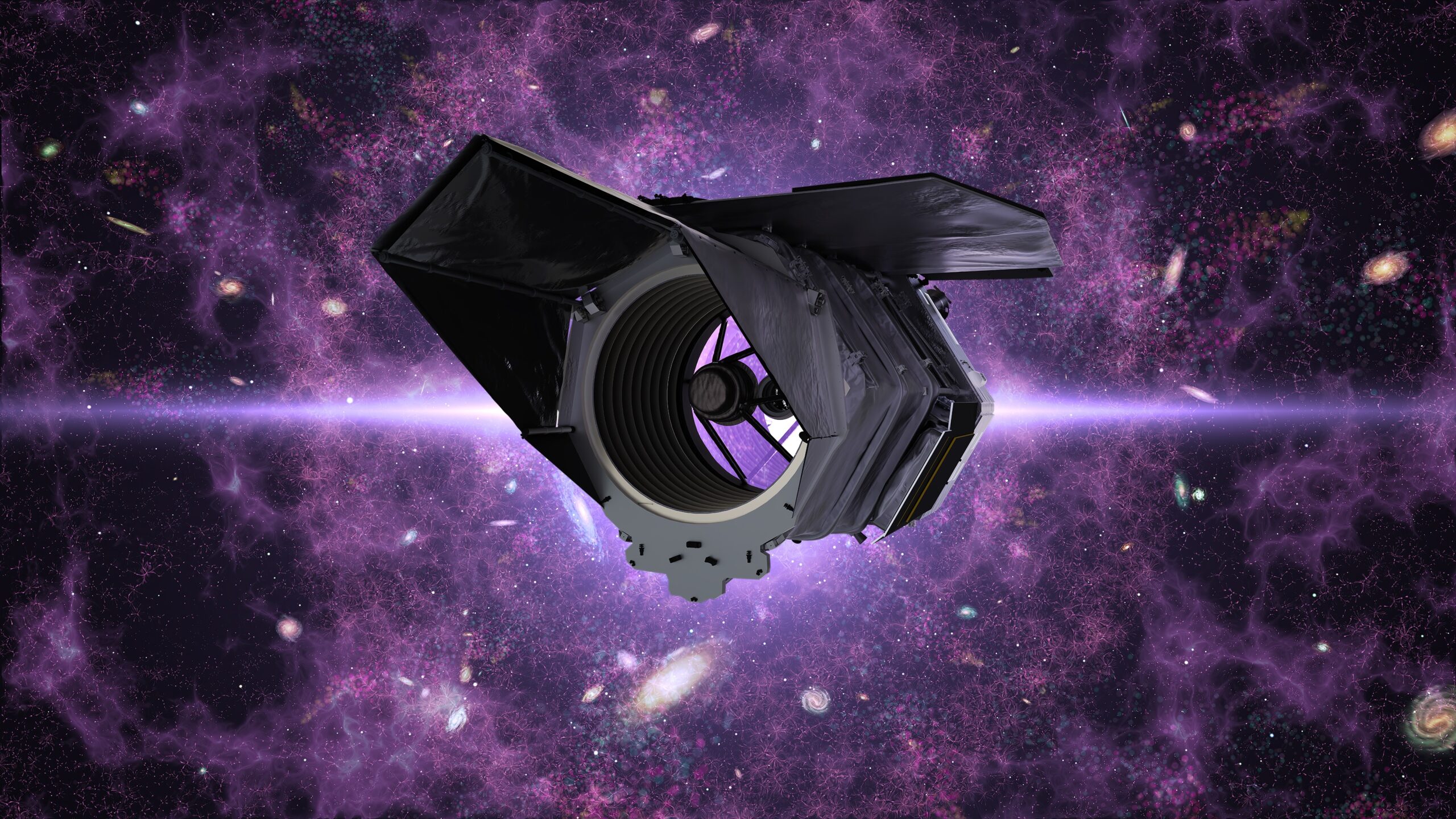
Less than five years after the revolutionary James Webb Space Telescope (JWST) made its debut, the United States National Aeronautics and Space Administration (NASA) has deployed another flagship-class space observatory – the Nancy Grace Roman Space Telescope. Named after NASA’s first chief astronomer Nancy Grace Roman, this space telescope will focus on unraveling the mysteries of dark matter, dark energy, and searching for thousands of exoplanets, providing unprecedented cosmic perspectives for astronomers in various fields.
The Roman Telescope was launched on August 30, 2026, aboard a SpaceX Falcon Heavy rocket from the Kennedy Space Center in Florida. At 7:57 AM Eastern Time, the telescope successfully separated from the rocket’s second stage and began its independent journey.
Currently en route to the Sun-Earth Lagrange point 2 (L2) orbit, approximately 1.5 million kilometers from Earth, the Roman Telescope is expected to arrive after a journey of about 3 months. Upon arrival, Roman will operate near L2, where gravitational forces are balanced, allowing objects to maintain a stable orbit without excessive external assistance. The telescope’s main scientific instruments have been activated and are in the on-orbit calibration phase, with NASA planning to release the first batch of images in early 2027.
At a time when the Webb (JWST) and the venerable Hubble telescopes are continuously returning high-resolution images and accumulating observational results, people naturally wonder: what new cosmic perspectives can this brand-new space telescope bring to us?
The core mission of the Roman Space Telescope focuses on three major areas:
1. Cosmology: by precisely measuring the shapes and distances of hundreds of millions of galaxies, tracing the distribution patterns of dark matter and dark energy.
2. Exoplanet Statistics: utilizing Gravitational Microlensing technology to search for thousands of distant exoplanets around stars.
3. Large-scale Astrophysical Surveys: establishing a massive database covering hundreds of billions of galaxies and stars.
With its wide-angle instrument known as the Wide Field Instrument (WFI), boasting a 300-megapixel infrared camera, the Roman Telescope has successfully received starlight in space. It also carries a Coronagraph Instrument (CGI) for blocking starlight to observe fainter objects like exoplanets and dust disks. The telescope’s high agility allows for quick area switching and observation steps to cover vast regions within its limited mission lifespan.
While the Webb Telescope focuses on depth and extreme resolution, Roman is designed for large-scale sky surveys. Roman mainly observes near-infrared light, overlapping with the Webb’s infrared range but extending further into the mid-infrared, diverging from Hubble’s coverage of visible and ultraviolet light.
In many ways, Roman is more similar to the seasoned Hubble in terms of its structure and design. Both telescopes feature a 2.4-meter primary mirror but Roman’s is lighter, contributing to its agility in operations.
Roman’s advanced technology includes an array of 18 HgCdTe infrared sensors with a field of view 100 times larger than Hubble’s advanced cameras, accumulating observational data significantly faster.
In terms of orbit and maintenance, Hubble orbits around 540 kilometers above Earth, while Roman is stationed at L2 approximately 1.5 million kilometers away, making direct human maintenance challenging albeit possible via robot servicing. Estimated to have at least a 22-year fuel supply, Roman was originally designed for a 10-year lifespan but could extend beyond that due to efficient fuel consumption.
As instruments are being activated in September, NASA anticipates completing calibration, testing, and reaching L2 in the coming months with the first images expected in early 2027. With unprecedented data, Roman will lead humanity to rediscover dark matter, dark energy, and potentially millions of alien worlds in the universe.