
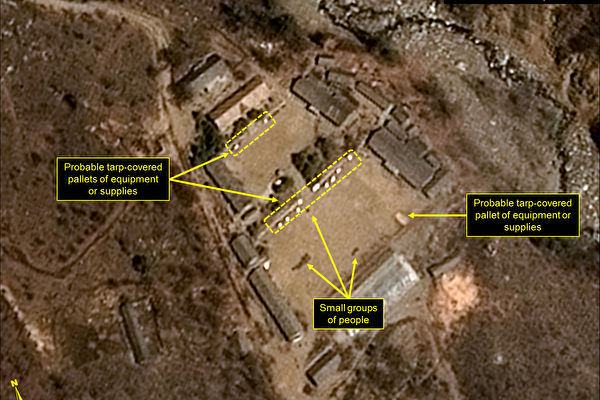
Since the last and most powerful nuclear test by North Korea in 2017, scientists have noted a continuous increase in the number and magnitude of earthquakes near the Punggye-ri nuclear test site.
According to CNN, North Korea conducted six underground nuclear tests at the Punggye-ri test site in Mount Mantap, Hamgyongbuk-do, between 2006 and 2017. The last test, estimated to have an explosive yield of 1.6 megatons of TNT, triggered a 6.3 magnitude earthquake and reportedly caused the collapse of underground tunnels at the test site.
In the past, it was known that nuclear tests could trigger small, detectable earthquakes, like during the Cold War when nuclear testing in Nevada, USA, would often result in earthquakes near the blast site days or weeks after the explosion.
However, a study by researchers at the University of Chicago led by Kwang-Hee Kim found that analysis of seismic wave data collected from South Korea and China between 2008 and 2025 showed a total of 1,399 earthquakes around Mount Mantap, with both the number and magnitude of earthquakes increasing over time.
Sunyoung Park, an assistant professor at the University of Chicago’s Department of Geophysical Sciences, stated that this indicates that the effects of some short-term disturbances may persist for several years or even decades, as the Earth’s crust has a long memory.
Following North Korea’s third nuclear test in 2013, the earliest earthquake was recorded. Before 2017, seismic activity in the region had been relatively low. However, seismic activity significantly increased in the years following North Korea’s sixth and most powerful nuclear test in 2017.
Kim noted that while these earthquakes are not very powerful, ranging mostly between magnitudes 2 and 3, it suggests that the earthquakes occur at shallow depths. The trend of seismic activity is clear, showing a linear increase that surprised the research team.
Historical records of seismic activity in China and South Korea span over 2,000 years, with very few events in the region and minimal seismic activity reported. The stability of the Korean Peninsula’s continental crust has been known, but the researchers discovered the presence of ancient crustal faults in the area, indicating that the seismic frequency and intensity are continually rising since 2017.
Moreover, the unique terrain of Mount Mantap, with its massive size, steep slopes, and asymmetric shape, suggests that some fault lines in the region may be closer to an unstable state than others, making them more susceptible to being triggered by underground nuclear explosions.
Kim emphasized that the research team only counted earthquakes detected simultaneously by multiple monitoring stations, and the actual number of earthquakes could be higher if all monitoring stations were considered.
Park noted that most earthquakes triggered by underground nuclear tests typically diminish rapidly after the initial disturbance. However, in North Korea’s case, the seismic activity not only persists but increases over time.
She pointed out that there are precedents where human activities have led to delayed and prolonged seismic events. For instance, in the Netherlands, over 1,700 earthquakes have occurred since the 1960s due to natural gas extraction. In Oklahoma, USA, increased seismic activity was observed from 2009 to 2015 due to oil and gas production activities and underground wastewater injection.
Park suggested that nuclear explosions may cause rock fractures, creating new cracks and channels for groundwater to seep in, increasing pressure within the rock and facilitating fault movement. The slow movement of water could delay seismic reactions by several years.
Researchers stated that the increasing seismic activity triggered by underground nuclear tests blurs the line between earthquakes caused by explosions and natural tectonic activity, making long-term monitoring of underground nuclear test sites more challenging.
Kim mentioned that researchers have been unable to access the Punggye-ri nuclear test site to obtain seismic data from within North Korea. Thus, there is no concrete evidence indicating whether North Korea has conducted further nuclear tests since 2017.
However, reports from the International Atomic Energy Agency (IAEA) in 2022 indicated that North Korea had begun repairing test tunnels since March 2022. A 2025 report by the Defense Intelligence Agency (DIA) of the United States suggested that North Korea had resumed activities at the nuclear test site.
Researchers also documented signs of potential radiation exposure among some North Korean defectors who had previously lived near the nuclear test site, but scientists state that the exact reasons for this exposure cannot be determined yet.