
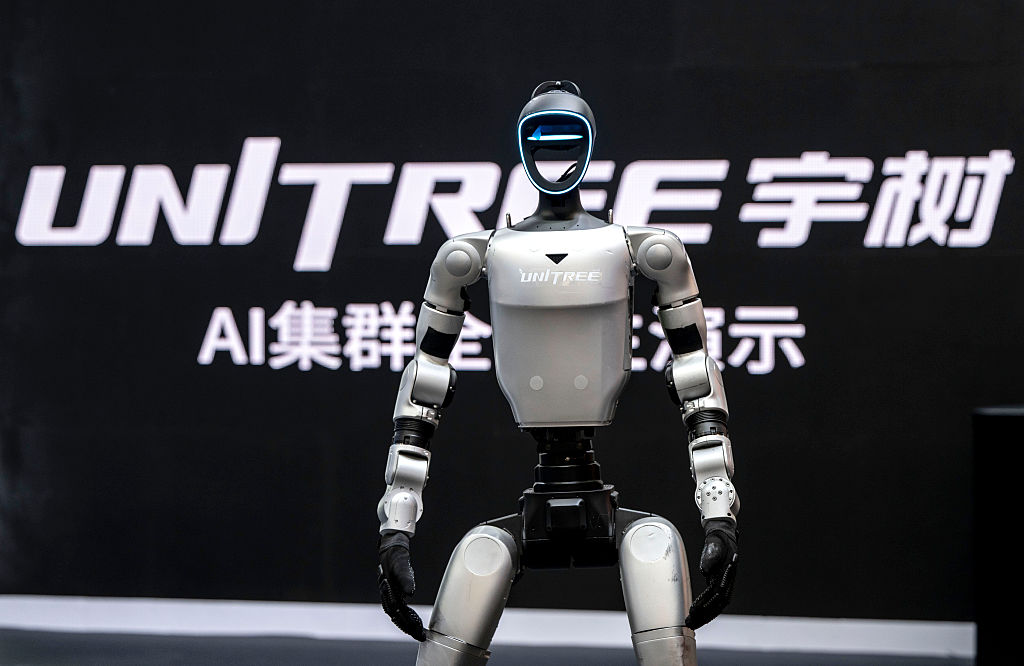
【Epoch Times News September 19, 2026】After a month of listing, the mainland robot company Yushu Technology’s stock price has dropped by 53.18% from the initial intraday high point as of September 18, with a decrease in the company’s market value of about 236.6 billion yuan. Despite the recent rebound in stock prices, doubts about its commercial progress and high valuation in the market have not subsided.
On September 18, Yushu Technology closed at 514.98 yuan, with a market value of about 208.3 billion yuan. The stock closed at 470 yuan on September 14 and then rebounded for four consecutive trading days, accumulating an increase of 9.57%. However, compared to the intraday high point of 1100 yuan on the first day of listing, it still fell by more than fifty percent.
Yushu Technology was listed on the Shanghai Science and Technology Innovation Board on August 19, with an IPO price of 150.80 yuan per share. On the first day of listing, the stock price surged to 1100 yuan at the opening, then fell back and closed at 845 yuan. According to the highest price that day, the company’s market value once reached about 444.9 billion yuan.
According to estimates by “The Paper News” based on the post-issuance shareholding ratio, the market value of the shares held by Yushu’s founder and CEO Wang Xingxing has decreased from a peak of about 139.2 billion yuan to about 65.2 billion yuan, a decrease of about 74 billion yuan.
Investors who bought at the high on the first day of listing and held it until now also suffered significant paper losses. Investor Cheng Xiao bought 400 shares at 925 yuan per share on the first day, spending about 370,000 yuan. When the stock price dropped to about 689 yuan the next day, he described seeing the market and feeling “black in front of eyes.” Based on the closing price on September 18, the paper loss on this investment has exceeded 160,000 yuan.
Xue Hongyan, the deputy director of the Xingtu Financial Research Institute, told “Beijing Daily” that in the early stage of Yushu’s listing, there were relatively few circulating shares, coupled with market enthusiasm for the humanoid robot concept, which pushed the forward expectations to a high level on the first day of listing. The subsequent decline reflects that the company’s valuation is too high, and market expectations have been prematurely exhausted.
Tian Lihui, a finance professor at Nankai University, stated that the market value of over 440 billion yuan on the first day of Yushu is mainly due to liquidity and concept premiums. The market priced the prospects of robots entering homes and factories in the future, but the company’s actual applications are still mainly concentrated in laboratories and exhibition scenarios.
Yushu’s semi-annual report shows that the company’s operating income in the first half of this year was 1.152 billion yuan, a year-on-year increase of 48.54%; the net profit after deducting non-recurring gains and losses was 244 million yuan, a year-on-year decrease of 19.34%.
Yushu’s prospectus shows that in the first three quarters of 2025, 73.6% of the company’s humanoid robot revenue comes from scientific research and education, commercial consumption accounts for 17.4%, and industry applications account for only about 9%.
Wang Xingxing also admitted on August 20 that humanoid robots have not yet entered factories and homes on a large scale, mainly because their work efficiency is still lower than that of humans. Once the task or environment changes, they need to be retrained, and their ability to adapt to different scenarios is insufficient.
Yushu’s prospectus also states that there is no rigid demand in the consumer market for humanoid robots, and large-scale commercial deployment still has uncertainties. If technological progress or market demand falls short of expectations, the company’s operations will be affected.
According to The Information, a US tech media, quoting sources, the China Securities Regulatory Commission has privately issued “window guidance” to some investment banks and companies, raising the listing threshold for startup companies in humanoid robots, requiring relevant companies to demonstrate the ability to continue to generate revenue, reduce losses, or possess substantial technological innovation.
Reuters reported earlier that the changes come as the private financing of robot companies overheats, a large number of enterprises queue up for listing, and Yushu’s stock price sharply falls from highs. The relevant financial regulatory authorities of the Chinese Communist Party did not respond to Reuters’ request for comment, and Reuters could not independently verify the news.