
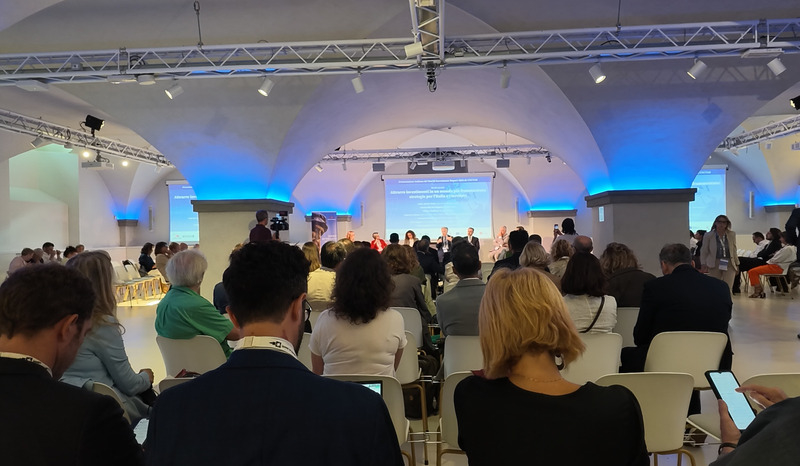
The United Nations Conference on Trade and Development (UNCTAD) held its annual report release conference in Italy on the 17th, emphasizing that in the face of geopolitical turbulence, AI, semiconductors, and other strategic areas have become crucial sectors. Bruno Casella, a senior economic official at UNCTAD, stated in an interview with Central News Agency that Italy should strengthen its economic and trade relations with Taiwan as Taiwan plays a pivotal role in industries such as semiconductors.
UNCTAD, a permanent United Nations institution, releases the influential “World Investment Report” annually, which has a significant impact on the global financial and political sectors.
On the 17th, UNCTAD was invited to present the 2026 Investment Report in Florence, Italy. The conference was organized by the Tuscany regional government and the “Invest in Tuscany” institution, focusing on deepening international economic and trade cooperation and attracting foreign investment.
Casella emphasized in the interview that this year’s report conveys the most important message that due to geopolitical, technological developments, and ecological changes, we are living in an extremely turbulent world where foreign investment is undergoing significant changes, especially in the “explosive growth of strategic industries.”
He explained that the strategic areas specifically refer to five industries, including AI, semiconductors, environmental sciences, critical minerals, and other advanced dual-use military-civilian technologies. Just these five industries have increased from 16% to 44% of total foreign direct investment (FDI) within five years, almost half of foreign investment.
Given Taiwan’s critical position in the semiconductor industry supply chain, Casella specifically recommended Italy to strengthen its economic and trade cooperation with Taiwan. He cited data showing that semiconductors are one of the most invested industries by foreign funds, and the investment amounts are substantial. “Interestingly, 30% of the total semiconductor investment currently flows through a single channel from Taiwan to the United States.”
“Therefore, it is clear that Taiwan is a very important partner,” Casella stated. “If some of Taiwan’s semiconductor investments were to flow to Italy instead of the United States, that would be fantastic.” Hence, he believes that Italy needs to enhance its connection with Taiwan because Taiwan is a significant player in international trade, particularly in the semiconductor sector.
In contrast to the explosive growth of strategic industries, data shows that traditional industries that have attracted vast foreign investments in the past three to four decades are facing stagnation and restructuring. Foreign investment in traditional industries is decreasing, with more turning to the “friendshoring” model, which has a significant impact on developing countries, especially industries like textiles, agriculture, and non-electric vehicle automobile manufacturing.
Regarding the implications of this trend for Italy, Casella said that as a developed country, Italy’s first focus should be to “keep pace with growth engines.” “If foreign funds are focusing on these five strategic industries, you must have a presence in these areas,” he added. He believes that Italy currently runs the risk of insufficient participation in critical strategic industries, including environmental technology, electric vehicles, batteries, and emphasized the need to bridge this gap.
Another key economic and trade focus for Italy is to “defend the traditional global value chain,” which refers to efficiency and cost-oriented multinational outsourcing division of labor. Casella mentioned that the traditional global value chain does not naturally exist and requires efforts to defend it during difficult times, thus, in the future, post-sales services, and customer retention will become more critical.
Overall, he believes that Italy should adopt a “dual approach strategy,” combining offense and defense in order to seize opportunities in the new world while preserving advantages in the old world.