
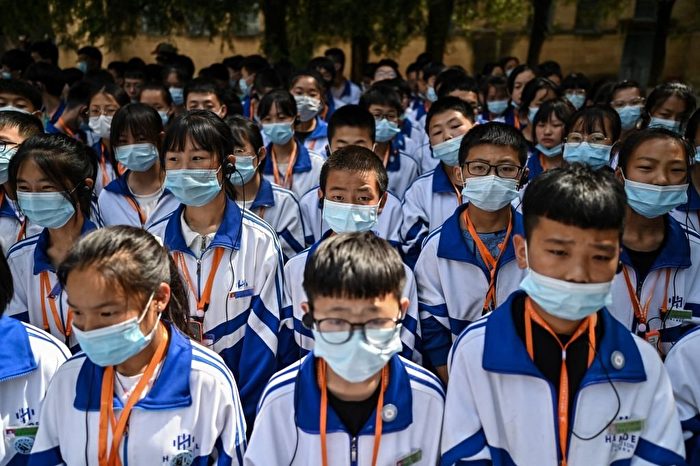
On September 1st, the new school year began for elementary and middle schools in mainland China. It has been reported that there is an increasing number of dropouts among students, with a rising sentiment of the futility of education, especially in the wave of youth unemployment. The Chinese education system has long been criticized for its political indoctrination of students, with schools being likened to prisons.
According to data from the National Bureau of Statistics of China, the unemployment rate for 16 to 24-year-olds in urban areas, excluding students, reached a record high of 17.9% in July 2026. However, these numbers are believed to be inflated by official manipulation.
In recent years, it has become common to see graduates of top Chinese universities taking on roles as grassroots city management officers or auxiliary police, while university students are frequently seen working as delivery drivers. Many online videos feature testimonials from graduates struggling to find employment.
A new trend of “education is useless” has emerged in China in recent years. In September 2025, the Cyberspace Administration of China issued a notice to conduct a two-month nationwide campaign against the propagation of negative sentiments, including discouraging the value of education.
The harsh reality of “graduate unemployment” has now started affecting elementary and middle school students as well. In a heart-wrenching incident on September 1st, a third-grade student from Tianjin’s Jinghai District broke down in tears while doing homework, expressing doubts about the purpose of life and questioning the need for education. His emotional outburst went viral on social media, resonating with over 145,000 netizens who praised the child’s insights.
Recent reports reveal a growing number of dropouts among elementary and middle school students in mainland China, with some as young as first graders opting out of formal education. During interviews, some children mentioned staying at home under parental supervision instead of attending school, citing concerns over safety and the quality of education.
Notably, instances of bullying and teacher abuse have also contributed to the disillusionment of students towards formal education. While some families cannot afford to send their children to school due to financial constraints, others opt for homeschooling to shield their children from what they perceive as excessive political indoctrination in schools.
Videos emerging from Hubei Xiangyang Public Security Bureau revealed a harsh crackdown on students at Xiangyang High-Tech Foreign Language School during the school’s reopening on September 1st. The police conducted thorough inspections of students’ personal belongings, sparking criticism online likening the school to a prison.
The prevailing “Hengshui Model” in Chinese education, derived from Hengshui Middle School in Hebei Province, has drawn scrutiny for its rigid academic regimen and closed-off management style. Despite being hailed as a success model for sending students to prestigious universities, the approach has faced allegations of resembling a prison environment, as depicted in photographs from Hengshui 2nd Middle School.
Comparison with the education system in the United States highlights stark differences in school hours and holiday breaks, with Chinese students often enduring long school days and minimal vacation periods. The strenuous academic environment has led some students to equate their schools to prisons, reflecting the growing discontent among the youth in China.
Over the past years, clashes between students and school authorities have escalated, with incidents like protests against shortened vacation periods and strict disciplinary measures being reported from various provinces, further underscoring the deep-rooted issues within the Chinese education system.