
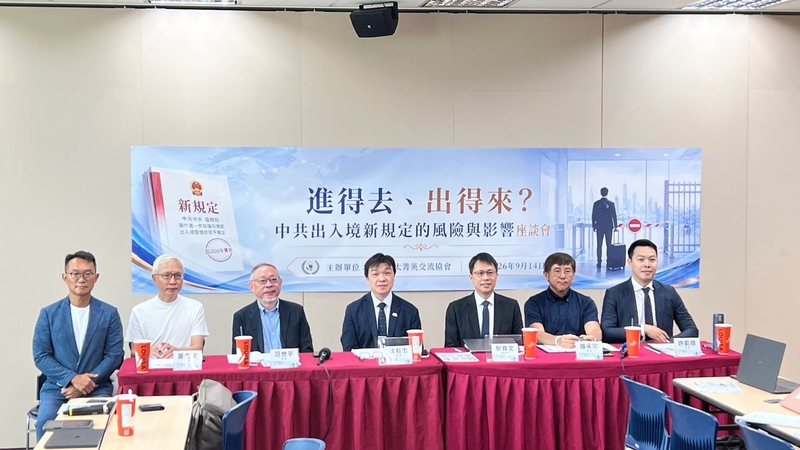
The new regulations on entry and exit management by the Chinese Communist Party will be implemented today, September 15. Shen Youzhong, Deputy Minister of Taiwan’s Mainland Affairs Council, warned that there are five categories of people in Taiwan who may face risks when entering or leaving the mainland, including Taiwanese businessmen in China, executives of Taiwanese companies, semiconductor and high-tech professionals, grassroots civil servants, and certain religious figures.
Shen Youzhong attended a seminar on “Can you enter and exit safely? Risks and impacts of the new entry and exit regulations by the Chinese Communist Party” held in Taipei on the 14th by the China Asia-Pacific Elite Exchange Association.
Regarding the Chinese Communist Party’s implementation of the new regulations on “Entry and Exit Management” starting today, which will “legalize” border control and expand law enforcement discretion, Shen Youzhong explained in detail the potential risks and impacts on the personal safety of Taiwanese people traveling to the mainland.
Shen Youzhong pointed out that the full text of the Chinese Communist Party’s “Entry and Exit Regulations” contains 19 articles. While appearing to be for general management purposes, it actually institutionalizes border control practices lacking clear legal basis and expands the authority of law enforcement agencies. As the Chinese Communist Party regards Taiwanese people as Chinese citizens under its legal framework, it may restrict the entry and exit of Taiwanese civilians into mainland China.
He noted that under the Chinese Communist Party’s “Entry and Exit Regulations,” Article 3 stipulates that immigration authorities and visa agencies may inquire about relevant information when verifying the identity and purpose of entry and exit of individuals, and individuals must cooperate by providing relevant documents, information, electronic data, and other information.
Furthermore, he said that Article 4 of the Chinese Communist Party’s “Entry and Exit Regulations” states that violation of regulations on export control, technology import and export management, which could potentially endanger industrial and technological security, may result in prohibitions on exiting the country. Article 6 further stipulates that in cases affecting national security or investigation, the individuals involved may be prohibited from exiting the country without being informed of the reasons, facts, legal basis, and available recourse.
Shen Youzhong emphasized that these regulations strengthen the Chinese Communist Party’s information monitoring and administrative discretion over entry and exit personnel, granting law enforcement officers at the border significant flexibility and discretionary space in enforcement.
In analyzing the content of the new regulations, the Mainland Affairs Council believes that five categories of people in Taiwan may face risks when entering or leaving mainland China, including Taiwanese businessmen in China, executives of Taiwanese companies, semiconductor and high-tech professionals, grassroots civil servants, and certain religious figures. The Mainland Affairs Council advises them to remember to register online when traveling to China for an added layer of security.
Shen Youzhong also stated that the number of individuals who have been interrogated, detained, or gone missing in China has increased recently. He said, “Currently, it does appear that the rate of increase in the past few years is indeed unusual.”
He warned that in response to the Chinese Communist Party’s upcoming leadership changes and internal stability demands, they will continue to consolidate power through legal means, with the “Entry and Exit Regulations” just being one aspect of it. The implementation of regulations such as the Ministry of Public Security’s “Measures for the Supervision and Inspection of Cyber Security by Public Security Organs” will also allow authorities to inspect and monitor personal devices, so individuals need to be more cautious.
Shen Youzhong reiterated the importance of cross-strait exchanges being based on goodwill, equality, and dignity. The government has always advocated for “healthy and orderly cross-strait exchanges” and welcomes normal interactions; however, the Chinese Communist Party’s ambiguous laws and expanded enforcement have cast a shadow over these exchanges.
The Mainland Affairs Council calls on the other side to truly consider the well-being of the people on both sides of the strait, and to bring exchanges back to a rational and predictable path. At the same time, it reminds Taiwanese individuals in mainland China or intending to go there to carefully consider the political environment of the Chinese Communist Party, evaluate the necessity of their trip, pay attention to relevant regulations, and act cautiously to ensure their safety.