
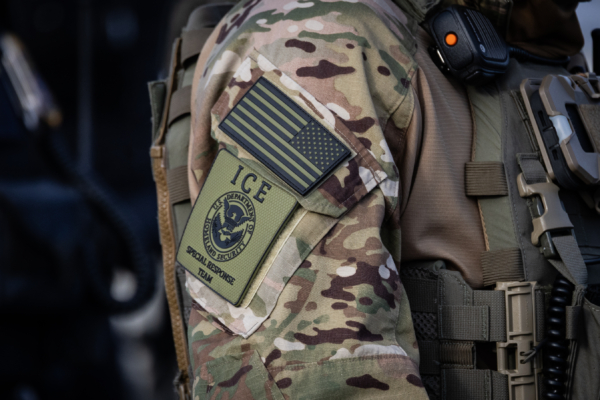
In the latest development, it has been reported that the United States Immigration and Customs Enforcement (ICE) is in the process of procuring electroshock gloves. Meanwhile, Democratic lawmakers in California are pushing for emergency legislation to prohibit federal law enforcement officers from using such devices within the state’s borders.
ICE began internally evaluating “wearable non-lethal compliance equipment,” including electroshock gloves, earlier this year. In August, federal procurement records revealed that ICE planned to spend $16.7 million to purchase 6,000 pairs of electroshock gloves from a company in Kentucky.
On August 21st, the California State Senate replaced the previous version of AB2760 with new content, stating that law enforcement agencies are prohibited from using wearable electroshock equipment within California. The proposal, now named “Law enforcement: wearable electroshock devices,” underwent discussions on August 27th and 28th in two separate committees and is awaiting a vote by the full Senate.
Assemblywoman LaShae Sharp-Collins, who represents the 79th District and introduced the bill, utilized the legislative procedure known as “gut and amend” in the final days of the session to expedite the process. The original AB2760 was passed by the Assembly in May with a vote of 51 in favor, 7 against, and 22 abstentions.
Sharp-Collins emphasized in the state legislature that taking action before tragedies occur is crucial, stating, “Although these gloves are not currently in use in California, waiting for a tragedy to happen before taking action is something California cannot afford.”
The statewide ban would apply to agencies such as ICE, Border Patrol, FBI, as well as local police departments and sheriffs. The proposal also prohibits California police departments from using state funds to purchase such wearable shock devices and calls for a reassessment of the use-of-force policies.
Senators including former California Secretary of State Alex Padilla and other Democratic members of Congress have written to the Department of Homeland Security urging the cancellation of related procurement contracts, describing the gloves as a “Taser disguised as restraints worn on the hands.”
According to Sharp-Collins’ statement in the proposal, these devices, concealed in gloves, can be used at close range and pose serious health risks if used excessively. Civil rights organizations such as the California Immigrant Policy Center strongly support the bill, viewing electroshock gloves as inhumane and indicative of excessive use of force.
Opposition to the proposal comes from organizations like the California State Sheriffs’ Association and some city and county police associations, arguing that the measure would limit officers’ ability to de-escalate situations. The California Police Chiefs Association noted that a blanket ban without sufficient evidence to demonstrate the inability to regulate new technology through policy and training is misguided, as less lethal means can ensure the safety of both officers and the public.
In a legal context, just last April, a federal court overturned a California law requiring immigration enforcement agents to wear masks and disclose their identities, ruling that the state had overstepped its authority in regulating federal law enforcement. Vikram Amar, a law professor at UC Davis, stated that states do not have the power to regulate how federal law enforcement officers carry out their duties under the Constitution. If this bill passes through the legislature and is signed by Governor Gavin Newsom, it is expected to face constitutional challenges once again.