
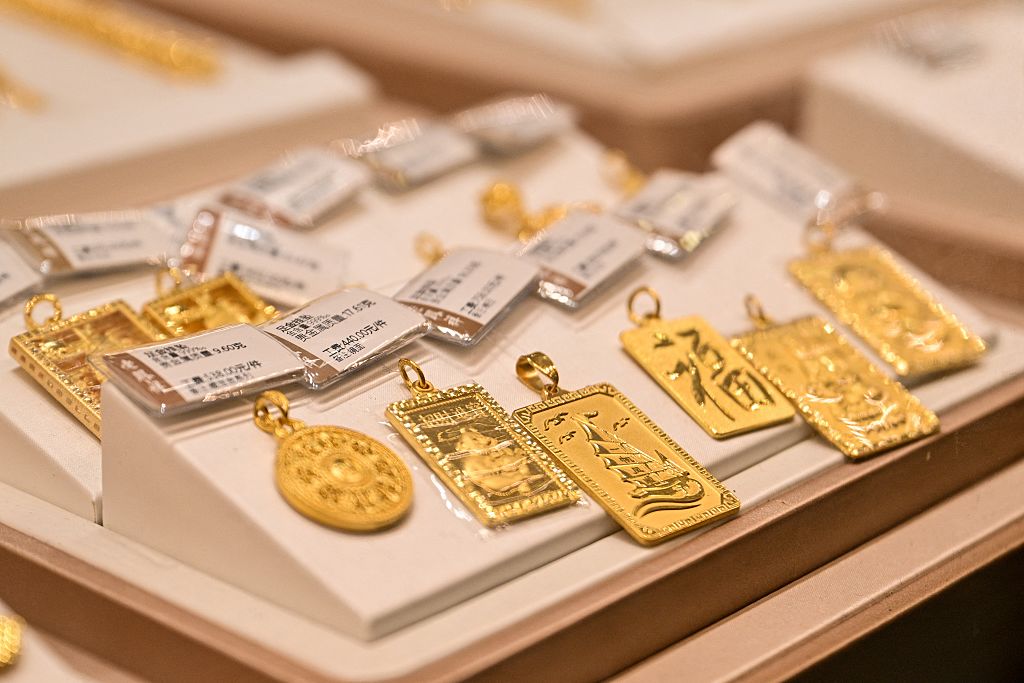
Two mainland jewelry chain enterprises shrunk their stores simultaneously in the first half of this year. Zhou Dasheng closed 557 stores, with a decrease in revenue from franchise channels of over 70%; while Laofengxiang reduced franchise network points in third- and fourth-tier cities, with a decline in revenue and net profit of over 40%.
According to Zhou Dasheng’s semi-annual report, the company’s revenue in the first half of the year was 3.641 billion yuan, a decrease of 20.79% compared to the same period last year. The net profit attributable to the parent company was 450 million yuan, a decrease of 24.24%.
As of the end of June, Zhou Dasheng had a total of 4006 terminal stores, including 3627 franchise stores and 379 self-operated stores. In the first half of the year, the company opened 84 new stores and closed 557, resulting in a net decrease of 473 stores.
The most significant contraction was seen in the franchise channel. In the first half of the year, Zhou Dasheng closed 517 franchise stores, resulting in a net decrease of 454 stores after deducting new openings. The revenue from franchise channels also decreased from 2.426 billion yuan in the same period last year to 0.707 billion yuan, a 70.84% year-on-year decrease, with the proportion of total revenue dropping from 52.76% to 19.42%.
Zhou Dasheng attributed the decline in franchise revenue to the sharp fluctuations in gold prices, low replenishment willingness of franchise customers, and general destocking. The semi-annual report also mentioned that the operating pressure on franchisees has increased, leading the company to close some inefficient stores.
In contrast to the shrinking franchise channel, Zhou Dasheng’s e-commerce channel revenue increased by 34.97% year-on-year, reaching 1.576 billion yuan. The company stated that this growth was mainly driven by sales of gold bars in their investment products. Meanwhile, revenue from pure gold jewelry decreased by 23.48% to 2.614 billion yuan during the same period.
Laofengxiang’s semi-annual report released on August 26 showed that the company’s revenue in the first half of the year was 19.987 billion yuan, a 40.08% year-on-year decrease. The net profit attributable to the parent company was 716 million yuan, down by 41.34%.
Among them, revenue from jewelry business decreased by 35.11%, and revenue from gold trading business dropped by 69.48%. As of the end of June, Laofengxiang’s chain network points decreased to 4916. In the first half of the year, 342 of the closed franchise stores were located in third- and fourth-tier cities, all of which were low-efficiency points.
At the same time, the net cash flow generated from operating activities of Laofengxiang turned negative, decreasing to -208 million yuan.
Industry data also indicate a significant weakening in gold jewelry demand. Data from the China Gold Association shows that the mainland’s gold consumption in the first half of the year was 511.412 tons, an increase of 1.23% year-on-year. Among them, gold jewelry consumption dropped to 132.133 tons, a 33.88% year-on-year decrease, while gold bar and coin consumption increased by 28.42% to 339.336 tons.
Another set of statistics from the World Gold Council shows that gold jewelry demand in mainland China in the second quarter decreased by 28% year-on-year to 50 tons, the lowest for the same period since 2004; gold jewelry demand fell by 30% in the first half of the year.
The council believes that insufficient consumer confidence and the high and volatile gold price are the main reasons for the weakened demand for gold jewelry.
Jiashu Chang, the head of research for the Asia-Pacific region at the World Gold Council and vice president of industry development in China, previously stated that the inhibitory effect of high gold prices on gold jewelry consumption may take three to four quarters to gradually diminish, and the divergence between weak gold jewelry consumption and rising gold investment may continue.