
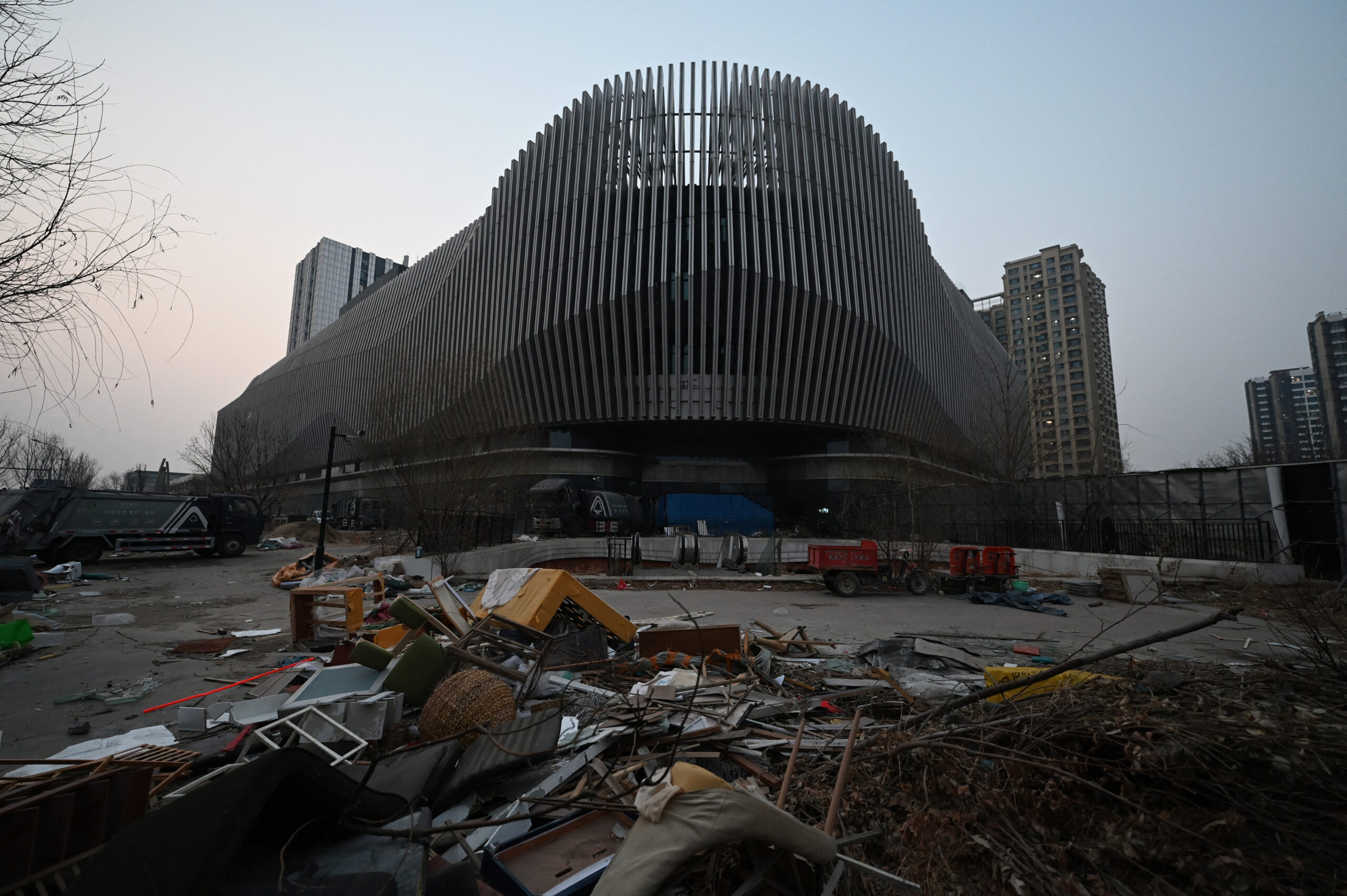
More than a year ago, Evergrande was forcibly delisted from the Hong Kong Stock Exchange. On August 20, a year later in 2026, the Intermediate People’s Court of Shenzhen, Guangdong Province, sentenced Evergrande Group’s founder Xu Jiayin to life imprisonment, confiscated all of Xu Jiayin’s personal assets, imposed a total fine of 15.82 billion RMB on Evergrande Group and its main real estate subsidiary companies. The next day, the court accepted the bankruptcy liquidation application of Evergrande Real Estate, the main real estate subsidiary in mainland China of Evergrande Group.
Evergrande Group was once one of the largest real estate developers in China and a symbol of China’s debt-driven real estate industry. The latest analysis article from the century-old financial media “Barron’s” pointed out that despite the downfall of the Evergrande empire, China’s real estate crisis is far from being resolved.
The article mentioned that the Chinese Communist authorities have spent five years busy cleaning up the aftermath of the bursting real estate bubble, including implementing the “guaranteed delivery” policy to address the issue of housing construction projects left unfinished. The World Bank estimates that by the end of last year, only 15% to 40% of the pre-sold but unfinished housing units have been completed under the “guaranteed delivery” project.
Traditionally, Chinese developers would sell properties before they were even built, using the pre-sale funds to apply for bank loans to fund the construction. The article pointed out that Evergrande Group’s default in 2021 completely shattered Chinese people’s confidence in the pre-sale property transaction market.
Nomura Securities’ Chief China Economist Lu Ting stated that China’s real estate market is essentially a futures market, and the key to futures trading is ensuring delivery. If the final on-time delivery rate is only 50%, would anyone still enter the market for trading and investment?
The World Bank expressed concerns about unfinished projects, coupled with further decline in house prices, leading Chinese homebuyers to adopt a wait-and-see attitude. Although the Chinese Communist Party’s “white list” for the “guaranteed delivery” project has provided over 7 trillion RMB (about 1.04 trillion USD) in loans to viable ongoing projects, as of May this year, the financing amount for Chinese developers has still decreased by 21% compared to the same period last year.
The World Bank believes that resolving the issue of unfinished projects may take time. Concurrently, the overall Chinese real estate market continues to shrink. According to data from the National Bureau of Statistics of China, in the first seven months of this year, real estate investment nationwide dropped by 19.2% year-on-year, residential construction starts declined by 24.6%, completions decreased by 25.5%, and housing sales area fell by 12.7%.
The article highlighted that punishing Xu Jiayin is much easier than restoring the economic model it disrupted. Chinese experts lament that the current drop in housing prices not only damages Chinese households’ balance sheets but also hampers consumption growth.
The decline in housing prices and consumption are interrelated. Data from the World Bank showed that inflation-adjusted Chinese housing prices have dropped by 23% from the peak in July 2021, with housing sales volume only half of the peak in mid-2021. In the first quarter of this year, the Chinese household savings rate reached 32.4%, higher than the pre-pandemic average of 29.6%. Meanwhile, retail sales in China in July only grew by 0.6% compared to the same period last year.
For investors, a sluggish real estate market equates to weak consumption. Luxury goods conglomerates, automakers, chain restaurants, and electronics companies are all banking on Chinese households eventually regaining consumer confidence.
The article suggested that even a slight recovery in the real estate market, without needing to return to its former prosperity, would uplift consumer confidence more than the shopping subsidies proclaimed by the Chinese authorities. To stabilize the real estate market, the Chinese authorities are making various desperate efforts. For instance, the Beijing government recently relaxed home purchase restrictions, including lowering the residential requirements for non-Beijing residents. Shanghai also implemented a series of measures, such as reducing the down payment ratio for some second homes and providing subsidies of up to 80,000 RMB for buyers engaging in trade-in transactions.
Currently, there are some initial signs indicating that certain city real estate markets are stabilizing, albeit unevenly. Data from the National Bureau of Statistics of China showed that in July, property prices in China’s four major first-tier cities rose by 0.2%, a slower growth compared to June. The prices of newly constructed homes in first-tier cities remained steady, while existing home prices in second and third-tier cities decreased by 0.3% and 0.4% respectively. Experts believe that the actual decline in house prices may be even greater.
Finally, the article warned that the Evergrande incident serves as a reminder to everyone not to declare victory too soon. After years of Evergrande’s collapse, China’s real estate market is still slowly adjusting, continuously weakening household confidence and making it harder for investors to bear the consequences.