
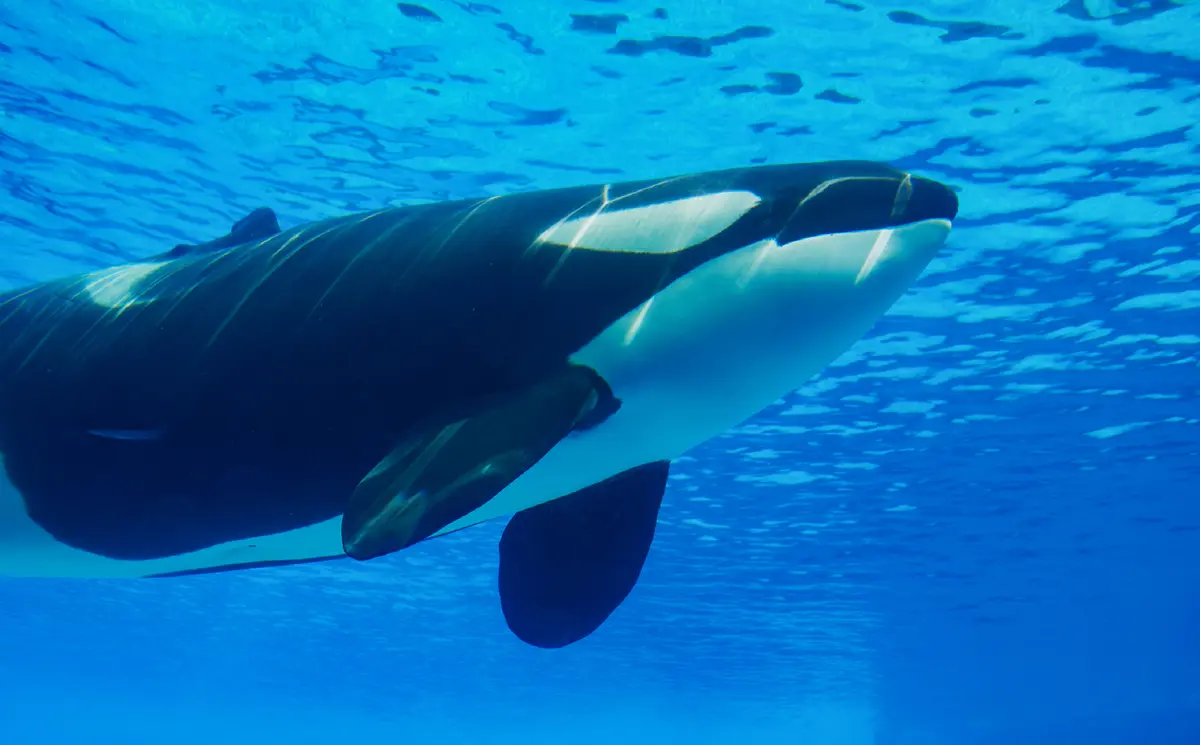
The killer whale (Orcinus orca) has always been regarded as the top predator in the marine food chain, capable of preying on animals like seals, sharks, and even large whales. However, scientists have made a surprising discovery that there is a deep-sea creature that can make killer whales actively avoid it, challenging people’s established impression of the “marine ruler.” What kind of creature possesses such astonishing deterrence power?
The research team led by marine biologist Anna Selbmann from the Sudurnes Science and Learning Center in Iceland published a paper in “Scientific Reports” in January this year, stating that killer whales, with their agility and high intelligence, reign at the top of the marine food chain and even hunt great white sharks just to consume their nutrient-rich livers. However, whenever the “pilot whales” (Globicephala melas) emit calls, killer whales often immediately turn away.
Why do killer whales react in this way? The scientific community has yet to unravel this mystery.
The team stated, “Killer whales react upon hearing the calls of pilot whales, and may perceive them as a threat.” “Currently, it is unclear why killer whales, as top predators in the food chain, would deliberately avoid pilot whales, who are smaller in size and appear to be at a disadvantage.”
This discovery began in 2012 when marine biologist Charlotte Curé’s team observed an intriguing phenomenon: playing killer whale calls in the ocean seemed to emit a mysterious summons, as pilot whales would actively move towards the source just by being able to hear the sound.
Subsequently, the research team led by Renaud de Stephanis, a marine scientist from the Spanish National Research Council, recorded a more puzzling phenomenon: since 2004, all encounters between pilot whales and killer whales have ended with the killer whales leaving. When pilot whales appear in the same waters where killer whales are present, the killer whales seem unwilling to stay in the area.
This avoidance behavior lacks a clear explanation. After conducting research in the Strait of Gibraltar, de Stephanis and the team found that pilot whales and killer whales do not compete for the same food and do not have a predator-prey relationship. Furthermore, the pilot whales are noticeably smaller than the killer whales, theoretically posing no threat to them.
Researchers speculate that perhaps at some point in evolutionary history, killer whales preyed on pilot whales, leaving the pilot whales with a long-term vigilance response. However, there is currently insufficient evidence to confirm this hypothesis.
This abnormal phenomenon caught the interest of Selbmann’s team. The team analyzed observation data from six regions in Iceland from 2007 to 2020, recording the occurrences of killer whales and pilot whales overlapping in activity, despite the pilot whales only appearing in the summer.
In 24 observed encounters, in the majority of cases (68%), killer whales would proactively leave before pilot whales approached, thus avoiding meeting them.
However, in 28% of the encounters, the situation was drastically different: both parties would engage in high-speed chases, reaching speeds of up to 13.5 knots (approximately 25 kilometers per hour), continuously accelerating with “porpoising” leaps, a common high-speed movement method among dolphins and whales.
Selbmann’s team played recordings of pilot whale calls to observe how killer whales fitted with tracking tags reacted. The results were astonishing: they quickly tightened formation, changed vocalizations, turned away, and increased swimming speed. The mere calling of a pilot whale was enough to trigger avoidance behavior in killer whales.
As of 2026, all results point to the same conclusion: killer whales do indeed avoid pilot whales. However, researchers are still unable to determine why pilot whales would actively approach killer whales, nor can they explain why killer whales choose to retreat, and no cases have been found where pilot whales directly attack killer whales.
Scientists speculate that one possibility is “mobbing behavior”: some animals, when facing potential threats, do not choose to flee but rather collectively surround and harass predators until they leave. Perhaps, pilot whales are using this strategy to force killer whales to retreat.
This article referenced a report from the scientific news media ScienceAlert.