
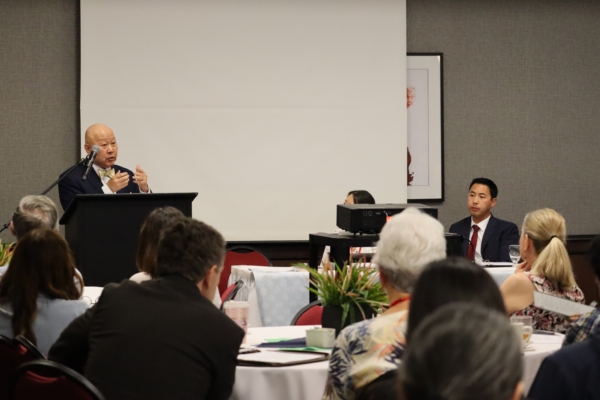
On July 25th, the Californians for Equal Rights Foundation (CFER) held its 4th annual conference in the city of Irvine, Orange County. The event coincided with the 30th anniversary of California’s Proposition 209, with a special focus on the historical significance of the proposition and the legal and financial controversies sparked by recent efforts to pass a “reparations bill” in California.
As a “free state” that has never implemented slavery, California’s frequent introduction of reparations bills in the legislature has faced scrutiny from various sectors regarding its rationale and the sources of substantial funding behind such proposals.
Lance Izumi, Senior Director of Education Studies at the Pacific Research Institute, was invited to speak at the conference and provided a retrospective look at the evolution of the reparations movement:
During the founding era: Quakers advocated against slavery and proposed that slave owners should provide reparations to former slaves to atone for their sins. Izumi emphasized that true redemption should involve compensation to the actual victims of oppression rather than their descendants, and it should be a voluntary act by the slave owners, not a government-funded initiative supported by taxpayers who are not slave owners.
Rejection of modern lawsuits: In the late 19th to early 20th centuries, former slave organizations sought $68 million in pension funds (equivalent to the total amount of cotton tax levied in the 1860s) from the federal government, but the claims were ultimately rejected by the U.S. Federal Appeals Court and the Supreme Court.
Shift in modern reparations movement: Around 2020, the focus of reparations shifted towards descendants of slaves or African American communities. The “California Reparations Task Force” proposed measures such as tuition assistance, housing aid, and cash compensation (approximately $1.4 million per person). Izumi noted that this resurgence of the reparations movement, after a century-long hiatus, involves Marxist principles of social justice, ranging from fighting alleged systemic racism to reducing prison sentences and redistributing wealth, among other initiatives. Izumi criticized proposals like the one in San Francisco that suggests giving $5 million in reparations to eligible African Americans, highlighting that the city is already facing a significant deficit and questioning the feasibility of such payouts.
Regarding comparisons to the government compensation received by Japanese Americans interned during World War II, Izumi stressed the essential distinctions between the two scenarios:
Direct victims: Izumi recounted his family’s experience, with his grandfather being a gardener who was interned at Rohwer camp in Arkansas during the war, along with thousands of other Japanese Americans. Emphasizing that his grandfather lost his home, business, farm, and educational opportunities during the war, Izumi pointed out that his grandfather received $20,000 in compensation, which contrasted starkly with the reparations proposed for descendants of African American slaves.
Non-racial privilege: Former California Assemblyman Naoyuki Takasugi, a survivor of internment camps, argued that race-based preferential policies are essentially discriminatory and suggested focusing on virtues displayed in adversity rather than emphasizing historical injustices. Izumi mentioned initiatives in Oakland’s school district aimed at compensating African American students, hiring more African American teachers, implementing culturally relevant curricula, and mandating anti-racism training for staff – despite these efforts, a significant portion of students are still falling below academic standards, posing challenges for their future enrollment in the University of California (UC) system.
Andrew Quinio, a lawyer from the Pacific Legal Foundation, highlighted that Proposition 209 serves as a robust barrier against racial discrimination or preferences, with no exemptions. He outlined several challenges faced by the modern reparations movement:
Constitutional risks: Bills such as the “Road to Repair” pushed by the state legislature’s “African American Legislative Core Group,” which attempt to grant reparations based on racial criteria, violate Proposition 209 and amendments to the U.S. Constitution. Quinio recounted his testimony with CFER’s Xu Jiong concerning opposition to California’s Assembly Bill 87, which proposed preferential treatment for descendants of slaves. Despite facing a busload of students supporting the bill, he emphasized the unified stance against these reparations initiatives.
Judicial precedents: Referring to the recent Supreme Court ruling in the “Students for Fair Admissions v. Harvard” case, Quinio suggested that racially-based privileges and reparations proposals are at a high risk of legal challenge. Beyond legal arguments, Quinio stressed that the American ethos prioritizes meritocracy and diligence as pathways to success, contrasting with viewpoints that emphasize race as a determining factor in one’s destiny.
Taxpayer burden concerns: With over a third of California’s working adults being foreign-born and half of children having at least one immigrant parent, imposing significant financial burdens on these immigrants and taxpayers with no ties to historical slavery contradicts fundamental American values that promote achievement through hard work.