
In November 2018, the spacecraft Voyager 2 crossed the boundary of the solar system and officially entered interstellar space. Voyager 2, a legendary probe, accomplished this journey by utilizing a gravitational assist technique known as the “planetary slingshot,” harnessing the gravitational pull of Jupiter, Saturn, Uranus, and Neptune to gain tremendous speed and break free from the gravitational pull of the Sun.
This gravitational assist technique formed by the alignment of planets allowed the probe to forgo the need for a large propulsion system and saved NASA hundreds of millions of dollars in fuel costs. It remains an indispensable tool in deep space exploration.
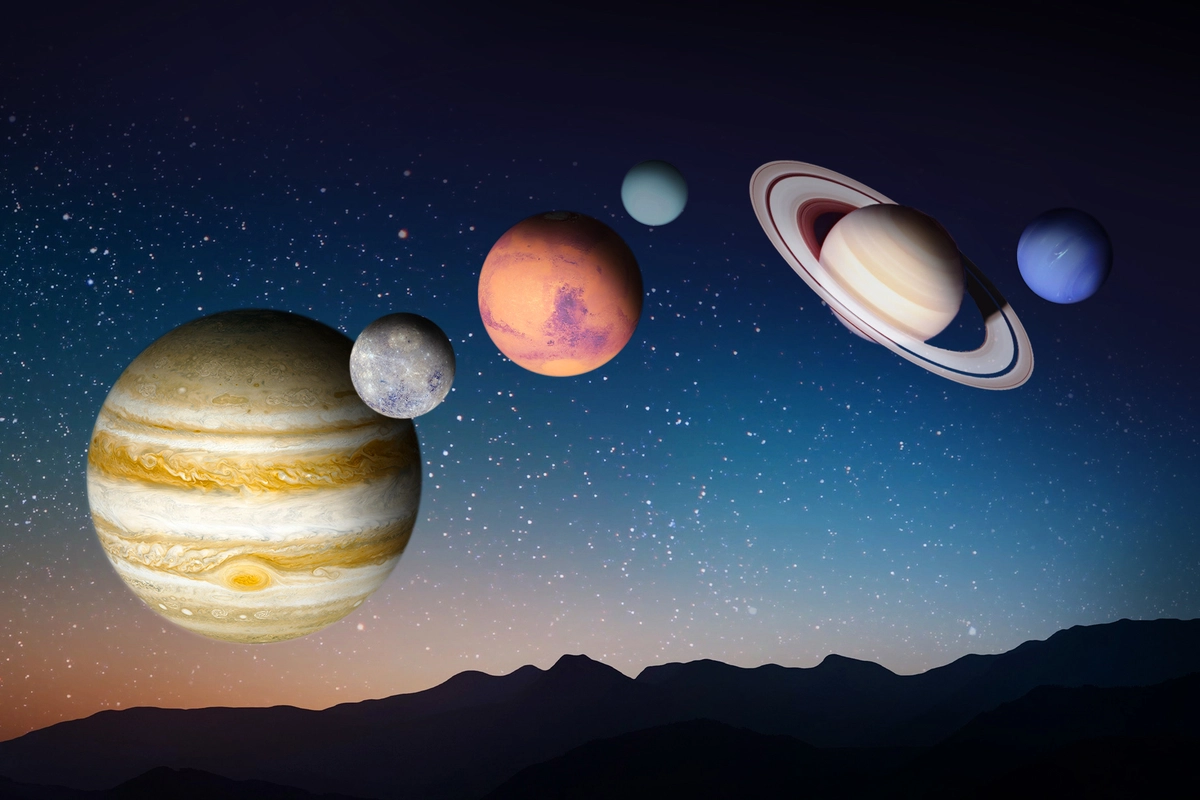
On August 12th of this year, a “parade of planets” consisting of six planets will span the dawn sky, showcasing the geometric beauty of celestial motion. Jupiter, Mercury, Mars, Uranus, Saturn, and Neptune will line up along the ecliptic, an invisible arc formed by the Sun’s trajectory in the sky.
The term “parade of planets” may be misleading as it might suggest a perfectly straight line, which is highly improbable in three-dimensional space. Astronomers define a “parade of planets” as the alignment of three or more planets on the same side of the Sun or when they appear concentrated within a small region of the sky as seen from Earth.
Throughout history, what truly astounded humanity was not the perfect alignment of planets but the discovery that these wandering celestial bodies seemed to move along a shared cosmic path, akin to beads strung together on a loose thread. Scientists later found that the orbital planes of planets mostly align with the ecliptic but do not completely overlap, resulting in a slight deviation near the ecliptic and forming a subtle “Z” pattern.
The planetary dance, akin to horses racing on the same circular track, is why it is symbolically termed the “planet parade.” On August 12th, the parade will see Neptune rise first in the eastern horizon, followed by Saturn, Uranus, and the red hues of Mars stretching across the southwestern sky. Subsequently, Mercury and Jupiter will rise just before dawn near the horizon.
The viewing window to observe all six planets simultaneously will be brief, lasting less than 30 minutes in most cities around the world, primarily due to the fleeting appearance of Mercury in the lower sky region near dawn, making it challenging to observe.
In cities like New York, the observation window will be from 5:18 to 5:34 am, while in Los Angeles, it will be from 5:28 to 5:46 am (local time). In London, observers should look from 4:54 to 5:03 am, and in Paris, from 5:52 to 6:03 am.
In New Delhi, observers should look between 5:04 and 5:24 am, and in Tokyo, between 4:15 and 4:31 am.
The viewing window starts from when Mercury rises 5 degrees above the horizon and ends when civil twilight appears, gradually obscuring the dim planet in morning light.
However, astronomers caution against high expectations, as Mars and Saturn may be the only visible bright spots to the naked eye. Nevertheless, witnessing just these two planets is a spectacle worth waking up early for. To explore further, one should gaze toward the eastern sky two to three hours before sunrise to see Mars’ warm red glow shifting from Taurus to Gemini. Saturn will appear higher in the southwestern sky in Pisces, although its iconic rings may be challenging to observe without a small telescope.
Jupiter, radiating brightly in Cancer, will be below Mercury and close to the horizon before sunrise. If Jupiter is obscured from view, it is likely due to obstruction by trees or buildings or the increasing dawn light. Avoid pointing binoculars directly at the Sun near the horizon to prevent eye damage.
For those interested in exploring astronomy, using binoculars to locate the faint Uranus in Taurus, positioned between Mars and Saturn, presents a challenging nighttime target. Neptune, an invisible faint blue dot in Pisces to the right of Saturn, stands as the most elusive celestial object of the night.
Therefore, if you have binoculars, bring them along to witness this planetary parade. Opt for open fields, coastlines, mountaintops, rooftops, or balconies with a clear eastern sky view, and allow your eyes a few minutes to adjust to the darkness.
August 12th is not a fixed date for this celestial event. The alignment is likely to remain visible the day before or after. Nonetheless, the fleeting window to see all six planets together is brief, as dawn mercilessly ends the cosmic display. Those able to capture this moment will witness the geometric arrangement of planets that once propelled Voyager 2 into the silent realm of interstellar space.