
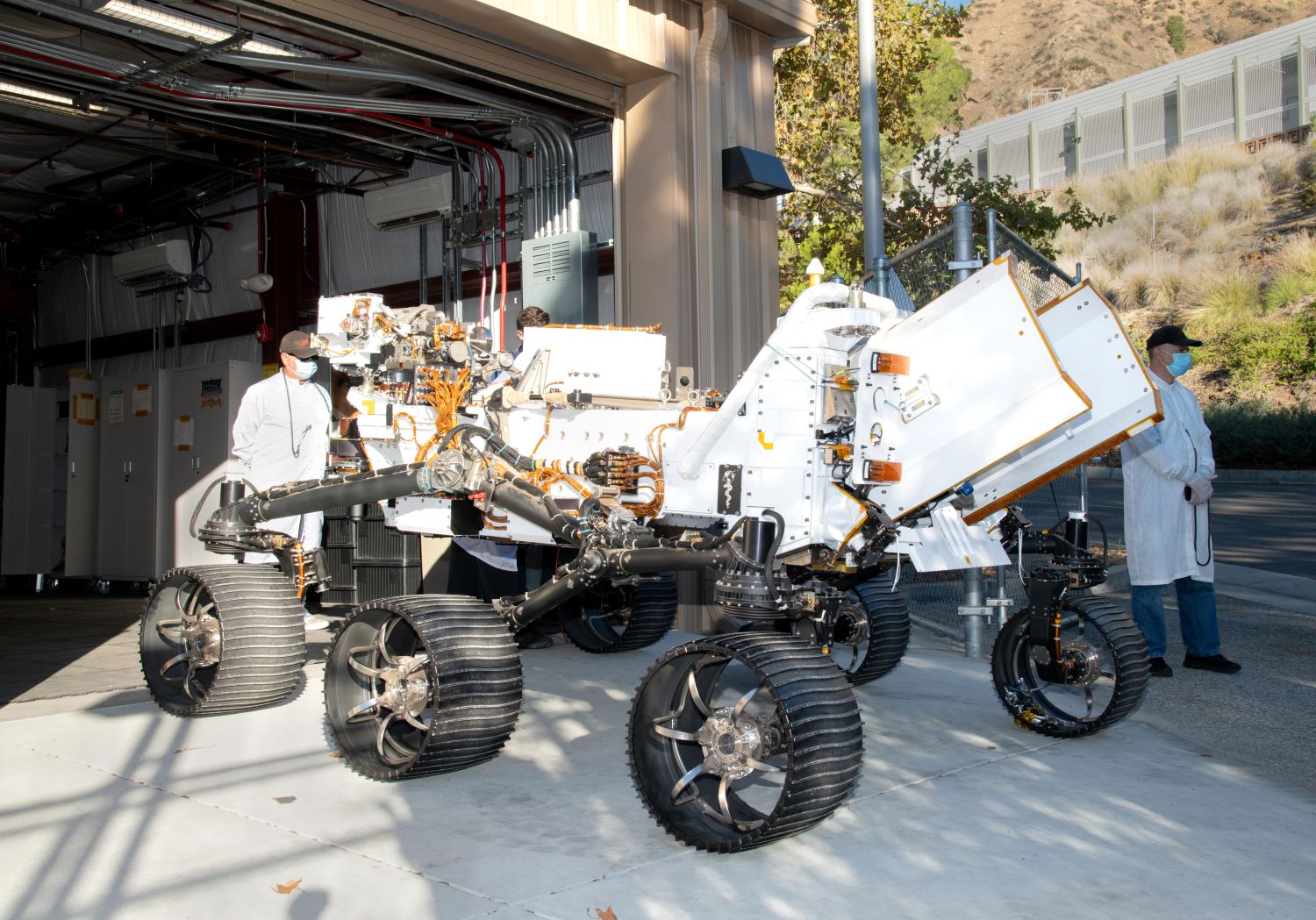
The United States National Aeronautics and Space Administration (NASA) officials announced at the end of June that they are seriously considering sending the full-size engineering model of the Mars rover “Perseverance” currently stored at the Jet Propulsion Laboratory (JPL) in California to the Moon, in order to accelerate exploration of the lunar south pole.
The rover, nicknamed “Promise,” which is similar in size to a car, was originally used as a test platform for the “Perseverance” rover and had no previous launch plans. If the mission goes ahead, it will carry a Multi-Mission Radioisotope Thermoelectric Generator (MMRTG) to the Moon to provide power for traversing rugged terrain and surviving long moonlit nights, unlike NASA’s other rovers that mainly rely on solar power.
“We are now seriously considering sending ‘Promise’ to the Moon,” said NASA Administrator Jared Isaacman in the agency’s monthly progress report on the lunar base construction project at the end of June.
NASA has an available MMRTG, and the plutonium-238 radioisotope fuel inside it decays naturally even if not used. Due to the large size of “Promise,” weighing around 1 ton, the rover may need to be transported to the Moon by Blue Origin’s “Blue Moon” lander or SpaceX’s “Starship.”
Isaacman and another leading NASA official Carlos García-Galán, who is in charge of the lunar base project, appear excited about the idea of utilizing existing hardware to enhance the capabilities of lunar exploration missions.
“That would be an extraordinary capability,” García-Galán said. “For lunar exploration missions, carrying a nuclear RTG allows us to go wherever we want without being restricted by sunlight conditions. Overcoming the challenge of enduring long lunar nights has always been a major obstacle in such missions, and having this capability means we won’t have to worry at all. This will enable long-distance travel and exploration of extremely difficult-to-reach areas—just like the incredible accomplishments demonstrated by Curiosity and Perseverance on the surface of Mars.”
For years, “Promise” has served as a test platform for “Perseverance,” simulating and verifying the potential issues the rover may encounter on Mars.
In JPL’s Mars Yard in California, engineers typically test various operational commands on “Promise” to ensure accuracy before sending the same commands to “Perseverance” on the Martian surface. “Promise” also helps the engineering team confirm if “Perseverance” can safely traverse various terrains on Mars.
“Perseverance” was launched to Mars in July 2020, while its predecessor, the similarly sized “Curiosity” rover, was launched to the Red Planet in November 2011.
“At the beginning of a mission, it’s reasonable to validate things on Earth through test platforms before uploading commands to Mars,” Isaacman said. “But now, with years of experience operating these two rovers on the Martian surface, and the equipment in ‘Promise’ paid for by taxpayers, someone raised the question: What if we sent it to the Moon?”
Although these Mars rovers are designed to operate on the Martian surface, JPL engineers mentioned that with proper modifications, “Promise” can also carry out missions on the lunar surface. NASA will need to adjust some scientific instruments on the rover, but Isaacman believes that this creative approach not only maximizes the use of existing equipment but also helps NASA gain insight into the lunar environment for future plans to establish a long-term human presence on the Moon.
“We already have this hardware, and that’s exactly what we should be doing—sending exploration capabilities like ‘Promise’ to the Moon and creating tangible achievements one after another,” he said.
Rovers like “Promise” can accomplish many missions of significant scientific research and exploration value.
In fact, NASA had studied a concept for a lunar rover called “Endurance” less than ten years ago. According to the plan, the rover would travel nearly 2,000 kilometers in the South Pole–Aitken Basin on the far side of the Moon, conducting long-distance scientific exploration missions. However, this rover was ultimately not built.
The decision on this initiative is still pending, and NASA is assessing the feasibility of using “Promise” as one of the main resources in its future lunar rover fleet. Nevertheless, the announcement at the end of June highlights Isaacman and his team’s active inventorying of NASA’s existing hardware and various resources, aiming to expedite the agency’s return to the Moon and the establishment of a surface base mission.
Currently, NASA is almost operating at a “wartime footing” pace to accelerate plans for manned landings at the lunar south pole, aiming to arrive ahead of China and be the first to explore the most scientifically valuable regions. In comparison, Mars is not NASA’s immediate priority mission.
“From a certain perspective, this is quite symbolic—reintegrating the remaining assets of the Mars program and transporting them to the Moon,” said Casey Dreier, Space Policy Head of The Planetary Society.