
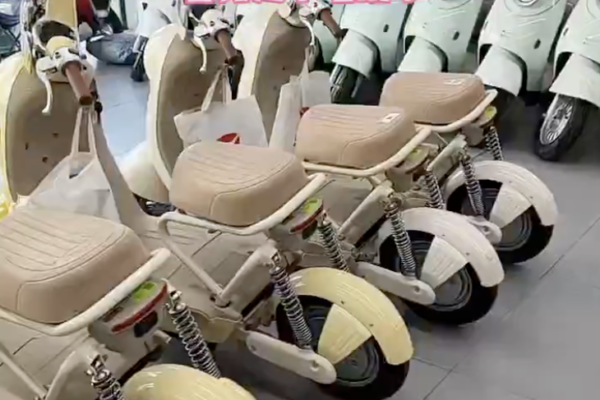
With the cancellation of the state subsidies for electric bicycles and the comprehensive ban on the sale of old national standard models, the sales of electric bicycles have been continuously declining this year. The latest industry data shows a sharp drop of nearly 40% in sales. Additionally, Chinese-made electric bicycles have frequently caused fires, leading to multiple significant casualties and property losses.
According to a report from “Financial Magazine” on April 5th, a dealer of Yadea electric bicycles in Guangzhou, who goes by the pseudonym Yang Li, said, “This year, the ‘state subsidy’ for electric bicycles has been canceled, and Guangzhou has also abolished the policy of replacing old electric bicycles with new ones.” She added, “The monthly sales volume in the store has dropped by 40%.”
According to the 2026 state “subsidy” policy, electric bicycles are no longer included in the list of 6 major consumer goods eligible for the “replace old with new” subsidy, and currently, there are no local subsidies for electric bicycles in various cities.
In 2024 and 2025, electric bicycles were included in the “state subsidy” for consumer goods. The subsidy standard in 2025 was as follows: consumers who trade in their scrapped old electric bicycles (including complete batteries) and purchase new electric bicycles priced at 1500 yuan or more are eligible for a one-time subsidy of 500 yuan.
Yang Li also mentioned, “Currently, the new bicycles in the store are all new national standard compliant, and there are no old national standard electric bicycles for sale,” and “However, the new national standard bicycles require promotions to slowly sell, with an average of 5 to 6 units needing to be sold per day for the store to survive.”
On December 31, 2024, the Chinese Ministry of Industry and Information Technology and other 5 departments jointly issued new national standards for electric bicycles, which were fully implemented starting from September 1, 2025, with a comprehensive ban on the sale of old national standard electric bicycles by December 31, 2025. The main differences between the new and old national standards include the requirement for pedal function, a speed limit of 25 km/h, and restrictions on the overall weight of the vehicle (including the battery) such as lead-acid at 63kg and lithium at 55kg. The new national standard has significantly increased the procurement cost of electric bicycles, while the performance (speed, load capacity) has intuitively decreased.
According to data from the home appliance and home furnishing market research and consulting company AVC Cloud, in January this year, the domestic sales volume of electric two-wheeled vehicles was 3.457 million units, a year-on-year decrease of 3.6%. In February, domestic sales of electric two-wheeled vehicles reached 2.988 million units, with a widened year-on-year decline to 37.9% (March data has not been released yet).
The organization believes that the year-on-year decline in sales of electric two-wheeled vehicles in January reflects a period of market contraction and transition viewing features in the initial stage of switching to the new national standard and after the cancellation of the 2026 “state subsidy”. The decline in sales in February is due to the impact of the Chinese New Year holiday shutdown and compressed production cycles, resulting in companies generally lowering their shipment expectations.
Blogger “Things About Electric Cars” believes that the retail end data is even worse, with the above-mentioned data being statistics from the enterprise end. In February, he analyzed that there is a vast distributor network between manufacturers “selling” to consumers “riding,” and taking only the top three brands such as Yadea, Aima, and Tailg as examples, their total number of offline stores nationwide is close to one hundred thousand. Assuming each store only stocks and preps 15-25 units, by conservative estimates, the entire channel’s inventory could easily approach or exceed two million units. These stocked bikes were “sold” to distributors, included in the production and sales data, yet remain quietly parked in warehouses or showrooms without hitting the streets.
As the second quarter approaches, the electric bicycle market faces another challenge. Due to the Iran war, the prices of raw materials such as Series 6 aluminum alloy, PP plastic, etc., needed for electric bicycles, have seen a significant fluctuation and rise, leading to multiple electric bicycle companies increasing their prices.
According to the pricing adjustment letter sent by Yadea to its distributors, due to the continuous significant rise in the prices of bulk raw materials, such as metals like aluminum, copper, iron, with an increase of over 40%, and chemical raw materials like plastic pellets with an increase of over 80%, Yadea has decided to uniformly adjust the factory prices of all products starting from April 1, 2026, with a single-unit increase of over 300 yuan. Additionally, top brands like Aima, Tailg, etc., have also simultaneously increased their retail prices by 200 to 300 yuan.
China is a major producer and seller of electric bicycles, but not a manufacturing powerhouse. In recent years, electric bicycles produced in the mainland have frequently caused fires due to battery thermal runaway issues, resulting in multiple significant casualties and property losses.
According to data from the state-run Xinhua News Agency, as of September 2025, about 380 million electric bicycles are in circulation in China. According to production and sales data from AVC Cloud, the production scale of electric two-wheeled vehicles in China in 2025 reached 63.16 million units.
According to a report from “Quanzhou Evening News” on March 29, 2026, around 12:00 pm, a sudden fire broke out in a parking shed near the intersection of Binha North Road and Quanpu Road in the Quangang District of Quanzhou City. The fire quickly spread, engulfing multiple electric bicycles and motorcycles. The fire resulted in 23 electric bicycles and 9 motorcycles being burnt.
According to an official account report from the Haidian District Firefighting and Rescue Detachment on February 22, 2026, a sudden fire broke out in an electric bicycle charging cabinet in the Panlong District of Kunming, Yunnan. Twelve second-hand electric bicycles were burnt, and the portable board room storing vehicles was also destroyed. The fire even spread to surrounding buildings.
According to a recent report from “Zhejiang TV”, on November 25, 2025, in Hangzhou, Zhejiang, Mr. Zhang was riding an illegally modified electric bicycle with non-standard lithium batteries, carrying his wife to pick up their child. During the journey, the battery of the bicycle suddenly exploded, causing severe burns covering 70% of his wife’s body.
As reported by “The Paper”, on October 7, 2025, at 11:00 pm, a fire broke out in a charging shed for electric bicycles parked near Building 7 of Tianrui International Community in the Economic and Technological Development Zone of Anshun City. The fire destroyed 15 electric bicycles parked inside the shed, causing a direct economic loss of about 30,000 yuan, with the fire caused by the thermal runaway of lithium batteries.
According to CCTV, on April 28, 2024, in the early morning of February 23, a major fire accident occurred at Building 6 of Ming Shangxi Yuan Residential Community, No. 9 Xishi Road, Yuhuatai District, Nanjing. The incident resulted in the death of 15 people, with 2 seriously injured and 42 sustaining minor injuries, causing a direct economic loss of over 33 million yuan. The official attribution by the authorities indicated it was a major fire incident caused by the thermal runaway of batteries.
Other fire incidents caused by electric bicycles include:
– In the early hours of April 7, 2023, a fire broke out in a residential community in Fengtai District, Beijing, resulting in two deaths and one injury. The fire was caused by the thermal runaway of electric bicycle batteries during the charging process.
– On December 28, 2023, in Dongxindian Village, Cuigezhuang Township, Chaoyang District, Beijing, a fire occurred in a villager’s self-built house, causing the death of four trapped individuals.
– On December 13, 2023, a fire broke out in a high-rise residential community in Huidong County, Huizhou City, Guangdong, resulting in the death of two minors.
The Hubei Provincial Fire Brigade’s official WeChat account previously reported multiple cases of electric bicycle fires. On July 26, 2025, in an outdoor area in Enshi Prefecture, Hubei, 42 electric bicycles parked outside caught fire due to the thermal runaway of a lithium battery, quickly burning into blackened “iron frames.”
In February 2025, a fire broke out at a centralized electric bicycle charging station in a village in Yiwu City, Zhejiang, affecting 12 vehicles and resulting in the destruction of 13 electric bicycles.
In Beijing’s Changping District in 2024, a fire occurred in an outdoor electric bicycle shed in the North Area of Xinkang Yuan. The fire destroyed 12 electric bicycles inside the shed, affecting nearly 20 electric bicycles and bicycles in total.
According to the statistics from the National Fire and Rescue Bureau of the Chinese government, there were a total of 21,000 reported cases of electric bicycle fires nationwide in 2023, 18,000 cases in 2022, and 14,000 cases in 2021.