
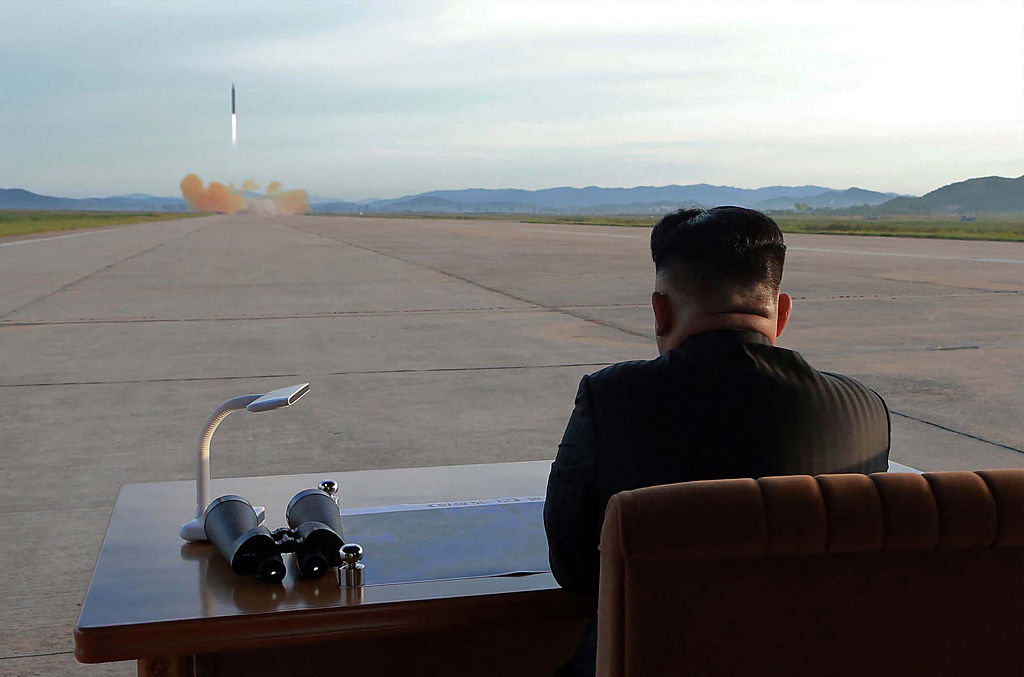
In East Asia, the nuclear strategic balance is facing unprecedented challenges. The rapid expansion of nuclear arsenals by the Chinese Communist Party and North Korea, along with the continuous enhancement of their nuclear strike capabilities, are putting increasing pressure on the US nuclear umbrella. As a result, allies in the region such as South Korea and Japan are beginning to reassess their options for independent nuclear deterrence, leading to a rapid rise in the risk of nuclear proliferation in the Asia-Pacific region.
In April 2026, a survey conducted by the Asan Institute of Policy Studies showed that 80% of South Koreans surveyed supported acquiring independent nuclear weapons capabilities, marking the highest record in the institute’s history.
On July 27, retired South Korean Lieutenant General Chun In-bum advocated for South Korea to establish its own nuclear arsenal and integrate it into the US regional alliance deterrence network.
A Gallup Korea poll released on August 28, 2026, indicated that 65% of South Korean adults still support the country’s development of an independent nuclear arsenal to counter increasing threats of war. Since North Korea’s third nuclear test in 2013, the proportion of support for South Korea’s nuclear possession in these surveys has consistently remained above 60%, peaking at 74.9%.
These survey results from different sources are consistent, indicating enduring majority support in South Korea for nuclear capabilities and continued upward trends.
Facing the normalized nuclear missile threats from North Korea, South Korea’s existing conventional defense system appears inadequate in the face of asymmetrical nuclear deterrence. This has led to more active discussions within South Korean public opinion and military leadership about implementing a “nuclear sharing” arrangement similar to the NATO model or even seeking to establish independent nuclear deterrence capabilities.
Meanwhile, in Japan, the taboo surrounding nuclear weapons is starting to weaken. On July 17, 2026, Japanese Defense Minister Taro Kono stated that nuclear weapons are an issue Japan “cannot avoid,” and Japan should discuss relevant security policies without taboo.
On July 23, he further expressed in Brussels that Japan should discuss future national security policies, including nuclear deterrence. These policy debates reflect a reexamination by regional allies’ citizens and political leaders of the US’s “extended deterrence” strategy in East Asia.
The statements by the Japanese Defense Minister reflect concerns over the regional security landscape. This anxiety may be starting to erode Japan’s post-war pacifist constitution and “Three Non-Nuclear Principles,” making the nuclear weapons issue no longer an absolute political taboo. This shift indicates a reevaluation of Japan’s existing security frameworks in response to China and North Korea’s nuclear expansions and skepticism toward the US’ “extended deterrence.”
The nuclear threat anxiety in East Asia primarily stems from the nuclear expansion by China and North Korea. The Stockholm International Peace Research Institute (SIPRI) annual report released on June 8, 2026, indicated that China leads the world in the rate of expansion of its nuclear arsenal, currently possessing approximately 620 nuclear warheads. As of January 2026, China had deployed hundreds of intercontinental ballistic missiles at three major missile launch sites in the northwest region and was simultaneously constructing new ballistic missile launch silos in the eastern mountainous areas.
The Chinese military is advancing toward establishing a “triad” of land-based intercontinental ballistic missiles, nuclear submarines, and bombers for a comprehensive nuclear strike capability.
Research from the Hudson Institute corroborates this trend, highlighting that China’s nuclear power is reshaping the global political landscape.
China’s recent submarine-launched ballistic missile test demonstrates advancements in its sea-based nuclear capabilities. Additionally, China is working on the H-6N project with nuclear strike capabilities to supplement its airborne nuclear forces. Combining progress in these two aspects with land-based intercontinental ballistic missiles, China is gradually forming a complete nuclear triad. Unlike China’s past reliance on monotonous and limited intercontinental missiles to maintain minimal nuclear deterrence, its nuclear power now emphasizes second-strike capability, albeit still in a rudimentary state due to limitations in maritime and aerial platform capabilities.
China’s strategic nuclear forces are aimed at narrowing the gap with the US and potentially threatening the US homeland to weaken the efficacy of US “extended deterrence” in the Western Pacific. This is a matter of concern for Japan and South Korea, as the stability of the East Asian regional nuclear order is in jeopardy.
North Korea’s evolving nuclear strategy is exacerbating geopolitical anxieties. In the first half of 2026, Kim Jong-un further solidified North Korea’s status as a nuclear-armed state. On March 23, he declared in a policy speech that North Korea’s status as a nuclear-armed state is “irreversible” and pledged to strengthen its nuclear capabilities permanently.
SIPRI estimated in June 2026 that North Korea may have assembled around 60 nuclear warheads and possesses enough fissile material to reproduce at least 30 more warheads. The Federation of American Scientists (FAS) similarly estimated North Korea possesses around 60 nuclear warheads, with accumulated nuclear materials sufficient for potentially manufacturing at least 90 warheads.
Notably, North Korea is expanding its capabilities for producing nuclear materials. A recent assessment by the International Atomic Energy Agency (IAEA) on September 9 revealed that North Korea has constructed a new uranium enrichment facility at the Yongbyon nuclear site, capable of housing up to 28 gas centrifuge systems. Additionally, a related building adjacent to the Kangson enrichment facility near Pyongyang has started operations.
A more strategically significant transformation is North Korea’s deployment of nuclear weapons, expanding from land-based ballistic missiles to sea-based platforms. On June 23, North Korea commissioned its first 5000-ton missile destroyer, the “Choe Hyon,” and on September 6, the second vessel of the same class, the “Kang Kyung,” entered service. North Korea claims that these warships can carry nuclear weapons, with Kim Jong-un directly referring to the “Kang Kyung” as an integral part of North Korea’s “nuclear counterattack system.”
The Institute for the Study of War (ISW) believes North Korea is enhancing its nuclear force’s survivability by dispersing nuclear weapons across different platforms and operational domains.
The amendment to the North Korean Workers’ Party Charter on September 3 introduced provisions for wartime operations, with Article 27 enabling the wartime Political Bureau to discuss and decide on “significant issues” based on authorization from the Central Committee’s full meeting. These arrangements allow for the suspension of elections within certain leadership structures during wartime, facilitating the continuous operation of decision-making mechanisms.
The Korea Institute for National Unification suggests that this implies a defense and military decision-making mechanism centered on the Political Bureau would be established in urgent situations in North Korea.
The ISW suggests that North Korea may be strengthening a more “flexible” and “institutionalized” nuclear command system, aiming to make the US and South Korea believe that even a “decapitation strike” against Kim Jong-un would not necessarily lead to disarray in North Korea’s nuclear capabilities.
In 2026, what is most concerning about North Korea is not just how many nuclear warheads it possesses but the formation of an increasingly sophisticated and combat-capable nuclear strike system. This real threat forces South Korea and Japan to recognize the necessity and urgency of developing sovereign nuclear deterrence capabilities.
As early as the mid-1960s, faced with China’s atomic bomb tests, Chiang Kai-shek instructed the Sun Yat-sen Institute of Science to secretly develop nuclear weapons. Taiwan’s covert nuclear weapons program continued under US surveillance for many years. In 1988, Chang Hsien-yi, the deputy director of the Nuclear Research Institute at the Sun Yat-sen Institute of Science, took crucial data to the US. Washington then pressured Taipei to shut down related facilities, ending the over 20-year-long nuclear weapons program.
This history demonstrates that in regional conflicts, if one side possesses nuclear weapons, the side without nuclear weapons will seek independent nuclear development due to vulnerability in security guarantees. Today, the struggles faced by Japan and South Korea are very similar to that of Taiwan.
The US’ “extended deterrence” aims to maintain stability in the Pacific region, particularly on the Korean Peninsula, giving security assurances to regional allies.
During the Third Taiwan Strait Crisis from 1995 to 1996, General Xiong Guangkai of the People’s Liberation Army, in discussions with US diplomat Chas Freeman, stated that the US would not risk losing Los Angeles for Taipei. This overt nuclear threat was evidently directed at all US security commitments in the Western Pacific, including “extended deterrence.”
The nuclear expansions by China and North Korea are severely destabilizing the nuclear deterrence balance in the Western Pacific. By undermining US “extended deterrence,” South Korea and Japan are compelled to consider nuclear options by breaking away from diplomatic and constitutional constraints.
Whether Japan and South Korea will ultimately cross the nuclear threshold depends on the political decisions of their respective governments, domestic public opinion, alliance relationships with the US, international nuclear non-proliferation treaties, and the future nuclear threats from China and North Korea. However, it is certain that this situation will complicate nuclear non-proliferation efforts, with implications extending beyond the Indo-Pacific region to a broader global scale.